Global Biomass: Mapping the Mass of Life on Earth
When we think of the "weight" of life on Earth, we often imagine the massive scale of blue whales or the sprawling expanse of the Amazon rainforest. In ecology, this measurement is known as biomass—the total mass of living organisms in a given area or biosphere. Current estimates place the total global live biomass at approximately 550 billion tonnes of carbon, with the vast majority residing in the planet's forests.
While plants dominate the scale, the distribution of life is far more complex than a simple count of trees. From the microscopic prokaryotes in the deep subsurface to the anthropogenic mass created by human industry, the balance of biological matter is constantly shifting. Interestingly, by 2020, the mass of human-made materials—defined as inanimate solid objects not yet demolished—was projected to surpass the total living biomass of the entire planet.
Key Facts
- Total Global Biomass: Estimated at 550 billion tonnes of carbon.
- Dominant Kingdom: Plants (Plantae) make up the bulk of Earth's biomass.
- Animal Contribution: Animals represent less than 0.5% of total global biomass.
- Human Impact: Humans and livestock account for 96% of all mammal biomass.
- Primary Production: Earth generates roughly 104.9 billion tonnes of carbon per year through photosynthesis.
The Distribution of Global Biomass
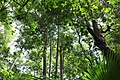
The distribution of life is heavily skewed toward plants. To understand the scale, ecologists categorize biomass by kingdom. While plants hold the majority, fungi and bacteria also play critical roles in the global carbon budget.
| Kingdom | Biomass (Billion Tonnes C) | Dry Biomass (Billion Tonnes) | Wet Biomass (Billion Tonnes) |
|---|---|---|---|
| Plantae | 450 | 900 | 2700 |
| Bacteria + Archaea | 30 | 60 | 200 |
| Fungi | 12 | 24 | 80 |
| Protista | 4 | 8 | 25 |
| Animalia | 2 | 4 | 13 |
| Total | 500 | 1000 | 3000 |
Animals, despite their visibility, represent a tiny fraction of the Earth's total mass. Most animal biomass is found in the oceans, specifically among arthropods like copepods and various fish species. In contrast, land animals account for only about 20% of the total animal biomass.
![The global biomass broken down by kingdom and into taxonomic groups for animals.[1] The estimates for bacteria and archaea have been updated to 30 billion tonnes C combined since this figure was made.[20]](/images/67/63/676327450ece8aa5479d62942ab629dcb20dfd2bc15e1d3e342938b810754863.png)
The Mammalian Divide
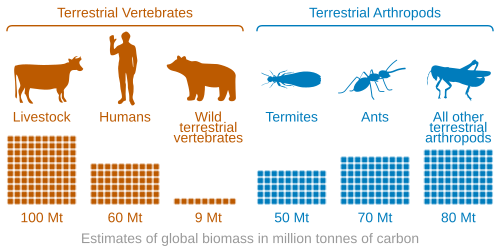
Within the animal kingdom, the disparity between wild and domesticated mammals is stark. Humans (approximately 80 million tonnes C) and livestock (approximately 90 million tonnes C) dominate the landscape. Wild terrestrial mammals represent only about 3 million tonnes C, which is less than 2% of the total mammalian biomass on land.
![Humans and their livestock represent 96% of all mammals on earth in terms of biomass, whereas all wild mammals represent only 4%.[1]](/images/db/d3/dbd34d1aca494553d0f483164e350c8690b7ee229b16c42a5c89b36010ae02a6.png)
Microbial and Bacterial Biomass
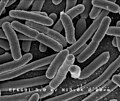
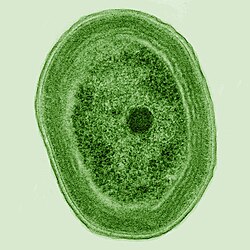
Estimating the biomass of prokaryotes (single-celled organisms lacking a nucleus, such as bacteria and archaea) has proven challenging. Early studies in 1998 suggested they might rival plants in mass, but updated data has significantly lowered these figures.
Current estimates from the Deep Carbon Observatory and other research suggest a total prokaryotic biomass of 23 to 31 billion tonnes of carbon. A significant portion of this—roughly 70%—is located in the deep terrestrial subsurface, far below the surface soil.
Ecological Pyramids and Energy Flow
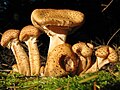
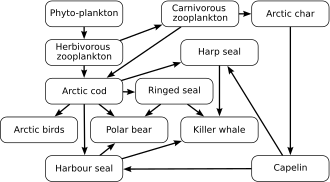
Biomass is not just about total weight; it is about how energy moves through an ecosystem. This is visualized through ecological pyramids. In an energy pyramid, only about 10% of the energy is transferred from one trophic level (a step in a food chain) to the next, with the rest lost as heat or used for metabolism.
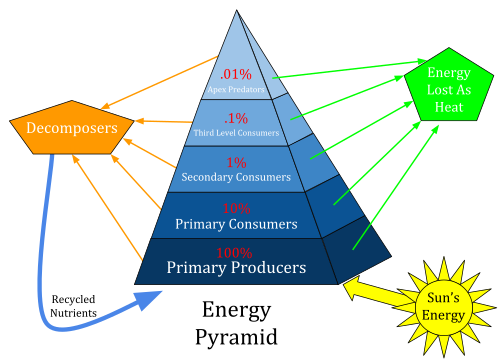
While terrestrial biomass pyramids usually have a wide base of plants, aquatic pyramids can be inverted. In the ocean, the biomass of primary producers (like phytoplankton) may be smaller than the biomass of the consumers they support because phytoplankton reproduce and are consumed so rapidly.
Global Rate of Production
Net primary production (NPP) is the rate at which new biomass is generated, primarily through photosynthesis. This process is monitored via satellite by scanning chlorophyll levels in oceans and the normalized difference vegetation index (NDVI) on land.
The Earth produces approximately 104.9 billion tonnes of carbon per year. This is split almost evenly between terrestrial habitats (56.4 billion tonnes C/yr) and oceanic habitats (48.5 billion tonnes C/yr).
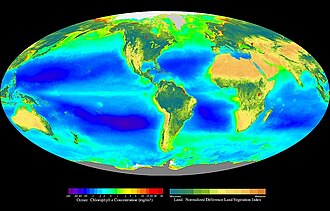
High-Productivity Ecosystems
Not all areas produce biomass at the same rate. Swamps, marshes, and tropical rainforests are among the most productive environments on Earth, while deserts and the open ocean have much lower productivity rates per square meter.
Frequently Asked Questions
Which kingdom has the most biomass on Earth?
The kingdom Plantae (plants) has the highest biomass by far, estimated at 450 billion tonnes of carbon.
How much of the Earth's mammal biomass is wild?
Wild terrestrial mammals make up less than 2% of the total mammalian biomass on land; the vast majority consists of humans and domesticated livestock.
What is the difference between terrestrial and aquatic biomass pyramids?
Terrestrial pyramids typically have a broad base of producers. Aquatic pyramids can be inverted at the base because the primary producers (phytoplankton) have a very high turnover rate, supporting a larger biomass of consumers despite their own small standing stock.
What is net primary production?
Net primary production is the rate at which new biological matter is created by producers (mainly through photosynthesis) after accounting for the energy the producers use for their own respiration.
Do humans create more mass than the Earth's living biomass?
Yes, as of 2020, the mass of anthropogenic materials (human-made solid objects) was projected to exceed the total biomass of all living organisms on Earth.