Glasgow Stock Exchange: A Legacy of Venetian Gothic Architecture
Standing as a testament to Scotland's financial heritage, the Glasgow Stock Exchange is a landmark building located in the heart of Glasgow. Once a hub of intense economic activity, this architectural gem now serves as a multifunctional space, blending the city's rich commercial history with modern urban utility.
The History of the Institution
The exchange was officially founded in 1844, establishing Glasgow as a critical center for trade and investment. For over a century, it operated as a primary financial institution until 1973, when it merged with the London Stock Exchange. Today, the building has transitioned from a center of finance to a versatile commercial hub; as of 2019, it is occupied by various shops, government offices, and other professional suites.
Architectural Design and Evolution
The current structure was erected between 1875 and 1877. Designed by architect John Burnet, the building is a striking example of the Venetian Gothic style—an architectural movement characterized by ornate pointed arches and intricate stonework. It is believed that Burnet drew inspiration from the Royal Courts of Justice in London when crafting the design.
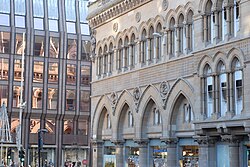
Located on the corner of Buchanan Street and Nelson Mandela Place (which was known as St George's Place until 1986), the building has undergone several modifications to meet the needs of the city. An extension was added to the St George's Place side in 1906, and the entire structure underwent a significant remodeling process between 1969 and 1971.
Due to its historical importance and architectural merit, the structure is now protected as a Category A listed building, a designation reserved for buildings of national or international importance.
Key Facts
- Founded: 1844
- Construction Period: 1875–1877
- Architect: John Burnet
- Style: Venetian Gothic
- Listing Status: Category A listed building
- Merger: Joined the London Stock Exchange in 1973
| Feature | Details |
|---|---|
| Location | Nelson Mandela Place & Buchanan Street, Glasgow |
| Architectural Style | Venetian Gothic |
| Key Extensions | 1906 extension; 1969–1971 remodeling |
| Current Use | Retail, government, and professional offices |
Frequently Asked Questions
When was the Glasgow Stock Exchange founded?
The institution was founded in 1844.
Who designed the current building?
The building was designed by architect John Burnet and constructed between 1875 and 1877.
What architectural style is the building?
It is built in the Venetian Gothic style, which is thought to have been inspired by the Royal Courts of Justice.
What happened to the exchange in 1973?
In 1973, the Glasgow Stock Exchange merged with the London Stock Exchange.
What is the building used for today?
As of 2019, the building houses shops, government offices, and other commercial offices.
What is the significance of its "Category A" listing?
A Category A listing indicates that the building is of national or international architectural or historic importance and is therefore protected.