Gillett & Johnston: A Legacy of Master Bells and Clocks
For over a century, the name Gillett & Johnston (and its predecessors Gillett, Bland and Co. and Gillett & Co.) stood as a titan of British campanology—the study of bells—and horology—the science of measuring time. From the heart of Croydon to the far reaches of the British Empire and beyond, this foundry produced some of the world's most imposing bells and precise public clocks.
Their work is characterized by a transition from traditional bell ringing to the complex art of the carillon (a musical instrument composed of at least 23 cast bronze bells), as well as the engineering of massive clock movements that defined the skylines of global cities.
Key Facts
- World Records: Cast the world's largest tuned bell (the 20-ton bourdon at Riverside Church, NYC).
- Global Reach: Installations span the UK, Canada, USA, New Zealand, Australia, Malaysia, Singapore, Egypt, Iran, and Brazil.
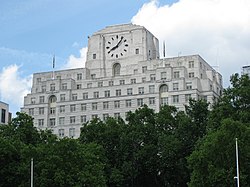
- Engineering Feats: Created the largest public clock in London at Shell Mex House.
- Political Symbols: Cast the 10-ton Freedom Bell in Berlin as a symbol of anti-communism.
Masterworks in Campanology
The foundry's expertise evolved from casting simple rings of bells for parish churches to creating massive, tuned carillons. One of their most significant achievements was the Laura Spelman Rockefeller memorial carillon at Riverside Church in New York City (1928), which features a 20-ton "bourdon" (the lowest-pitched bell), the largest ever cast in Britain.
Other notable musical installations include the 53-bell carillon for the Peace Tower on Parliament Hill in Ottawa (1926) and the 72-bell carillon for Rockefeller Chapel at the University of Chicago (1930), featuring an 18-ton bourdon.
Beyond musical carillons, the firm produced singular monuments of sound. The John Wanamaker Memorial Founder's Bell in Philadelphia, cast in 1926, was the world's largest tuned bell at the time of its creation, weighing 16 tons.
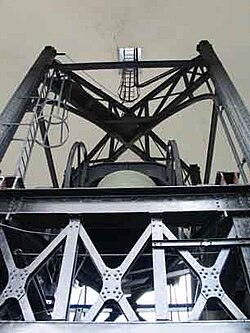
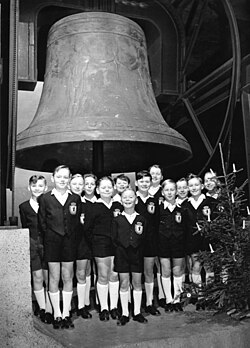
The firm also contributed to the cultural landscape of post-war Europe. In 1950, they cast the 10-ton Freedom Bell for the Rathaus Schöneberg in Berlin, gifted by Americans to symbolize anti-communism.
Notable Bell Installations
| Location | Year | Type/Detail |
|---|---|---|
| Riverside Church, NYC | 1928 | 74-bell carillon (20-ton bourdon) |
| Peace Tower, Ottawa | 1926 | 53-bell carillon |
| University of Chicago | 1930 | 72-bell carillon (18-ton bourdon) |
| Wanamaker Building, Philadelphia | 1926 | 16-ton tuned memorial bell |
| National War Memorial, Wellington | 1929 | 49-bell carillon |
Precision Horology and Public Clocks
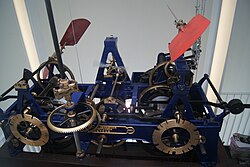
Parallel to their bell casting, Gillett & Johnston were masters of the clock movement. Their work ranged from the restoration of historic astronomical clocks—such as those at Hampton Court (1879), Wells Cathedral (1880), and Exeter Cathedral (1885)—to the installation of new timepieces in civic centers worldwide.
Their influence extended to the colonial administration of the era, with clocks installed in the Sultan Abdul Samad Clock Tower in Kuala Lumpur (1897), the Victoria Theatre and Concert Hall in Singapore (1906), and the Chennai Central Railway Station in India (c. 1873).
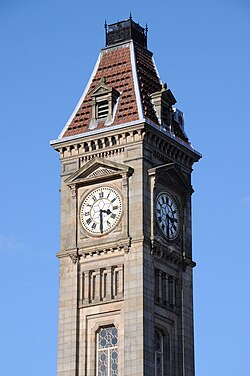
In their home city of London, the firm achieved a landmark with the 1932 clock for Shell Mex House, which stood as the largest public clock in the city.
Global Clock Distribution
- Americas: Montreal Clock Tower (1922), Fredericton City Hall (1878), and Torre Monumental in Buenos Aires (1916).
- Africa: Durban Town Hall (1883) and Pietermaritzburg City Hall (1899).
- Asia/Middle East: Tabriz City Hall, Iran (1934) and Cairo University, Egypt (1937).
- Oceania: Dunedin Town Hall, New Zealand (1880) and Sydney Town Hall, Australia (1884).
Frequently Asked Questions
What is the largest bell ever cast by Gillett & Johnston?
The largest bell cast by the firm is the 20-ton Low C "bourdon" located in the Laura Spelman Rockefeller memorial carillon at Riverside Church in New York City.
Did the company only work in the United Kingdom?
No, the company had a massive international presence, installing clocks and bells in Canada, the USA, New Zealand, Australia, India, Malaysia, Singapore, Egypt, Iran, and Brazil.
What was the significance of the Freedom Bell in Berlin?
Cast in 1950 and weighing 10 tons, the Freedom Bell was a gift from the United States to the city of Berlin, serving as a symbol of anti-communism.
What is the difference between a ring of bells and a carillon?
A ring of bells is typically a smaller set used for change ringing, whereas a carillon is a larger musical instrument (usually 23 or more bells) played via a keyboard to perform melodies.
Which London clock is noted as their largest public installation?
The clock on Shell Mex House, completed in 1932, was the largest public clock in London.