German–Ottoman Alliance of World War I: Strategic Interests and Secret Treaties
On August 2, 1914, the German Empire and the Ottoman Empire ratified a strategic alliance that would fundamentally reshape the landscape of World War I. This partnership was born from a mutual need for survival and expansion: the Ottomans sought to modernize a crumbling military infrastructure, while Germany aimed to secure safe passage toward British colonies in Asia.
Key Facts
- Ratification Date: August 2, 1914.
- Primary Ottoman Goals: Military modernization, financial stability, and state survival.
- Primary German Goals: Strategic access to the Persian Gulf and British Raj via the Baghdad Railway.
- Key Figures: Enver Pasha, Talat Pasha, and Grand Vizier Said Halim Pasha.
- Turning Point: The closure of the Dardanelles on September 27, 1914, which blocked Russian trade.
- Termination: The alliance ended on November 7, 1918, following the Armistice of Mudros.
The Fragile State of the Ottoman Empire
On the eve of the Great War, the Ottoman Empire was in a state of severe decline. Having suffered disastrous losses in the Italo-Turkish War and the Balkan Wars, the empire's resources were exhausted, its economy was in shambles, and its population was demoralized. The Sublime Porte (the central government of the Ottoman Empire) faced a critical dilemma: it lacked the weaponry, machinery, and capital to remain independent and secure.
Talat Pasha, the Minister of Interior, noted that joining a major power bloc was the only way for the empire to organize its domestic administration, maintain commerce, and expand its railroads to ensure its very existence.
The Search for an Ally
Finding a partner proved difficult, as most European powers viewed the ailing empire with skepticism. Russia, a long-time adversary, only offered an alliance on terms that would have effectively turned the Ottoman Empire into a Russian protectorate. France was unavailable due to its alliance with Russia, and Great Britain declined Ottoman requests for support.
While Sultan Mehmed V preferred to remain a non-belligerent, he was largely a figurehead. Real power rested with senior advisors and the "Three Pashas," who pushed the empire toward the Central Powers.
German Imperial Ambitions
Germany viewed the Ottoman Empire as a vital strategic asset. By 1909, Germany had realized it could not win a naval arms race against Britain and lacked the energy infrastructure to support a distant fleet. Consequently, Berlin looked toward land-based expansion.
The Baghdad Railway was the centerpiece of this strategy. This project aimed to link industrialized Europe to the Persian Gulf, facilitating the movement of German troops toward the British Raj (British India) and allowing for German settlement in Anatolia. Although Germany eventually agreed in June 1914 not to extend the line south of Baghdad to appease British concerns, the strategic value of the region remained paramount.
The Secret Treaty and Entry into War
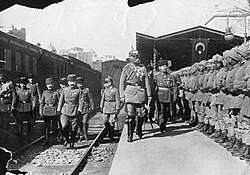
A secret treaty was signed on August 2, 1914, stipulating that the Ottomans would join the war one day after Germany declared war on Russia. The agreement was ratified by key officials, including Enver Pasha and Talat Pasha, though Sultan Mehmed V and Cemal Pasha did not sign it.
Initially, Germany was content with Ottoman neutrality, provided that German warships—such as the Goeben—remained in the Sea of Marmara to distract British naval forces. However, after German setbacks at the First Battle of the Marne and Russian gains against Austria-Hungary, Berlin pushed for active Ottoman participation.
The situation escalated on September 27, 1914, when the Ottomans closed the Dardanelles, cutting off over 90% of Russia's import and export traffic. Following a gold loan of 5 million liras from Germany to fund mobilization, the Ottoman fleet bombarded Russian ports on October 29, 1914, marking their formal entry into the conflict.
Evolution of the Alliance
The partnership evolved through several legal stages to ensure cohesion. A general five-year alliance was signed in January 1915, and by September 1916, both nations pledged not to sign a separate peace treaty with the Allies. Austria-Hungary officially joined this pact on March 21, 1916.
| Date | Event | Significance |
|---|---|---|
| August 2, 1914 | Secret Treaty signed | Initial agreement to join Central Powers |
| September 27, 1914 | Closure of Dardanelles | Blocked Russian Black Sea trade |
| October 10, 1914 | Gold Loan Agreement | Financed Ottoman mobilization (5 million liras) |
| October 29, 1914 | Bombardment of Russian ports | Formal entry of Ottoman Empire into WWI |
| January 22, 1915 | General Alliance Treaty | Established a formal five-year partnership |
| November 7, 1918 | Armistice of Mudros | Termination of the alliance |
Frequently Asked Questions
Why did the Ottoman Empire ally with Germany instead of Britain or France?
Britain declined Ottoman requests for an alliance, and France was allied with Russia, the Ottomans' long-term enemy. Russia only offered terms that would have compromised Ottoman sovereignty, leaving Germany as the only viable partner willing to provide the financial and military support the empire needed to survive.
What was the strategic importance of the Baghdad Railway?
The railway was intended to give Germany easier access to trade markets in British India and the Persian Gulf, while strengthening the Ottoman Empire's connection to industrialized Europe.
How did the closure of the Dardanelles affect the war?
Closing the Dardanelles was a critical blow to Russia, as it blocked more than 90% of its import and export traffic, effectively isolating the Russian Empire from its allies and trade partners.
Did the Ottoman Sultan support the alliance?
Sultan Mehmed V specifically wanted the empire to remain neutral. However, he was a figurehead with little actual power, and the decision to join the Central Powers was driven by his senior advisors and the "Three Pashas."
What role did German warships play in the alliance?
Germany provided two cruisers to the Ottoman Navy. The presence of these ships, particularly the Goeben, was popular with the local population and served as a strategic deterrent against British naval forces in the Sea of Marmara.