George Papandreou: A Legacy of Greek Politics and Global Leadership
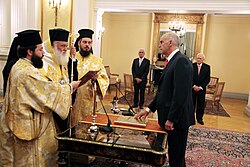
George Papandreou is a prominent figure in Greek political history, having served as the 182nd Prime Minister of Greece from 2009 to 2011. Born into a storied political dynasty, Papandreou's career has spanned several decades, characterized by his leadership of the Panhellenic Socialist Movement (PASOK) and his influence on the international stage as President of the Socialist International.
His tenure as Prime Minister was defined by one of the most challenging periods in modern Greek history: the government debt crisis. This era of economic instability eventually led to his resignation to facilitate the formation of a national unity government.
Key Facts
- Prime Minister of Greece: Served from October 6, 2009, to November 11, 2011.
- Political Dynasty: Third member of the Papandreou family to hold the office of Prime Minister, following his father, Andreas, and grandfather, Georgios.
- Party Leadership: Led PASOK from February 2004 until March 2012.
- Global Role: President of the Socialist International from 2006 to 2022.
- Education: Holds a BA from Amherst College and an MSc from the London School of Economics.
Early Life and Academic Foundation
George Jeffrey Papandreou was born on June 16, 1952, in Ramsey, Minnesota, United States. His father, Andreas Papandreou, was a professor at the University of Minnesota at the time. His mother, Margaret Chant-Papandreou, was also American-born. Despite his American birth, Papandreou's life became deeply entwined with Greek governance, and he formally renounced his US citizenship in 2000.
The Ascent Through Greek Politics
Papandreou entered the Hellenic Parliament in 1981 as a Member of Parliament (MP) for Achaea, the same year his father became Prime Minister. Over the next two decades, he held a variety of high-ranking ministerial roles, often serving under his father's administration.
Ministerial Roles and Foreign Affairs
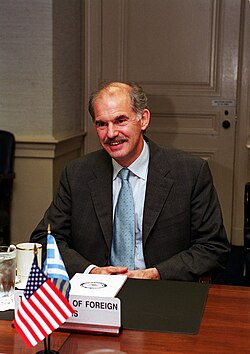
His early career included terms as the Minister of National Education and Religious Affairs (1988–1989 and 1994–1996). He also gained significant diplomatic experience as the Minister of Foreign Affairs under Prime Minister Costas Simitis from 1999 to 2004. Additionally, in 1997, he served as the Minister Responsible for Government Coordination for the bid to host the 2004 Olympic Games.
Leadership of PASOK and International Influence
In February 2004, Papandreou took the helm of the Panhellenic Socialist Movement (PASOK), the party founded by his father. His leadership extended beyond Greece; from January 30, 2006, to November 25, 2022, he served as the President of the Socialist International, a global organization grouping 132 political parties.
Prime Ministership and the Debt Crisis
On October 6, 2009, George Papandreou assumed office as Prime Minister. His term was immediately overshadowed by the Greek government debt crisis, a period of severe financial instability that required complex negotiations with international creditors.
During this period, his government faced intense pressure to implement austerity measures—policies designed to reduce government budget deficits. In June 2011, Papandreou narrowly survived a motion of no confidence in the Hellenic Parliament, securing 155 of the 300 seats.
Resignation and Transition
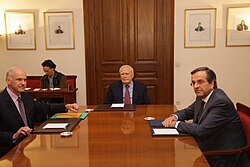
The volatility of the crisis led Papandreou to propose a referendum on the bailout terms, though this was ultimately called off. On November 11, 2011, he resigned from office to make way for a caretaker national unity government, which saw Lucas Papademos succeed him as Prime Minister.
Summary of Political Offices
| Office | Tenure | Key Context |
|---|---|---|
| Prime Minister of Greece | 2009–2011 | Managed the Greek debt crisis |
| President of PASOK | 2004–2012 | Led the Panhellenic Socialist Movement |
| President of Socialist International | 2006–2022 | Global socialist leadership |
| Minister of Foreign Affairs | 1999–2004; 2009–2010 | Diplomatic leadership under Simitis and himself |
| Minister of National Education | 1988–1989; 1994–1996 | Served under Andreas Papandreou |
Personal Life and Honors
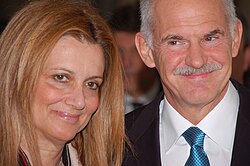
Papandreou has been married twice: first to Evanthia Zissimides (1976–1987), with whom he has a son, Andreas, and later to Ada Papapanou (1989–2016), with whom he has a daughter, Margarita-Elena. Throughout his career, he has received numerous international honors, including the Grand Cross of the Order of Merit of the Federal Republic of Germany and the Knight Grand Cross of the Order of Merit of the Italian Republic.
Frequently Asked Questions
Who is George Papandreou?
George Papandreou is a Greek politician who served as the Prime Minister of Greece from 2009 to 2011 and was the leader of the PASOK party from 2004 to 2012.
Why did George Papandreou resign as Prime Minister?
He resigned on November 11, 2011, during the height of the Greek government debt crisis to allow for the formation of a national unity government.
What is his connection to other Greek Prime Ministers?
He is part of a political dynasty; both his father, Andreas Papandreou, and his grandfather, Georgios Papandreou, also served as Prime Ministers of Greece.
What international roles has he held?
He served as the President of the Socialist International from January 30, 2006, until November 25, 2022.
Where was George Papandreou born?
He was born in Ramsey, Minnesota, in the United States, and later renounced his US citizenship in 2000.