Generative Semantics vs. Interpretive Semantics: The Battle Over Deep Structure
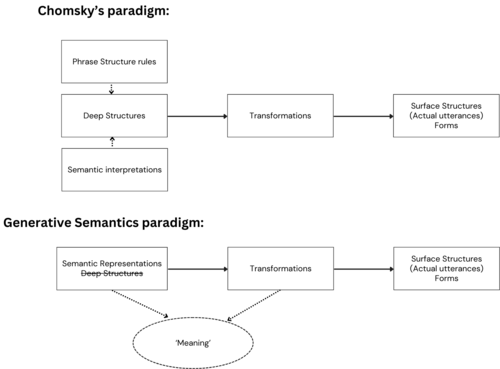
In the evolution of modern linguistics, a profound disagreement emerged regarding the relationship between meaning and structure. At the heart of this dispute were two competing paradigms: generative semantics (initially known as Abstract Syntax) and interpretive semantics. The central point of contention was the degree of abstractness of the deep structure—the underlying representation of a sentence—and how far it sits from the surface structure, which is the final sentence as spoken or written.
While generative semanticists argued that meaning directly drives the structure of a sentence, Noam Chomsky and the interpretivists maintained that syntax operates as an independent system. This theoretical clash reshaped how linguists understand the mental processes involved in language production.
Key Facts
- Generative Semantics views deep structure as a direct representation of meaning.
- Interpretive Semantics advocates for autonomous syntax, where syntactic rules operate independently of meaning.
- Lexical Decomposition is the process of breaking words down into atomic semantic bits (e.g., "kill" as CAUSE + BECOME + NOT + ALIVE).
- Deverbal Nouns are nouns derived from verbs (e.g., "revolution" from "revolve") which interpretivists argue should be separate lexical entries.
- The Katz-Postal hypothesis suggests that transformations are transparent and do not alter the underlying meaning.
The Generative Semantics Approach
Generative semantics was originally inspired by Chomsky's Aspects model, specifically the idea that deep structures determine semantic representations and contain selectional restrictions—rules governing which words can coexist based on meaning (for example, the verb "eat" requires an edible object).
However, generative semanticists expanded this idea, eventually conflating semantic representation and deep structure. They argued that meaning is the primary driver of language; transformations simply apply to these meaning-based deep structures to create various surface structures while preserving the original intent.
Logical Form and Category Reduction
In this framework, the derivation of a sentence is a direct mapping of logic and meaning onto the surface structure. Generative semanticists proposed that semantic deep structure is generated universally, similar to predicate logic. This led them to reduce all syntactic categories to just three:
- S (Proposition)
- NP (Argument)
- V (Predicate)
Under this analysis, adjectives, auxiliaries, and negatives are all categorized as verbs, with other forms derived through transformations.
Lexical Decomposition and Predicate Raising
To explain the semantic implications inherent in words, generative semanticists used lexical decomposition. This theory posits that words are composed of atomic semantic units. For instance, the word "kill" is decomposed into CAUSE, BECOME, NOT, and ALIVE.
This allowed linguists to argue that "kill" and "die" share the same semantic base (NOT ALIVE), differing only by the transformation applied: "die" is an inchoative transformation (BECOME NOT ALIVE), while "kill" is a causative transformation (CAUSE TO BECOME NOT ALIVE).
Building on this, McCawley proposed predicate raising, suggesting that lexical items can enter the derivation process at any point, rather than only at the deep structure. This effectively undermined the necessity of a separate syntactic deep structure, suggesting that semantic features should map directly to the surface structure.
The Interpretivist Critique
Noam Chomsky responded to these developments through a series of lectures and papers known as Remarks, establishing the interpretivist program. He argued for autonomous syntax, where syntax has its own independent rules, and meaning is derived later through interpretive rules applied to those structures.
Lexicalism and Deverbal Nouns
Chomsky challenged lexical decomposition by introducing lexicalism. He argued that deverbal nouns (nouns formed from verbs) often have distinct meanings that cannot be explained by simple transformations. For example, "revolution" has a broader scope than the verb "revolve." He noted that some nouns, like "proofs," function structurally like regular noun phrases, suggesting they possess their own independent internal structure rather than being derived from verbs.
The Problem of Temporal and Causal Intricacies
Philosopher Jerry Fodor further criticized lexical decomposition. He pointed out that replacing a decomposed phrase with a single word can change the sentence's validity. For example, saying someone "caused [another] to die on Wednesday by poisoning them three weeks earlier" is logically sound, but saying they "killed [another] on Wednesday by poisoning them three weeks earlier" creates a temporal contradiction.
Formalism in Underlying Structures
Interpretivists provided several arguments to prove that a formal, non-semantic structure is necessary:
Coreference and Infinite Loops
Generative semanticists analyzed coreference (e.g., "Harry thinks he should win") by replacing the pronoun with the noun in the deep structure. Interpretivists argued this would create an infinite loop of embedding in complex sentences. Instead, they proposed that pronouns are base components and their antecedents are found via interpretive rules.
Transformations and Meaning Shifts
While the Katz-Postal hypothesis claimed transformations are transparent, Chomsky argued that passive transformations can actually alter meaning. For example, "Everyone in the room knows two languages" may imply different languages for each person, whereas "Two languages are known by everyone in the room" implies the same two languages for all. This suggests that transformation movements are governed by formal rules, not just semantic ones.
| Feature | Generative Semantics | Interpretive Semantics |
|---|---|---|
| Deep Structure | Equivalent to semantic representation | Independent syntactic level |
| Role of Meaning | Drives the surface structure | Derived from syntactic structure |
| Lexical Approach | Lexical Decomposition (atomic bits) | Lexicalism (separate entries) |
| Transformations | Transparent; preserve meaning | Can alter meaning/scope |
| Syntactic Categories | Reduced (S, NP, V) | Diverse and formal |
The Decline of Generative Semantics
Ultimately, generative semantics struggled with empirical confirmation. While interpretive semantics relied on codified phrase-structure rules and the theory of an innate linguistic faculty in the brain, generative semantics relied on less explicit hypotheses regarding speaker intent and entailment. The lack of rigorous formulas and the blurring of lines between syntax and semantics led to its decline, as it was seen as creating more theoretical problems than it solved.
Frequently Asked Questions
What is the main difference between generative and interpretive semantics?
The primary difference is the role of deep structure. Generative semantics views deep structure as the meaning itself, which then maps to the surface sentence. Interpretive semantics views syntax as an autonomous system where the structure is built first, and meaning is interpreted from that structure.
What is lexical decomposition?
Lexical decomposition is the theory that words are made of smaller, atomic semantic components. For example, the word "kill" is broken down into the concepts of causing someone to become not alive.
What are deverbal nouns?
Deverbal nouns are nouns that are derived from verbs, such as "marriage" from "marry." Interpretivists argue these should be treated as separate entries in the lexicon because their meanings often diverge from the original verb.
Why did generative semantics eventually decline?
It declined because it lacked explicit rules and formulas, making its predictions difficult to test or compare. Critics argued that by trying to merge syntax and semantics, the framework became too irregular and lacked the empirical rigor of the interpretivist approach.
How do passive transformations affect meaning in interpretive semantics?
Interpretivists argue that transformations can change the scope of quantifiers. For instance, changing a sentence to the passive voice can shift the meaning from "everyone knows different things" to "everyone knows the same things," proving that syntax is not a transparent map of meaning.