General Sir Bruce Hamilton: A Distinguished Career in the British Army
General Sir Bruce Meade Hamilton (1857–1936) was a prominent figure in the British Army, whose service spanned nearly half a century. From the rugged terrains of Afghanistan to the strategic demands of the First World War, Hamilton established himself as a leader of boldness and resolution. His career is a testament to the professional military trajectory of the late Victorian and Edwardian eras.
Key Facts
- Full Name: General Sir Bruce Meade Hamilton, GCB, KCVO.
- Service Period: 1874–1918.
- Major Conflicts: Second Anglo-Afghan War, First and Second Boer Wars, and the First World War.
- Highest Rank: General.
- Notable Commands: Scottish Command, 2nd Division, and 3rd Division.
Early Life and Military Foundations
Born on December 7, 1857, in Sidmouth, Devon, Bruce Hamilton was born into a family with a strong military tradition. He was the second son of General Henry Meade Hamilton. This familial influence was evident as all three of his brothers, including Hubert Ion Wetherall Hamilton, also became officers in the British Army.
Hamilton began his professional journey in 1874 when he was appointed as a sub-lieutenant in the West Suffolk Regiment of Yeomanry Cavalry. By 1877, he had transitioned into the East Yorkshire Regiment. His early years of service were marked by active deployment in the Second Anglo-Afghan War (1880) and the First Boer War (1881).
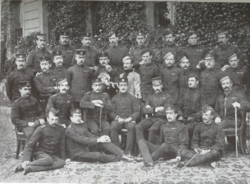
Rise Through the Ranks
Hamilton's steady ascent through the officer ranks saw him promoted to captain in September 1887 and to major in October 1895. In 1897, he expanded his leadership experience by serving as the commander of the Niger Coast Protectorate Force based in Benin City.
The Second Boer War
The Second Boer War (1900–1902) served as a defining period for Hamilton. He played a pivotal role in the capture of Naauwpoort and later commanded military columns in the Eastern Transvaal. Following the peace announcement on May 31, 1902, he was tasked with supervising the surrender of arms in the region.
His performance earned high praise from Lord Kitchener, the Commander-in-Chief, who described Hamilton as an officer possessing "qualities of boldness, energy and resolution in no common degree." In recognition of his service, he was appointed a Knight Commander of the Order of the Bath (KCB) in June 1902, receiving the investiture from King Edward VII at Buckingham Palace in October.
Senior Commands and the First World War
Upon returning to England, Hamilton transitioned into high-level command. In April 1903, he became the general officer commanding the 5th Brigade, 3rd Division within the 1st Army Corps, later moving to the 2nd Division in 1904. His rise continued with a promotion to lieutenant general in February 1907, and by 1909, he was appointed general officer commanding-in-chief for Scottish Command.
During the First World War, Hamilton served as the army commander for the Home Defence formations, specifically the First Army and the Northern Army. His contributions during this era were recognized in the 1915 Birthday Honours, where he was appointed a Knight Grand Cross of the Order of the Bath (GCB). In December 1915, he also became the colonel of the Border Regiment.
Career Summary
| Category | Details |
|---|---|
| Born/Died | 7 Dec 1857 (Sidmouth) / 6 July 1936 (Wendover) |
| Primary Units | Suffolk Yeomanry, East Yorkshire Regiment, Border Regiment |
| Key Honors | GCB, KCVO, Grand Officer of the Order of the Crown of Italy |
| Major Commands | Scottish Command, 2nd Division, 3rd Division |
Frequently Asked Questions
What were Sir Bruce Hamilton's most significant military achievements?
His most notable achievements include the capture of Naauwpoort during the Second Boer War and his leadership of the Home Defence formations (First and Northern Armies) during the First World War.
Which honors and awards did General Hamilton receive?
He was appointed a Knight Grand Cross of the Order of the Bath (GCB) and a Knight Commander of the Royal Victorian Order (KCVO). He was also a Grand Officer of the Order of the Crown of Italy and was Mentioned in Despatches.
What role did he play in the Second Boer War's conclusion?
Following the peace announcement in May 1902, General Hamilton supervised the surrender of arms in the Eastern Transvaal region of South Africa.
Was there a family history of military service?
Yes, he was the son of General Henry Meade Hamilton, and all three of his brothers also served as officers in the British Army.
Which specific regiments was he associated with?
He served with the West Suffolk Regiment of Yeomanry Cavalry, the East Yorkshire Regiment, and later became the colonel of the Border Regiment.