Gene Vincent: The Pioneer of Rockabilly
Before the global explosion of rock and roll, a few visionary artists blended country music with rhythm and blues to create a high-energy sound known as rockabilly. Among the most influential of these pioneers was Gene Vincent. With his raw vocals and rebellious energy, Vincent helped define the sonic landscape of the 1950s, leaving an indelible mark on music history despite a career marked by volatility.
Key Facts
- Real Name: Vincent Eugene Craddock.
- Signature Hit: "Be-Bop-a-Lula," a top-10 hit and rockabilly staple.
- Backing Band: The Blue Caps (named after U.S. Navy enlisted sailors).
- Major Accolades: Inductee of both the Rockabilly Hall of Fame (1997) and the Rock and Roll Hall of Fame (1998).
- Military Service: Served as a Seaman in the U.S. Navy during the Korean War (1952–1955).
Early Life and the Birth of the Blue Caps
Born Vincent Eugene Craddock on February 11, 1935, the future star began his musical journey in the local scene of Norfolk. Adopting the stage name Gene Vincent, he formed Gene Vincent and His Blue Caps. The original lineup featured a powerhouse of talent: Cliff Gallup on lead guitar, Jack Neal on upright bass, Dickie Harrell on drums, and Willie Williams on rhythm guitar.
The group quickly built a reputation in Norfolk's country bars. Their big break came after winning a talent contest organized by local radio DJ "Sheriff Tex" Davis, who subsequently became Vincent's manager.
The Rise to Stardom: "Be-Bop-a-Lula"
In 1956, Vincent wrote "Be-Bop-a-Lula," a track that would become one of the most significant early examples of rockabilly. Though Capitol Records originally intended it to be the B-side of the single "Woman Love," promotional copies sent to radio stations by publisher Bill Lowery sparked an immediate public frenzy. The song surged in popularity, peaking at number seven on the Billboard pop chart and number five on the Cash Box chart.
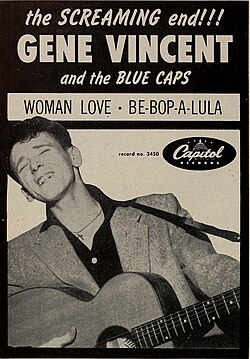
The success of "Be-Bop-a-Lula" launched Vincent into the stratosphere of rock and roll. He followed this with "Lotta Lovin'" in 1957, which reached number 13 on the Billboard chart. Together, these two tracks earned him gold records for sales of two million and 1.5 million copies, respectively.
Global Influence and Television Appearances
Vincent's appeal extended far beyond the United States. In 1957, he toured the east coast of Australia alongside fellow rockers Little Richard and Eddie Cochran, performing to massive crowds of 72,000 at the Sydney Stadium. He also ventured into cinema, appearing in The Girl Can't Help It with Jayne Mansfield.
On November 17, 1957, Vincent and the Blue Caps performed "Dance to the Bop" on The Ed Sullivan Show, a milestone that brought his high-energy performance to a national television audience. This song later appeared in the film Hot Rod Gang, featuring dancers performing the West Coast Swing.
Later Career and European Success
While his chart success in the U.S. waned after 1957, Vincent remained a significant star in the United Kingdom, achieving eight top-40 hits between 1956 and 1961. By the end of 1959, the Blue Caps were no longer credited on his records, and Vincent began recording as a solo artist.
Throughout the 1960s, Vincent experimented with folk rock and country rock. He recorded for various labels, including EMI's Columbia and Challenge Records. Despite the critical reception of some of these later works, they failed to recapture the commercial heights of his early Capitol years.
Death and Lasting Legacy
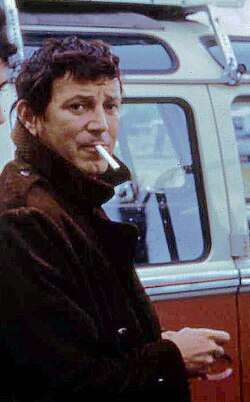
Gene Vincent's life was cut short when he passed away on October 12, 1971, at the age of 36. However, his influence persisted. He was the first person inducted into the Rockabilly Hall of Fame in 1997, followed by the Rock and Roll Hall of Fame in 1998. His contributions are further immortalized with a star on the Hollywood Walk of Fame and a bronze star on the Legends of Music Walk of Fame in Norfolk.
| Category | Details |
|---|---|
| Active Years | 1955–1971 |
| Primary Genres | Rockabilly, Rock and Roll, Country |
| Key Labels | Capitol, Columbia, Dandelion, Kama Sutra |
| Most Famous Song | "Be-Bop-a-Lula" |
| Instruments | Vocals, Guitar |
Frequently Asked Questions
What is rockabilly?
Rockabilly is a genre that blends elements of country music (hillbilly) with rhythm and blues, characterized by a high-energy sound and often featuring a slap-back echo on vocals.
Who were the Blue Caps?
The Blue Caps were Gene Vincent's backing band. The name was a reference to enlisted sailors in the U.S. Navy, a nod to Vincent's own military service.
Why was "Be-Bop-a-Lula" so significant?
It is considered one of the definitive early examples of the rockabilly style and was highly influential in the development of early rock and roll, eventually being ranked by Rolling Stone as one of the 500 Greatest Songs of All Time.
Did Gene Vincent have more success in the US or the UK?
While he had early hits in the US, his chart career there was brief. He enjoyed more sustained popularity in the UK, where he achieved eight top-40 hits between 1956 and 1961.
When was Gene Vincent inducted into the Rock and Roll Hall of Fame?
Gene Vincent was inducted into the Rock and Roll Hall of Fame in 1998. His backing band, the Blue Caps, were retroactively inducted in 2012.