Geddy Lee: The Musical Legacy of Rush's Virtuoso
Geddy Lee, born Gary Lee Weinrib, is a towering figure in the world of progressive rock. As the lead vocalist, bassist, and keyboardist for the legendary Canadian band Rush, Lee has spent over five decades redefining the boundaries of rock music. From his early days in Toronto to his induction into the Rock and Roll Hall of Fame, Lee's career is a testament to technical mastery and artistic evolution.
Lee joined Rush in September 1968 at the invitation of his childhood friend, Alex Lifeson. Replacing original frontman Jeff Jones, Lee became a cornerstone of the band's sound. Alongside Lifeson, he is one of only two members to appear on every single Rush album, maintaining a creative partnership that lasted through the band's initial dissolution between 2015 and 2025.
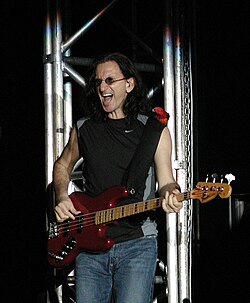
Key Facts
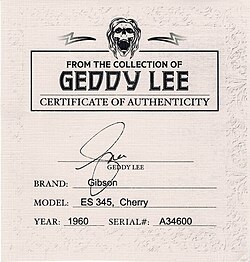
- Full Name: Gary Lee Weinrib
- Primary Roles: Lead vocals, bass guitar, and keyboards for Rush
- Active Years: 1968 to present
- Notable Solo Work: My Favourite Headache (2000) and The Lost Demos (2025)
- Major Honors: Rock and Roll Hall of Fame (2013) and Officer of the Order of Canada (1996)
- Signature Gear: Fender Geddy Lee Jazz Bass
Musical Evolution and Solo Ventures
While Rush defined much of his career, Lee has explored various artistic avenues. In 2000, he released his solo album, My Favourite Headache. Decades later, in April 2025, he revisited this era by releasing The Lost Demos, a 12" single featuring re-recordings of unpublished tracks. The A-side, "Gone," reached 62nd on the UK singles chart, while the release hit 30th on the Official Physical and Vinyl Singles Charts in the UK.
Lee's versatility extended to side projects and guest appearances. In 1982, he produced the only album for the Toronto new wave band Boys Brigade. He also contributed guest vocals to the humanitarian project USA for Africa on the song "Tears Are Not Enough" for the 1985 album We Are the World.
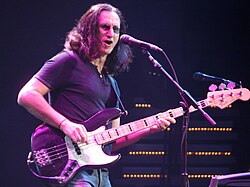
The Art of the Bass: Equipment and Style
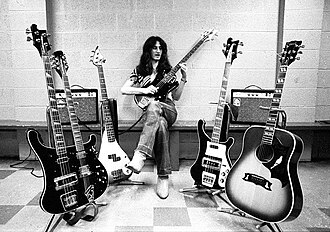
Geddy Lee is renowned for his distinct bass tone, which evolved significantly over the years. In the early days of Rush, he utilized a modified blue "teardrop" Fender Precision Bass. Seeking a sound similar to Chris Squire of Yes, he transitioned to a black Rickenbacker 4001, which served as his primary instrument through the 1970s.
During the "synth era" of the mid-1980s, Lee adopted Steinberger and Wal basses, the latter providing a "jazzy" tone. By 1993's Counterparts, he returned to the Fender Jazz Bass, reclaiming his signature high treble sound. This preference led to the 1998 release of the Fender Geddy Lee Jazz Bass, a signature model based on a 1972 instrument he purchased at a pawn shop in Michigan.
Keyboards and Technical Innovation
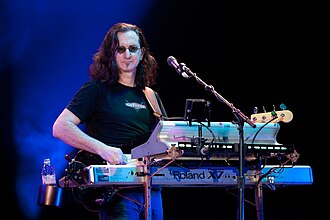
Beyond the bass, Lee's mastery of synthesizers is a hallmark of the Rush sound. He has utilized a vast array of equipment, including Moog Taurus pedals, the Roland Jupiter 8, and Yamaha DX7. To manage these complex sounds during live performances, Lee utilized advanced sampler technology, such as the Roland XV-5080, to recreate vintage tones without needing multiple physical machines on stage.
Collections and Personal Passions
Outside of performing, Lee is a dedicated collector. He possesses an immense collection of over 250 vintage basses, including a 1961 Fender Precision Bass once owned by John Entwistle of The Who. In 2019, he auctioned several high-value guitars, including a 1959 Les Paul Standard and a 1955 Fender Stratocaster.
Lee is also an avid baseball fan. His memorabilia collection includes authentic signatures from Mickey Mantle, Christy Mathewson, and various U.S. presidents. His passion for the sport was highlighted in 2013 when he threw the ceremonial first pitch for the Toronto Blue Jays.
![Lee is an avid baseball fan with an immense collection of memorabilia, including authentic signatures from Christy Mathewson, Murderers' Row, Mickey Mantle, and presidents of the United States.[65] Pictured is Lee throwing a ceremonial first pitch for the Toronto Blue Jays in 2013](/images/8b/c2/8bc298f40ba01dedf6f19ac2888d3178c61785efef0f7717b007cca48ad793bf.jpg)
Career Summary and Achievements
| Year | Achievement / Award | Category |
|---|---|---|
| 1990 | Asteroid (12272) Geddylee | Scientific Recognition |
| 1994 | Juno Hall of Fame | Music Industry |
| 1996 | Officer of the Order of Canada | National Honor |
| 2010 | Hollywood Walk of Fame | Cultural Icon |
| 2013 | Rock and Roll Hall of Fame | Music Industry |
| 2021 | Lifetime Achievement Award (APJ) | Philanthropy |
Frequently Asked Questions
What is Geddy Lee's signature bass guitar?
His signature model is the Fender Geddy Lee Jazz Bass, which is a recreation of a 1972 Fender Jazz Bass he bought in a Michigan pawn shop in 1978.
Did Geddy Lee ever release solo music?
Yes, he released the solo album My Favourite Headache in 2000 and a 12" single titled The Lost Demos in 2025.
What other instruments does Geddy Lee play?
In addition to the bass guitar, Lee is an accomplished keyboardist and singer, and he also plays the guitar.
What are Geddy Lee's interests outside of music?
Lee is a passionate collector of vintage bass guitars and a devoted baseball fan with a massive collection of sports memorabilia.
Which awards has Geddy Lee received?
His honors include being named an Officer of the Order of Canada, induction into the Rock and Roll Hall of Fame, and receiving a star on the Hollywood Walk of Fame.