Gabriel García Moreno: The Conservative Architect of Modern Ecuador
Gabriel García Moreno remains one of the most polarizing figures in South American history. Rising to power during a period of intense civil unrest in 1859, he served as the President of Ecuador across multiple terms, leaving a legacy defined by rigid conservatism, deep religious devotion, and an aggressive drive toward national modernization.
His leadership was characterized by a paradox: while he implemented sophisticated financial reforms and expanded the nation's educational and physical infrastructure, his methods often relied on authoritarian control and the exploitation of marginalized populations.
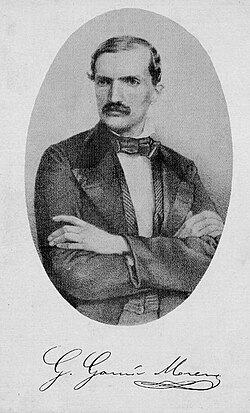
Key Facts
- Presidencies: Served multiple terms, including 1861–1865 and 1869–1875.
- Economic Reform: Stabilized government finances by cutting corruption and reducing unnecessary state positions.
- Education: Increased primary schools from 200 to 500 and expanded student enrollment from 8,000 to 32,000.
- Religious Policy: Established Christianity as the official state religion and required candidates and voters to be Catholic.
- Infrastructure: Developed a major highway system using the controversial trabajo subsidario tax.
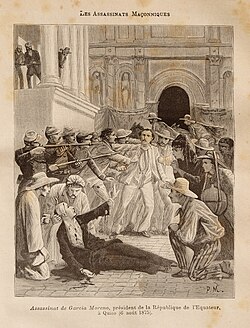
- Death: Assassinated on August 6, 1875, by Faustino Rayo and other conspirators.
The First Term (1861–1865): Stability and Infrastructure
After being chosen by a conservative junta in 1859, García Moreno's presidency was confirmed via popular election in 1861. He inherited a nation plagued by an empty treasury and massive debt. To rectify this, he implemented a stringent economy, abolished redundant government positions, and targeted the corruption that had previously siphoned off tax revenue. These measures stabilized the economy and made Ecuador more attractive to foreign investors.
The Cost of Progress: Trabajo Subsidario
To fund his ambitious public works, García Moreno utilized the trabajo subsidario tax. This was a requirement for every citizen to provide four days of unpaid labor to the state annually or pay a monetary equivalent. This system mirrored the colonial mita (a mandatory public service system used by the Spanish Empire).
Because indigenous populations often could not afford the monetary payment, the burden of this forced labor fell disproportionately on them. While the resulting highway system is praised for its utility, contemporary accounts, such as those by Friedrich Hassaurek, describe the "lamentable sight" of indigenous workers being driven by overseers with whips and lacking sufficient tools.
Beyond roads, García Moreno focused on intellectual growth. He reformed universities, established a military school, and created two agricultural and polytechnic colleges.
The Second Term (1869–1875): Faith and Governance
After a period of residence at the Hacienda Guachalá and the founding of the Conservative Party in 1869, García Moreno returned to the presidency. His second tenure saw the introduction of free and compulsory education in 1871, alongside the construction of more hospitals and schools.
The Union of Church and State
García Moreno's personal piety was central to his governance. He attended daily mass and advocated for a state deeply intertwined with the Catholic Church. Under the 1869 constitution, Christianity became the official religion of the state, and Catholicism became a prerequisite for both voting and running for office.
His relationship with the Vatican was complex; while he insisted on eliminating the state's power to appoint bishops (a remnant of Spanish rule), he was the only world leader to protest the loss of the Papal States. In 1871, he led the legislature in consecrating Ecuador to the Sacred Heart of Jesus.
Political Conflict and Assassination
García Moreno's authoritarian style and use of secret police to suppress leftist dissent earned him the enmity of Liberals. Radicals viewed him as a dictator, a sentiment echoed in Juan Montalvo's influential pamphlet, La dictadura perpetua (The Perpetual Dictatorship).
Tensions peaked following his third election victory in 1875. Despite warnings from a priest regarding a plot by Freemasons, García Moreno maintained that his only preparation was to be ready to appear before God.
On August 6, 1875, he was ambushed on the steps of the National Palace in Quito. He was attacked with a machete by Faustino Rayo, a former captain, and shot by several other assailants. According to his admirers, his final words were "¡Dios no muere!" ("God does not die!").
Summary of García Moreno's Administration
| Category | Key Actions/Changes | Outcome/Controversy |
|---|---|---|
| Finance | Cut corruption; reduced state positions | Stabilized treasury; attracted foreign investment |
| Infrastructure | Highway system via trabajo subsidario | Modernized transport; relied on forced indigenous labor |
| Education | Expanded primary schools (200 to 500) | Student population grew from 8,000 to 32,000 |
| Religion | 1869 Constitution; Consecration to Sacred Heart | Catholicism required for citizenship/voting |
Frequently Asked Questions
What was the trabajo subsidario tax?
The trabajo subsidario was a law requiring citizens to provide four days of unpaid labor to the state annually or pay a monetary equivalent. It was used primarily to fund public works like highways, but it disproportionately affected indigenous people who could not afford the payment.
How did García Moreno impact education in Ecuador?
He significantly expanded the educational system by making education free and compulsory in 1871, increasing the number of primary schools from 200 to 500, and establishing specialized polytechnic, agricultural, and military colleges.
Why was García Moreno's relationship with the Church so significant?
He integrated the Catholic Church into the state's legal framework, making Catholicism a requirement for voting and holding office. He also consecrated the nation to the Sacred Heart of Jesus and maintained a close friendship with the Jesuits.
Who assassinated Gabriel García Moreno?
He was assassinated on August 6, 1875, by Faustino Rayo, a former captain, and several other accomplices who used machetes and firearms in an ambush at the National Palace in Quito.
Why did Liberals oppose his rule?
Liberals opposed him due to his authoritarian governance, his use of secret police to silence dissent, and his ultraconservative policies that merged church and state.