Futsal: The Fast-Paced World of Indoor Football
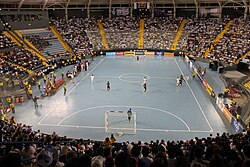
Futsal is a dynamic, high-intensity team sport that brings the excitement of football indoors. Derived from the Portuguese futebol de salão and Spanish fútbol sala—both meaning "indoor football"—the game is characterized by its smaller pitch, fewer players, and a specialized ball designed for hard surfaces. While it shares roots with association football, futsal has evolved into a distinct discipline with its own governing bodies and global following.
The sport's popularity spans the globe, from its strongholds in South America to growing competitions in Asia and Europe. Whether played professionally in massive arenas or informally on basketball courts, futsal emphasizes technical skill, quick decision-making, and precise ball control.
Key Facts
- Governing Bodies: Primarily managed by FIFA and the Asociación Mundial de Futsal (AMF).
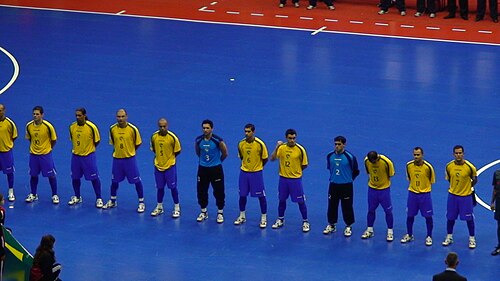
- Team Size: 5 players per side.
- Origin: Developed in Montevideo, Uruguay, in 1930.
- Pitch: Played on a flat, smooth surface (wood or artificial material).
- Olympic Status: Included in the Youth Olympics since 2018.
The History and Evolution of Futsal
Origins in Uruguay
Futsal was originally developed for basketball courts in Uruguay. Following Uruguay's massive success in association football during the 1920s and their 1930 FIFA World Cup victory, there was a strong desire to create a similar team game that could be played regardless of the weather. A formal rule book for the sport was published in September 1933.
The Battle for the Name
The term "futsal" may have been coined by Brazilian journalist José Antônio Inglêz in the 1960s, but it didn't gain widespread use until the 1980s. During this time, a dispute arose between FIFA and FIFUSA (now the World Futsal Association) over the use of the word "football." To avoid conflict, the term futsal was adopted as a universal name that transcended language barriers. FIFA eventually adopted the term in the 1990s, and it is now the internationally accepted name for the sport.
Gameplay and Technical Specifications
The Pitch and Equipment
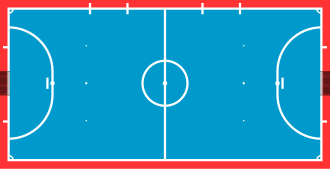
A futsal pitch is a rectangular surface made of wood or artificial materials. For international matches, the dimensions typically range from 38–42 meters in length and 20–25 meters in width. The standard international size is 40m x 20m.
The goals are 3 meters wide and 2 meters high. A critical area of the pitch is the penalty area, a semi-circle with a 6-meter radius from the goalposts where the goalkeeper is permitted to use their hands. There are two penalty marks: one at 6 meters and a second penalty mark at 10 meters, used for direct free kicks after a team commits six or more fouls in a period.
The Futsal Ball
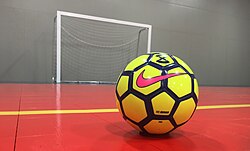
Unlike a standard football, a futsal ball is designed to have a lower bounce to suit hard indoor surfaces. For players aged 8–12, a size 3 ball is used. A key technical requirement is the rebound: when dropped from 2 meters, the first bounce must be between 50 cm and 65 cm.
Core Rules
Futsal is a contact sport played with 5 players per side. One of the most significant differences from association football is the lack of an offside rule, which allows for a more fluid and attacking style of play. The game also utilizes kick-ins rather than throw-ins to restart play from the touchlines.
Global Governance and Competitions
The sport is currently split between two main governing bodies: the Asociación Mundial de Futsal (AMF) and FIFA. While they organize separate competitions, both have contributed to the sport's global expansion.
FIFA organizes the prestigious FIFA Futsal World Cup for men and recently expanded into women's competition. The inaugural FIFA Futsal Women's World Cup took place in the Philippines from November 21 to December 7, 2025.

World Rankings (as of May 8, 2026)
Brazil continues to be a dominant force in the sport, holding the number one spot in both the men's and women's FIFA World Rankings.
| Rank | Men's Team (Points) | Women's Team (Points) |
|---|---|---|
| 1 | Brazil (1684.97) | Brazil (1514.38) |
| 2 | Portugal (1575.32) | Spain (1413.46) |
| 3 | Spain (1574.39) | Portugal (1378.9) |
| 4 | Argentina (1513.38) | Argentina (1268.75) |
| 5 | Iran (1507.71) | Italy (1233.04) |
Frequently Asked Questions
What is the difference between futsal and regular football?
Futsal is played indoors on a smaller, hard court with 5 players per side instead of 11. It uses a smaller, lower-bounce ball and has no offside rule.
Who governs futsal internationally?
The sport is governed by two primary organizations: FIFA (Fédération Internationale de Football Association) and the AMF (Asociación Mundial de Futsal).
Where did futsal originate?
Futsal was developed in Montevideo, Uruguay, in 1930, originally designed to be played on basketball courts.
Is futsal an Olympic sport?
Futsal is not a part of the main Summer Olympics, but it has been included in the Youth Olympics since 2018.
What is the "second penalty mark" in futsal?
The second penalty mark is located 10 meters from the goal line. It is used for direct free kicks awarded to the opposing team once a team has committed six or more fouls in a single period.