Funitel Technology: Engineering Stable Aerial Cableways
In the world of mountain transport, stability and wind resistance are critical for passenger safety and operational efficiency. The funitel represents a sophisticated evolution in cableway engineering, designed specifically to overcome the limitations of traditional single-cable systems. By utilizing two parallel cables, the funitel provides a stable platform that minimizes cabin sway, allowing lifts to operate in weather conditions that would force other systems to shut down.
How Funitels Work
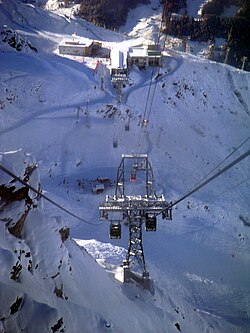
A funitel installation consists of two cables—or a single cable arranged in two loops—strung between two terminals and supported by intermediate towers. Unlike standard gondolas, a series of detachable passenger cabins are suspended from both cables simultaneously. These cables move in parallel at exactly the same rate, effectively "sandwiching" the cabin to prevent it from swinging.
This technology evolved from the Double Monocable Creissels (DMC) lift, developed by the French company Denis Creissels SA and manufactured by Poma in the 1980s. The DMC featured two monocables (cables that provide both support and propulsion) spaced about one meter apart. However, the cabins were hung underneath the cables using long hanger arms, which remained susceptible to wind-induced swinging.
In the 1990s, the modern funitel emerged. By spacing the cables far enough apart to hang the cabin between the cables rather than underneath them, engineers eliminated the need for long hanger arms, drastically increasing stability in strong winds.
Cable Synchronization and DLM
Early funitels utilized separate tensioning systems and separate, electrically synchronized motors for each cable. To simplify this, the Double-Loop Monocable (DLM) was developed. In a DLM system, a single cable is looped around twice. This mechanical arrangement ensures that the cable sections supporting the cabin move at the same speed without the need for complex electronic motor synchronization.
Historical Development and Global Implementation
The first official funitel was constructed in 1990 in Val-Thorens, France, through a collaboration between Denis Creissels SA, Enterprises Reel, and Städeli-Lift. While European development was prominent, a funitel-style lift appeared in the United States in 1988 at the June Mountain ski area near Mammoth Mountain, California, built by Yan Lift.
The Yan "QMC" design differed from European models by using a quad-monocable system with vertically aligned drive sheaves. However, this specific installation suffered from design flaws, most notably unsafe cable grips. Consequently, California safety inspectors shut the system down in 1996, and it was dismantled shortly thereafter.
The Mechanics of Detachment
Funitel cabins are connected to the overhead cables via four spring-loaded grips—two for each cable section. Like other detachable-carrier lifts, the cabins undergo a specific process at the terminals: they are decelerated and detached from the cables to allow passengers to board safely, then accelerated and reattached for the transit across the mountain.
Reversible Funitels
While most funitels operate in a continuous loop, reversible funitels operate similarly to aerial tramways, where cabins shuttle back and forth between stations rather than moving in a constant circle.
Poma produced an early reversible system in 1985 in Megève, France. Although originally called a DMC lift, it utilized the DLM configuration. In these systems, cabins do not detach from the cable during normal operation. A similar installation was created in 1993 at Montmorency Falls Park in Canada by Doppelmayr.
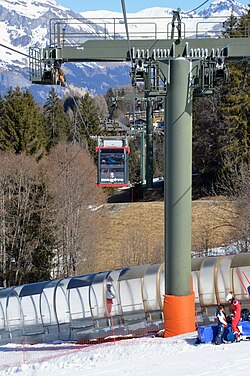
Later iterations of reversible funitels introduced grouped cabins. In 2002, Poma installed a system in Val Thorens featuring two groups of three smaller cabins shuttling back and forth. This concept was mirrored by Doppelmayr in Alpe d'Huez in 2004 and by the Swiss manufacturer Bartholet in Val Thorens in 2011.
Key Facts
- Stability: Cabins are suspended between two cables to eliminate the swinging caused by long hanger arms.
- DLM Technology: The Double-Loop Monocable uses one cable looped twice to ensure synchronized speed without electronic motors.
- Grip System: Each cabin uses four spring-loaded grips to maintain a secure connection to the parallel cables.
- First European Install: Val-Thorens, 1990.
- Reversible Operation: Some systems shuttle cabins back and forth rather than moving in a continuous loop.
| Type | Cable Arrangement | Cabin Movement | Key Characteristic |
|---|---|---|---|
| Standard Funitel | Two parallel cables / DLM | Continuous Loop | Detachable cabins for boarding |
| DMC (Early) | Two parallel monocables | Continuous Loop | Cabins hung underneath via arms |
| Reversible Funitel | Two parallel cables / DLM | Shuttle (Back-and-Forth) | Non-detachable cabins |
Frequently Asked Questions
What is the main advantage of a funitel over a standard gondola?
The primary advantage is wind stability. By suspending the cabin between two parallel cables instead of from a single cable with a long hanger arm, the funitel significantly reduces swinging in strong winds.
How does the Double-Loop Monocable (DLM) work?
The DLM system uses a single cable that is looped around the circuit twice. This ensures that the two cable sections supporting the cabin move at the exact same speed mechanically, removing the need for separate, synchronized motors.
What happened to the first funitel-style lift in the United States?
The Yan "QMC" lift at June Mountain, California, was shut down in 1996 by safety inspectors due to design flaws, specifically regarding the safety of the cable grips, and was subsequently dismantled.
Do all funitels use detachable cabins?
No. While standard funitels use detachable cabins to facilitate boarding at terminals, reversible funitels typically feature cabins that do not detach from the cable during normal operation.
Who were the primary developers of funitel technology?
The technology was largely developed by the French engineering company Denis Creissels SA and manufactured by Poma, with further contributions and similar systems built by Doppelmayr and Bartholet.