Detachable Chairlift History and Engineering Evolution
The evolution of the detachable chairlift revolutionized the ski industry by drastically reducing ride times and improving the loading experience for skiers and snowboarders. Unlike fixed-grip lifts, detachable chairlifts allow the carrier to disconnect from the main haul rope at terminals, slowing down for safe loading and unloading while maintaining high speeds on the mountain.
While the concept began with the Platter lift in 1908—where sticks detached from the cable during loading—the modern era of high-speed transport truly took shape in the late 20th century, primarily driven by competition between global engineering firms in North America and Europe.
Key Facts
- First Detachable Quad: The Quicksilver SuperChair, built by Doppelmayr in 1981 at Breckenridge, CO.
- Highest Lift in North America: The Imperial Express SuperChair at 12,840 feet.
- Grip Technology: Doppelmayr uses double-position grips, while Poma utilizes single-position grips.
- Speed Milestone: Poma's Green Mountain Express (1990) was the first to reach 1,100 feet per minute.
- Safety Evolution: The industry shifted from chain-driven contours to tire-driven systems for smoother transitions.
Doppelmayr: Pioneering the High-Speed Quad
Doppelmayr established a major milestone in 1981 with the installation of the Quicksilver SuperChair at Breckenridge, Colorado. This was the world's first detachable quad chair. After 38 seasons of service across Colorado and Quebec, this historic lift was finally dismantled in 2019.
The company's technical evolution is most evident in its grip systems—the mechanism that attaches the chair to the cable. Early models used the Spring Series (DS-104 and DS-108), which were succeeded in 1995 by the Torsion series (DT-104, DT-106, and DT-108). The Torsion grip remains the primary option today.
Doppelmayr employs a double-position grip design. As a chair enters the terminal, a metal strip pushes an angled roller to open the grip jaw, which remains open until it reattaches upon departure. Because grip force is measured just before reattachment, most Doppelmayr lifts can operate in reverse, allowing a failed grip to be backed into the terminal for inspection.
Terminal Evolution
Early terminals, such as those on the Quicksilver Quad, were fully enclosed and used chains for contours. By 1985, the CLD-260 terminal was introduced, followed by the UNI design in 1989. The progression continued with the UNI-M, and currently, the UNI-G and UNI-GS models are available, the latter of which debuted in 2003 at Gunstock Mountain Resort.
Poma: Innovation and Extremes
Poma entered the detachable quad market around 1985. Many of their early high-speed quads were known as Alpha Evolution lifts, characterized by Performance terminals with vault drives located underneath the structure. Over time, Poma integrated the bullwheel machinery directly into the main terminal to eliminate the need for external cabling.
Technologically, Poma differs from Doppelmayr by using single-position grips. These grips are pressed down to open the jaws for detachment and released to close them for attachment. This allows grip force to be measured as the chair travels through the contour. If insufficient force is detected, the lift stops before the chair reattaches. Consequently, most Poma lifts are not designed to operate in reverse.
Poma is also recognized for pushing the boundaries of lift installation. They built the Quicksilver Super6 (North America's only double loading chairlift), the Peak 8 SuperConnect (the first Colorado high-speed lift with a midway load), and the Imperial Express SuperChair, the highest lift in North America.
Other Major Contributors: CTEC and Yan
CTEC entered the detachable market in 1989 at Solitude Mountain Resort through a partnership with Von Roll, creating Utah's first detachable quad.
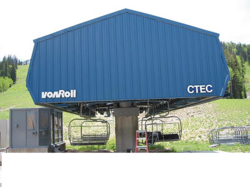
CTEC later partnered with Garaventa in 1990 before merging in 1992. Their combined technology was deployed at numerous resorts, including Deer Valley, Snowbird, and Palisades Tahoe, until they merged with Doppelmayr in 2002.
In contrast, Yan Lift (later Lift Engineering) took a different approach to grip design between 1987 and 1994. Their grips used a steel bar with V-shaped troughs and rubber springs, relying more on friction and gravity than raw clamping force. This design proved unstable, leading to frequent slipping. Following two fatal accidents—one at Sierra-at-Tahoe in 1993 and another at Whistler Blackcomb in 1995—Yan ceased detachable production and filed for bankruptcy in 1997.
Technical Comparison Summary
| Manufacturer | Grip Type | Grip Force Measurement | Reverse Operation | Notable Innovation |
|---|---|---|---|---|
| Doppelmayr | Double Position | Prior to reattachment | Generally Yes | First detachable quad (1981) |
| Poma | Single Position | During contour travel | Generally No | Highest lift in North America |
| CTEC/Garaventa | Various | Varies by partner | Varies | Early Utah detachable quads |
| Yan | Friction/Gravity | Low/Unstable | N/A | V-shaped trough grips |
Frequently Asked Questions
What is the difference between a detachable and a fixed-grip lift?
A detachable lift allows the chair to disconnect from the haul rope at the terminals, allowing it to slow down for passengers while the main cable continues at high speed. Fixed-grip lifts remain attached to the cable at all times, meaning they must move at a constant speed throughout the entire line.
Why can some lifts run in reverse while others cannot?
This depends on the grip design. Doppelmayr's double-position grips allow the lift to be reversed to bring a failed grip back into the terminal. Poma's single-position grips are designed to stop the lift before a failed grip reattaches to the rope, making reverse operation unnecessary for safety inspections.
What are "tire contours" in a lift terminal?
Contours are the mechanisms that accelerate or decelerate the chair as it attaches to or detaches from the cable. Early lifts used chains for this process, but the industry transitioned to rubber tires to provide a smoother, quieter transition for the passengers.
Which lift is the highest in North America?
The Imperial Express SuperChair, built by Poma at Breckenridge, is the highest lift in North America, reaching an elevation of 12,840 feet.
What happened to Yan Lift?
Yan Lift stopped producing detachable lifts after two fatal accidents caused by grip failures in 1993 and 1995. The company eventually filed for bankruptcy in 1997.