Frontier Airlines: Fleet Evolution and Operational Growth
Founded on February 8, 1994, Frontier Airlines has evolved from a regional player into a prominent Ultra Low-Cost Carrier (ULCC)—a business model that focuses on providing low base fares while charging for ancillary services. Headquartered in the United States and currently led by CEO James G. Dempsey, the airline has built a vast network serving 123 destinations across various countries and dependencies.
The airline's journey is marked by significant transitions in ownership and fleet strategy, moving from a mixed Boeing and Airbus fleet to a streamlined, all-Airbus operation designed for maximum efficiency.
Key Facts
- Founded: February 8, 1994.
- Fleet Size: 174 aircraft (as of May 2026).
- Parent Company: Indigo Partners (78% ownership).
- Primary Fleet: All-Airbus A320 family.
- Major Hub: Denver, Colorado (highest passenger volume).
- 2025 Revenue: US$ 3.724 billion.
Fleet Development and Modernization
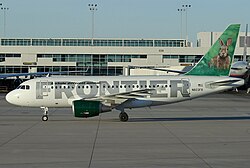
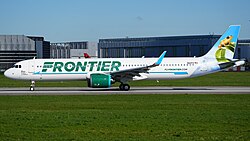
Frontier's fleet strategy has shifted toward the Airbus A320 family to reduce maintenance costs and improve fuel efficiency. The airline was notably the first operator of the Airbus A318. Over the last decade, Frontier has aggressively integrated "neo" (New Engine Option) aircraft, which offer better performance and lower emissions.
Current Fleet Composition
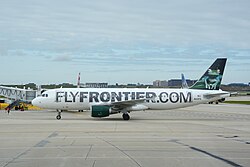
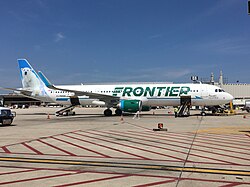
As of May 2026, Frontier operates a specialized fleet of 174 aircraft. The A320neo is the backbone of the operation, while the A321neo provides the highest passenger capacity per flight.
| Aircraft Type | In Service | Orders | Passenger Capacity |
|---|---|---|---|
| Airbus A320-200 | 6 | — | 180 |
| Airbus A320neo | 94 | 6 | 186 |
| Airbus A321-200 | 21 | — | 230 |
| Airbus A321neo | 62 | 136 | 240 |
Historical Fleet Transitions
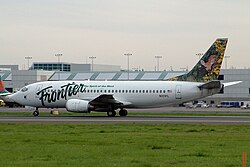
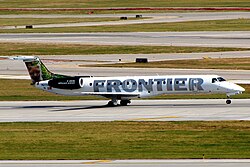
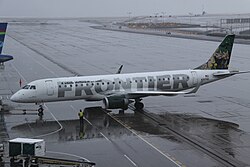
The airline's early years featured Boeing 737-200 and 737-300 aircraft, the latter of which were retired by 2005. Frontier also experimented with regional jets, including the Embraer ERJ-145 and E190, as well as the Bombardier CRJ series and De Havilland Canada Dash 8-400, before committing to its current all-Airbus strategy.
Operational Reach and Network
Frontier maintains several strategic operating bases to support its expansive route network. These include major hubs in Atlanta, Chicago (Midway and O'Hare), Dallas/Fort Worth, Las Vegas, Miami, Orlando, Philadelphia, Phoenix, San Juan, and Tampa.
![Countries and dependencies served by Frontier Airlines[124]](/images/62/17/621717ad681325cd3d338c96782972b24861b8a31c92fc79c5ca8c238a70891a.webp)
Top Destinations by Passenger Volume
Denver remains the airline's most critical hub, handling over 4 million passengers annually. Other high-traffic destinations include Orlando, Las Vegas, and Atlanta, reflecting the airline's focus on leisure and high-demand tourist corridors.
Financial Performance and Corporate Trends
Frontier's financial trajectory reflects the volatility of the aviation industry. While revenue grew steadily from US$ 1.317 billion in 2010 to a peak of US$ 3.775 billion in 2024, the airline faced severe challenges during the 2020 pandemic, resulting in a net loss of US$ 225 million that year.
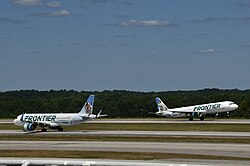
By 2025, the airline reported revenue of US$ 3.724 billion, though it faced a net income loss of US$ 137 million. Despite these fluctuations, the airline continues to expand its fleet, with A321neo deliveries scheduled to continue into 2031.
Frequently Asked Questions
What is the current fleet of Frontier Airlines?
As of May 2026, Frontier operates an all-Airbus A320 family fleet, consisting of the A320-200, A320neo, A321-200, and A321neo.
Who owns Frontier Airlines?
Frontier Airlines is 78% owned by Indigo Partners.
Which airport is Frontier's busiest hub?
Denver, Colorado, is the busiest origin airport for Frontier, serving over 4 million passengers annually.
What is the Frontier Miles program?
Frontier Miles is the airline's frequent-flyer program, which transitioned to a revenue-based loyalty model in late 2023.
When did Frontier stop using Boeing aircraft?
Frontier retired its last Boeing 737-300 in 2005 and its last Boeing 737-200 in 2006.