Frigatebirds: Masters of the Tropical Skies
The frigatebird is a large, slender seabird renowned for its extraordinary aerial capabilities and striking appearance. Found across the tropical oceans of the world, these birds are defined by their deep forked tails and immense wingspans, which allow them to glide effortlessly for vast distances. From their historical encounters with early explorers to their complex social structures, frigatebirds represent one of the most specialized avian families in the ocean environment.
Key Facts
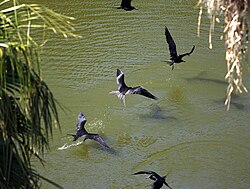
- Temporal Range: Present from the Early Eocene (approximately 50 million years ago) to the present.
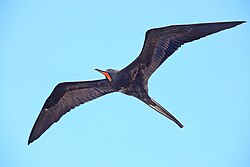
- Distinctive Silhouette: Known for a characteristic 'W' shape in flight due to their long wings and deeply forked tails.
- Sexual Dimorphism: Females are larger and up to 25% heavier than males.
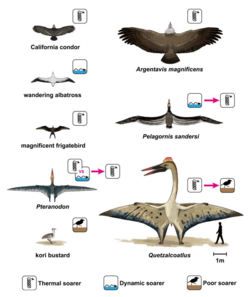
- Flight Style: They are thermal soarers, utilizing warm updrafts to remain airborne.
- Distribution: Restricted to tropical oceans; they are rare vagrants in temperate zones and absent from polar regions.
Taxonomy and History

The scientific classification of frigatebirds has evolved significantly since the 18th century. In 1758, Carl Linnaeus originally grouped them with cormorants, gannets, boobies, and pelicans under the genus Pelecanus. He identified their primary characteristics as a straight bill with a hooked tip, linear nostrils, a bare face, and fully webbed feet.
The dedicated genus Fregata was later introduced by French naturalist Bernard Germain de Lacépède in 1799. Historically, these birds have captured the imagination of mariners. Christopher Columbus noted them in 1492, referring to them as rabiforçado (forktail), while English sailors in the Caribbean dubbed them "Man-of-War birds."
The fossil record indicates a long evolutionary history, with species such as Limnofregata azygosternon dating back to the Eocene.

Species and Physical Characteristics

There are five recognized species of frigatebirds, all sharing a mostly black plumage and slender build. The magnificent frigatebird is the largest, reaching 114 cm in length, while the lesser frigatebird is the smallest at approximately 71 cm.
Their anatomy is perfectly adapted for soaring. Male wingspans can reach 2.3 meters, featuring eleven primary flight feathers. Their feet are totipalmate (all four toes connected by webbing), though the webbing is reduced and the feet are relatively weak, making them poorly suited for walking but efficient for their specific niche.
| Common Name | Scientific Name | Notable Characteristic |
|---|---|---|
| Magnificent Frigatebird | Fregata magnificens | Largest of the five species |
| Ascension Frigatebird | Fregata aquila | Vulnerable status; breeds on rocky outcrops |
| Christmas Frigatebird | Fregata andrewsi | Critically endangered |
| Great Frigatebird | Fregata minor | High mobility across Pacific islands |
| Lesser Frigatebird | Fregata ariel | Substantially smaller than other species |
Distribution and Aerial Behavior
Frigatebirds are primarily found over tropical oceans, where they rely on trade winds and warm updrafts under cumulus clouds to stay aloft. While adults are generally sedentary and remain near their breeding islands, they are capable of incredible journeys. One male great frigatebird was recorded traveling 4,400 km from Europa Island to the Maldives.
Young birds are even more dispersive, with some traveling up to 6,000 km. Despite this mobility, genetic testing suggests a strong fidelity to their hatching sites.
Ecology and Breeding
Frigatebirds are long-lived seabirds. Research on Tern Island in the Hawaiian Islands revealed that some great frigatebirds live well beyond 37 years, with at least one individual reaching 44 years of age.
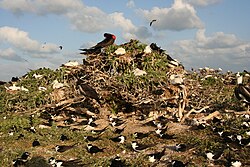
They typically breed in large colonies of up to 5,000 birds on remote oceanic islands, though they nest in smaller clusters of 10 to 30 individuals. Breeding is not tied to a specific month but is often triggered by the start of the dry season or an abundance of food.
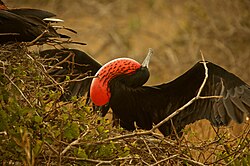
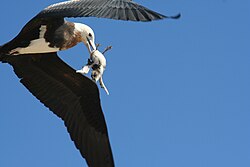
Their diet consists largely of flying fish and other marine life. Interestingly, they are also known for kleptoparasitism, a behavior where they steal food from other birds in flight.
Conservation Status
Currently, two of the five species face significant threats. The Christmas frigatebird is critically endangered, with a population estimated between 1,800 and 3,600 pairs. This decline is attributed to phosphate mining pollution and the loss of breeding habitat during World War II.
The Ascension frigatebird is listed as vulnerable. Its population was nearly wiped out on Ascension Island by feral cats introduced in 1815, forcing the birds to breed on offshore rocky outcrops. However, a cat eradication program between 2002 and 2004 has allowed some birds to return to the main island.
Frequently Asked Questions
Why are they called "Man-of-War" birds?
English mariners in the Caribbean gave them this name, likely due to their aggressive nature or their association with the tropical waters where Portuguese man-of-war jellyfish are found.
How do frigatebirds stay in the air for so long?
They are thermal soarers, meaning they use warm columns of rising air (thermals) to gain altitude and glide, which minimizes the energy required for flight.
What is the difference between male and female frigatebirds?
They exhibit marked sexual dimorphism; females are larger and heavier (up to 25% more) and typically possess white markings on their underparts.
Are frigatebirds endangered?
Two species are at risk: the Christmas frigatebird is critically endangered, and the Ascension frigatebird is considered vulnerable.
Do frigatebirds live in polar regions?
No, frigatebirds are found exclusively in tropical oceans and are not found in polar latitudes, though they occasionally appear as rare vagrants in temperate regions.