Free Kicks in Football: Rules, Types, and History
In association football, a free kick is a fundamental method of restarting play. Awarded after a team commits an infringement of the laws, it serves as both a penalty for the offending side and an opportunity for the non-offending team to regain possession and potentially score.
Key Facts
- Two Main Types: Free kicks are categorized as either direct or indirect.
- Distance Requirement: Opponents must generally remain at least 9.15 meters (10 yards) away from the ball.
- Direct Scoring: A goal can be scored directly from a direct free kick, but not from an indirect one.
- Location: Kicks are typically taken from the spot where the infringement occurred.
- All-Time Record: Marcelinho Carioca holds the record for the most free kick goals with 78.
Direct vs. Indirect Free Kicks
The primary distinction between the two types of free kicks is whether a goal can be scored immediately from the strike without the ball touching another player.
Direct Free Kicks
A direct free kick allows the attacking team to score a goal directly. If the ball enters the opponents' goal, a goal is awarded. However, if the ball enters the kicker's own goal, a corner-kick is awarded to the opposing team.
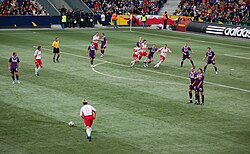
Indirect Free Kicks
An indirect free kick requires the ball to touch another player (of either team) before a goal can be scored. If the ball goes directly into the opponents' goal without touching anyone else, a goal-kick is awarded. If it goes directly into the kicker's own goal, a corner-kick is awarded.
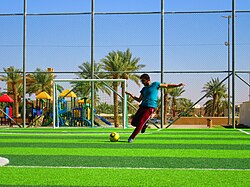
Procedure and Regulations
To ensure fairness, specific procedures govern how a free kick is executed and defended.
Location and Signal
The kick is taken from the place where the infringement happened. Referees use specific signals to indicate whether the kick is direct or indirect.
The Defensive Wall and Distance
Opponents must stay at least 9.15 meters (10 yards) from the ball. If a defender is too close, the kick is retaken unless the attacking team chooses a quick free kick. Defenders may be cautioned with a yellow card for failing to retreat or for deliberately blocking a quick restart.
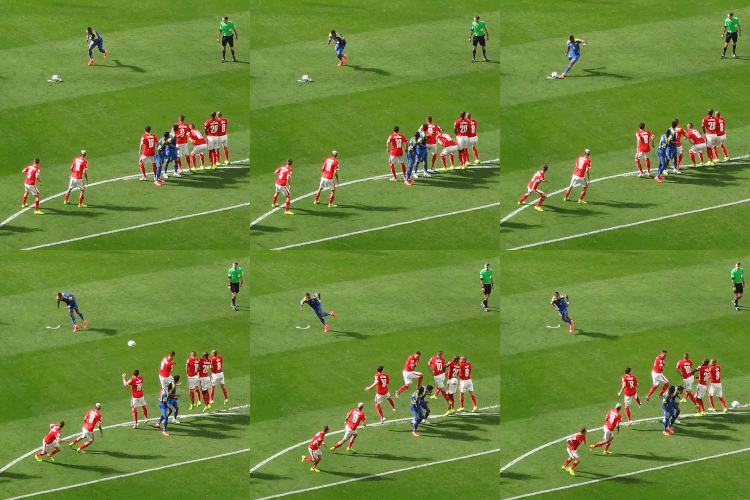
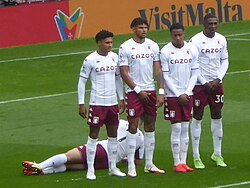
Defending teams often form a "wall" of players to block the direct path to the goal. Some teams employ specific strategies, such as placing a player on the ground behind the wall to prevent low shots from sneaking through.
In recent years, officials have used vanishing spray to mark the minimum distance for defenders, ensuring they do not encroach on the 10-yard limit.
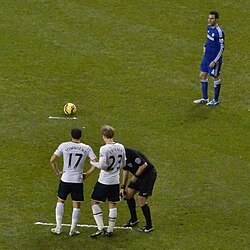
Strategic Execution
Attacking teams often use deception to confuse the defense. This may include having several players line up for the kick to mask who will actually take it, or using feints to move the wall.
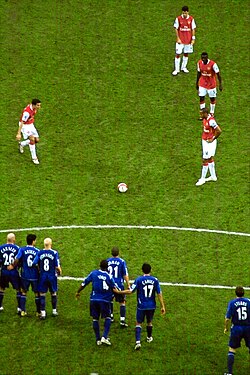
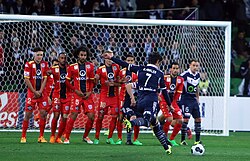
Infringements and Sanctions
Different fouls result in different types of free kicks. The severity and nature of the contact usually determine the award.
Offences Resulting in Direct Free Kicks
- Handball (except for the goalkeeper in their own penalty area).
- Physical fouls: kicking, tripping, jumping at, charging, pushing, or striking an opponent.
- Holding or impeding an opponent with physical contact.
- Biting, spitting, or throwing objects at the ball, opponents, or officials.
- Interfering with play after entering the field without permission.
Offences Resulting in Indirect Free Kicks
- Offside violations.
- Illegal handling of the ball by the goalkeeper within their own penalty area.
- Preventing the goalkeeper from releasing the ball or kicking it during the release process.
- Playing in a dangerous manner (without a more serious foul).
- Impeding an opponent's progress without physical contact.
- Dissent, offensive language, or abusive gestures.
- Technical errors during penalty kicks, such as the kicker feinting after the run-up is complete or a teammate taking the kick.
Historical Evolution
The concept of the free kick has evolved significantly since the early days of organized football. In the mid-19th century, free kicks were often awarded for a "fair catch" or after a "touch-down." Early codes, such as those from Rugby School (1845) and Cambridge (1856), established the foundation for these restarts.
The Football Association (FA) published its original laws in December 1863. Over the following century, rules were refined regarding the distance opponents must keep and the conditions under which a goal could be scored directly. For instance, the 10-yard distance rule was standardized in 1913.
| Date | Direct Goal (Attacking) | Direct Goal (Own) | Min. Distance (Opponents) | Double-Touch Remedy |
|---|---|---|---|---|
| 1863 | Yes | N/A | Not specified | N/A |
| 1872 | No | Not specified | Not specified | Yes |
| 1905 | Direct only | N/A | 6 yards (5.5m) | Indirect free kick |
| 1913 | Direct only | N/A | 10 yards (9.15m) | Indirect free kick |
| 1965 | Yes | Yes | 10 yards (9.15m) | Indirect free kick |
All-Time Leading Free Kick Scorers
Certain players have mastered the art of the direct free kick, turning these restarts into high-probability scoring opportunities.
| Rank | Player | Years | Goals |
|---|---|---|---|
| 1 | Marcelinho Carioca | 1988–2012 | 78 |
| 2 | Jair | 1938–1963 | 74 |
| 3 | Roberto Dinamite | 1971–1993 | 73 |
| 4 | Juninho Pernambucano | 1993–2013 | 72 |
| 5 | Lionel Messi | 2004–present | (Listed) |
Frequently Asked Questions
What happens if a defender is too close to the ball during a free kick?
If an opponent is less than 9.15 meters (10 yards) from the ball, the kick is typically retaken. However, if the attacking team takes a quick free kick before the defenders have time to retreat, the play continues.
Can a goal be scored directly from an indirect free kick?
No. For a goal to be awarded from an indirect free kick, the ball must touch another player before entering the goal. If it goes in directly, a goal-kick is awarded to the opposing team.
What is the difference between a direct free kick and a penalty kick?
While both allow for a direct shot on goal, a penalty kick is a specific type of direct free kick awarded when a direct-free-kick offense is committed by a player inside their own penalty area.
Why do players form a "wall" during free kicks?
The wall is a defensive strategy used to block the most direct path to the goal, forcing the kicker to attempt to curl the ball around the players or shoot over them.
What is a "quick free kick"?
A quick free kick is when the attacking team restarts play immediately after an infringement, without waiting for the referee's whistle or for the opposing team to retreat the required 10 yards.