Free Jazz: The Evolution of Avant-Garde Improvisation
Free jazz, also referred to as free form jazz, is a bold style of avant-garde jazz that emerged in the late 1950s and early 1960s. It represents an experimental approach to improvisation where musicians consciously sought to dismantle traditional jazz conventions. By breaking away from regular tempos, fixed tones, and predictable chord changes, these artists aimed to transcend the perceived limitations of bebop and modal jazz to create a new musical language.
The movement took its name from Ornette Coleman's seminal 1960 recording, Free Jazz: A Collective Improvisation. While the term is standard in the United States, musicians in Europe often prefer the term free improvisation. Other descriptors used to categorize this expansive style include "creative music," "art music," and "modern jazz."
Key Facts
- Origins: Developed in the United States during the late 1950s.
- Core Philosophy: Rejection of fixed song forms, regular meters, and pre-established chord changes.
- Key Pioneers: Ornette Coleman, Cecil Taylor, John Coltrane, and Sun Ra.
- Social Context: Deeply linked to the American Civil Rights Movement and the experience of Black Americans.
- Legacy: Influenced diverse genres including no wave, post-rock, and loft jazz.
Defining Characteristics of Free Jazz
Traditional jazz typically relies on a structured framework, such as the 12-bar blues or the 32-bar AABA popular song form. Free jazz eliminates this dependence on fixed forms, significantly increasing the role of spontaneous improvisation.
Rhythmically, the genre departs from the regular 4/4 or 3/4 meters common in other jazz styles. While free jazz often retains a sense of pulsation or "swing," it avoids a rigid meter. Instead, musicians frequently use accelerando (speeding up) and ritardando (slowing down) to create a wave-like rhythmic feel.
Initially, critics dismissed the abandonment of these elements as a lack of technical skill. However, by 1974, the genre had established a significant body of critical literature and academic respect.
The Social and Political Dimension
Many historians and critics view free jazz as more than a musical experiment; they see it as a reflection of the social tensions of the 1950s and 60s. The pursuit of musical "freedom" mirrored the struggle for racial integration and the goals of the civil rights movement.
Key historical milestones, such as the 1954 Brown v. Board of Education decision, the 1961 Freedom Riders, and the 1963 Freedom Summer, are often cited as political parallels to the music. In this context, free jazz is interpreted as a musical reaction to the oppression experienced by Black Americans.
Historical Development and Key Figures
Proto-Free Jazz and Early Experiments
While the movement peaked in the 60s, earlier works hinted at its arrival. In the late 1940s, Lennie Tristano explored atonal collective improvisation in pieces like "Intuition." Other early examples include Bob Graettinger's 1948 City of Glass and Jimmy Giuffre's 1953 "Fugue," though these are sometimes categorized as third stream jazz due to their use of classical techniques like serialism.
Ornette Coleman: The Catalyst
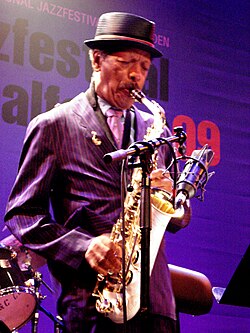
Ornette Coleman was pivotal in rejecting pre-written chord changes, arguing that improvised melodic lines should dictate harmonic progression. His 1958 recordings, Tomorrow Is the Question! and Something Else!!!!, began this departure. However, his move to New York and signing with Atlantic Records accelerated the movement. His 1960 album Free Jazz, featuring a double quartet, introduced a cacophonous, aggressive texture that defined the era.
Cecil Taylor and the Avant-Garde Piano
Classically trained pianist Cecil Taylor brought a different approach, influenced by Thelonious Monk and Horace Silver. By the early 1960s, collaborating with Jimmy Lyons and Sunny Murray, Taylor embraced tone clusters (groups of adjacent notes played together) and abstracted rhythms. His 1966 album Unit Structures abandoned notated scores and conventional meter, and he later experimented with prepared pianos (pianos with objects placed on the strings), a technique developed by John Cage.
John Coltrane's Exploration
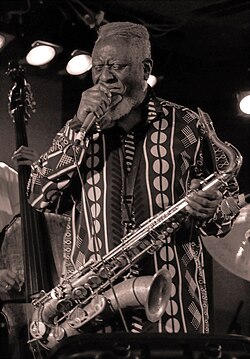
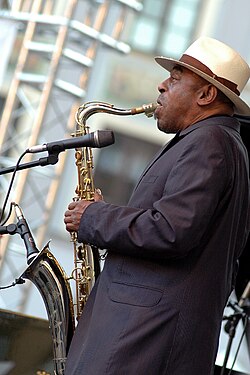
John Coltrane, while rooted in modal jazz and post-bop, was heavily influenced by Coleman. His 1965 recording Ascension is a landmark of free jazz, utilizing a large ensemble of horn players to create sections of collective improvisation. Coltrane also explored multiphonic tones (producing multiple notes at once) through over-blowing his instrument.
Sun Ra and Cosmic Instrumentation
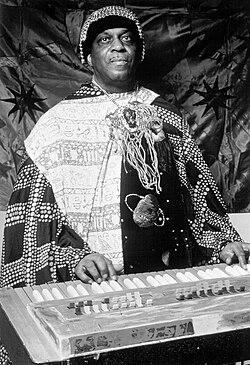
Sun Ra blended free jazz with a unique brand of mysticism. While he claimed his music was written, his 1965 works The Heliocentric Worlds of Sun Ra and The Magic City emphasized timbre and texture over harmony. He was a pioneer in using electronic instruments, including the Hammond B-3, electric celeste, and bass marimba.
Regional Scenes and Global Influence
Beyond New York, free jazz flourished in various American cities through artist collectives:
- Chicago: The Association for the Advancement of Creative Musicians (founded 1965).
- St. Louis: The Black Artists Group (active 1968–1972).
- Los Angeles: The Pan Afrikan Peoples Arkestra and Union of God's Musicians and Artists Ascension.
- Cleveland: A scene featuring the Black Unity Trio, Charles Tyler, and Norman Howard.
By the 1970s, the movement evolved into loft jazz in New York City, where musicians performed in private homes and unconventional spaces. During this period, free jazz began integrating elements of pop and world music, moving away from a strict rejection of tonality.

Summary of Free Jazz Evolution
| Feature | Traditional/Bebop Jazz | Free Jazz |
|---|---|---|
| Structure | Fixed forms (e.g., 12-bar blues) | Open, improvised forms |
| Harmony | Pre-established chord changes | Atonal or melody-driven harmony |
| Rhythm | Regular meter (4/4, 3/4) | Fluid pulsation, wave-like tempo |
| Instrumentation | Standard jazz ensembles | Expanded; includes electronics |
Frequently Asked Questions
What exactly makes jazz "free"?
Jazz is considered "free" when it removes the traditional constraints of the genre, specifically the reliance on fixed chord progressions, steady meters, and predetermined song structures, allowing the musicians to improvise with total autonomy.
Who is credited with naming the genre?
The term was derived from Ornette Coleman's 1960 album titled Free Jazz: A Collective Improvisation.
How did the Civil Rights Movement influence free jazz?
The music is often viewed as a sonic manifestation of the struggle for freedom and equality. The rejection of musical "rules" mirrored the social rejection of oppressive racial structures in the United States during the 1950s and 60s.
What is the difference between free jazz and free improvisation?
While often used interchangeably, "free jazz" is the term more common in the U.S., whereas "free improvisation" is the preferred term among European musicians.
What is "loft jazz"?
Loft jazz refers to a period in the 1970s when avant-garde musicians in New York City moved their performances into private lofts and unconventional spaces, often blending free jazz with other genres like world music.