François Rabelais: The Giant of Renaissance Humanism and Satire
François Rabelais was a polymath of the French Renaissance whose influence on literature remains profound. Often hailed as the first great French prose author, Rabelais navigated a complex life as a humanist—a scholar focused on the study of classical Greek and Roman texts—physician, diplomat, and Catholic priest. While his contemporaries knew him primarily for his medical expertise and scholarship, history remembers him as a master satirist who used grotesque imagery and larger-than-life characters to critique the society of his time.
Key Facts
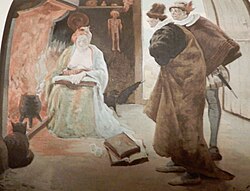
- Lifespan: Born between 1483 and 1494; died by March 14, 1553.
- Primary Works: The series Gargantua and Pantagruel.
- Education: Studied at the Universities of Poitiers and Montpellier.
- Professional Roles: Physician, Catholic priest, and Master of Requests.
- Literary Impact: Credited with adding over 800 words to the French language.
Early Life and Monastic Transitions
Born in Seuilly, Touraine, Rabelais was the son of Antoine Rabelais, a lawyer and seneschal. His early education followed the traditional medieval path: the trivium (grammar, rhetoric, and dialectic) followed by the quadrivium (arithmetic, geometry, music, and astronomy). While some traditions suggest he began as a Franciscan novice, he later joined the Benedictine Order at Maillezais after obtaining a special permission (indult) from Pope Clement VII.
Rabelais' passion for Greek scholarship often put him at odds with the religious authorities. In 1523, the Sorbonne banned the study of Greek to prevent personal interpretations of the New Testament, leading to the confiscation of Rabelais' books. This tension with the church continued throughout his life, as he briefly became an apostate after leaving his monastery without authorization in 1527, though he was later absolved by Pope Paul III in 1536.
Medical Career and Academic Fame
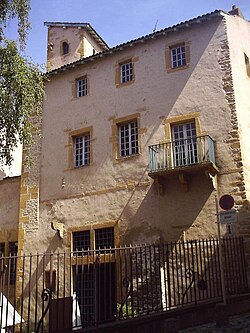
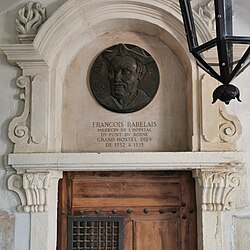
Rabelais pursued medical studies at the University of Poitiers and the University of Montpellier. By 1532, he was practicing as a doctor at the Hôtel-Dieu de Lyon, a major intellectual hub of the Renaissance. During this period, he collaborated with the printer Sebastian Gryphius to edit and translate the works of medical authorities such as Hippocrates and Galen.
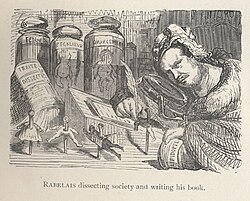
He officially obtained his doctorate in medicine in May 1537. Rabelais gained significant European fame for his scholarship and his daring approach to medical education, which included performing anatomy lessons using the corpses of executed criminals.
Diplomacy and Political Survival
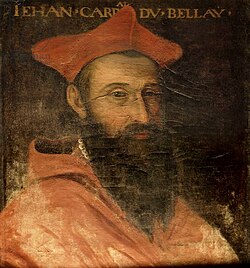
Rabelais' life was marked by a precarious balance between royal favor and ecclesiastical condemnation. Under the protection of Jean du Bellay, he traveled to Rome three times on diplomatic missions for King Francis I. These connections were vital, as his literary works were frequently targeted by the Sorbonne, the theological college of the University of Paris.
Despite the condemnation of Gargantua and Pantagruel in 1543, Rabelais continued to find support from the crown. He served as a Master of Requests in June 1543 and later lived in the free imperial city of Metz to avoid persecution. In his final years, he served as the curate of Meudon and Saint-Christophe-du-Jambet.
Literary Legacy: Gargantua and Pantagruel
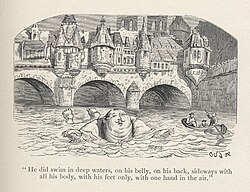
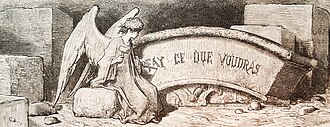
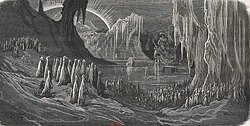
Rabelais is best known for his series of novels featuring the giants Gargantua and Pantagruel. These works are characterized by a blend of high-minded humanist philosophy and bawdy, grotesque humor. A central concept in his work is the Abbey of Thélème, a utopian community governed by the single, simple rule: "Do what you want."
His writing style was revolutionary, utilizing a mix of Latin, Greek, regional dialects, and neologisms (newly coined words). His fascination with the human body—specifically its functions and excretions—served as a vehicle for social and religious satire.
Summary of Major Works
| Work | Publication Date | Description |
|---|---|---|
| Pantagruel | 1532 | The first book of the giant series. |
| Gargantua | 1534 | A satirical look at education and society. |
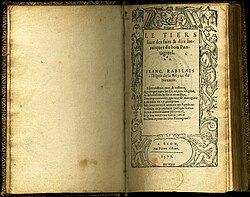
| The Third Book | 1546 | Banned by the Sorbonne on December 31, 1546. |
| The Fourth Book | 1552 | Published under royal privilege despite opposition. |
| The Fifth Book | 1564 | Posthumous publication; authorship is contested. |
| Pantagrueline Prognostication | 1532–1542 | A series of parodic astrological almanacs. |
Frequently Asked Questions
When was François Rabelais born?
The exact date is unknown, but scholars generally accept 1483 as the most likely birth year, though some theories suggest dates between 1483 and 1494.
Why were Rabelais' books banned?
His works were condemned by the Sorbonne because they were seen as provocative, utilizing satire and grotesque imagery that challenged the religious and academic hierarchy of the time.
What was the "Abbey of Thélème"?
It is a fictional utopian abbey in Rabelais' writing where the inhabitants live by the philosophy of "Do what you want," representing a humanist ideal of freedom and nobility.
How did Rabelais influence the French language?
Rabelais was a linguistic innovator who used neologisms, puns, and dialectal terms. It is estimated that his novel Gargantua alone added more than 800 words to the French language.
What was Rabelais' professional background outside of writing?
He was a highly educated physician who practiced at the Hôtel-Dieu de Lyon, a Catholic priest, and a diplomat who served the interests of King Francis I.