The School for Wives: Molière's Masterpiece of Comedy and Control
First staged on December 26, 1662, at the Palais Royal theatre for the brother of the King, The School for Wives (French: L'école des femmes) stands as one of the most significant achievements of the 17th-century French playwright Molière. The play is a sharp theatrical comedy that examines the intersection of control, innocence, and the unpredictability of love.
At its core, the story follows a man so intimidated by the perceived nature of femininity that he attempts to engineer a perfect, submissive wife through total ignorance. This bold approach to controversial social issues caused a public outcry upon its release, establishing Molière as a fearless dramatist. In June 1663, he responded to the controversy with a follow-up piece, La Critique de L'École des femmes, which offered a meta-commentary on his unique comedic style.
Key Facts
- Author: Molière, a leading 17th-century French playwright.
- Premiere: December 26, 1662, at the Palais Royal theatre.
- Core Theme: The futility of attempting to control another person's nature and emotions.
- Literary Origin: Inspired by María de Zayas y Sotomayor's Spanish novella El prevenido engañado (1637).
- Legacy: Shifted comedy from fantastical plots to realistic characters and situations.
Literary Origins and Inspiration
Molière did not create the plot of The School for Wives in a vacuum. He drew inspiration from the Spanish novella El prevenido engañado (1637) by María de Zayas y Sotomayor. This work had been translated into French and adapted by Paul Scarron in 1655 as La Précaution inutile, and again by Antoine Le Métel d'Ouville in 1656 under the same title.
While Molière used very few verbatim phrases from these translations, he adopted the central premise: a man who believes that wit makes women frivolous and unfaithful. To prevent being deceived, he raises a young girl in complete ignorance of the world, only to find that his precautions are ultimately useless.
Characters and Setting
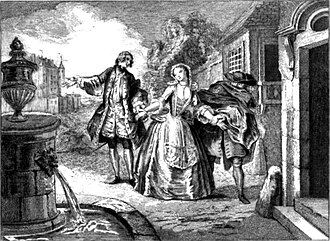
The play is set in a square within a provincial town and features a cast of characters caught in a web of deception and desire:
- Arnolphe: A bachelor who uses the alias Monsieur de la Souche; he is the protagonist obsessed with controlling his ward.
- Agnès: Arnolphe's innocent teenage ward.
- Horace: A young man who falls in love with Agnès.
- Chrysalde: A friend of Arnolphe who warns him against his schemes.
- Oronte: A friend of Arnolphe and the father of Horace.
- Enrique: Chrysalde's brother-in-law and the biological father of Agnès.
- Alain and Georgette: Peasant servants to Arnolphe.
Plot Summary
Arnolphe has groomed Agnès since she was four years old, keeping her in a nunnery until the age of 17 to ensure she remained ignorant of the world. His goal is to marry her once she is an adult, believing that her lack of education will make her too naive to ever be unfaithful.
Despite warnings from his friend Chrysalde, Arnolphe proceeds with his plan. However, the arrival of Horace, the son of Oronte, disrupts everything. Unaware that Arnolphe and "Monsieur de la Souche" are the same person, Horace confides in Arnolphe that he has been visiting Agnès in secret. This leads Arnolphe to attempt to outmaneuver the young man to secure Agnès's hand in marriage.
As the play progresses, Arnolphe's frustration grows. A critical misunderstanding occurs where Arnolphe believes Agnès has agreed to marry him, while Agnès believes Arnolphe has given her permission to marry Horace. The conflict reaches a climax in the final act when Oronte and Enrique arrive. They reveal that Horace is to marry Enrique's daughter—who is revealed to be Agnès—rendering Arnolphe's lifelong schemes entirely futile.
Reception and Artistic Significance
In the Parisian theatre scene, The School for Wives was a sensation. At the time, the intellectual elite viewed comedy as a minor genre lacking dignity. Molière revolutionized the form by replacing fantastical plots with realism—situations and individuals that mirrored real life. He famously believed that the goal of the stage was to make the audience recognize themselves in the characters.
The characters are noted for their complexity. While they often possess one dominant trait for dramatic effect, they maintain an underlying ambiguity. This is most evident in Agnès; her silence and perceived innocence leave audiences questioning how much she truly understands about the games being played around her.
| Category | Details |
|---|---|
| Genre | Theatrical Comedy |
| Original Language | French |
| Primary Conflict | Arnolphe's control vs. Agnès's emerging autonomy |
| Key Adaptation | Based on El prevenido engañado |
| Setting | Provincial town square |
Modern Productions and Recordings
The play continues to be performed and adapted globally. Notable 20th-century productions include:
- 1947: Staged by Compagnie Jouvet at the first Edinburgh International Festival.
- 1948: A Scots translation titled Let Wives Tak Tent by Robert Kemp at the Gateway Theatre.
- 1951: A French-language Broadway production featuring Louis Jouvet.
- 1971: A Broadway production at the Lyceum Theatre using Richard Wilbur's translation.
- 1983: A Swedish TV production directed by Ingmar Bergman.
- 1995: A production by the National Asian American Theater Company.
Audio adaptations have also preserved the work, including a 1965 production by Daniel Bernet and a 2009 L.A. Theatre Works recording featuring William Brown and Judy Greer.
Frequently Asked Questions
What is the main theme of The School for Wives?
The main theme is the futility of trying to control another person's will and emotions through ignorance and manipulation. It satirizes the idea that a woman's virtue can be manufactured by denying her an education.
Who inspired Molière to write the play?
Molière was inspired by a Spanish novella titled El prevenido engañado (1637) by María de Zayas y Sotomayor, which he accessed through French translations by Paul Scarron and Antoine Le Métel d'Ouville.
Why was the play controversial in the 17th century?
The play raised a public outcry because it dealt with controversial social issues and challenged the norms of the time, establishing Molière as a bold playwright who pushed the boundaries of the comedy genre.
Who is Monsieur de la Souche?
Monsieur de la Souche is the noble-sounding alias used by the protagonist, Arnolphe, to hide his true identity from those around him, including Horace.
How did Molière change the nature of comedy?
Molière moved comedy away from fantastical, unrealistic plots and toward realism, creating characters and situations that allowed the contemporary audience to see reflections of their own lives on stage.