Foreign Affairs: A Century of Shaping Global Diplomacy
For over a hundred years, Foreign Affairs has served as a premier forum for the analysis of international relations. Published by the Council on Foreign Relations (CFR), the journal has evolved from a niche quarterly for diplomats and scholars into a globally recognized publication that often previews and shapes the trajectory of United States foreign policy.
The Origins of the Council and the Journal
The Council on Foreign Relations was established in the summer of 1921. Its founding membership consisted primarily of lawyers, scholars, financiers, and diplomats. According to its founding charter, the Council's mission was to provide a "continuous conference on international questions affecting the United States" by uniting experts from science, education, industry, finance, and statecraft.
While the Council initially focused on small discussion groups and private meetings, it sought a broader reach in 1922. On September 15, 1922, the Council launched Foreign Affairs as a quarterly publication. The journal succeeded the Journal of International Relations (1910–1922), which had previously succeeded the Journal of Race Development (1911–1919), a title that reflected the era's concerns regarding race tensions and the stability of global empires.
The journal's early identity was shaped by Professor Archibald Cary Coolidge of Harvard University, its first editor. Because Coolidge remained in Boston, Hamilton Fish Armstrong served as the New York-based managing editor, overseeing daily operations. Armstrong is credited with choosing the magazine's signature light blue cover, while his sisters, Margaret and Helen, designed the lettering and logo.
Early Influence and the Interwar Period (1922–1945)
From its inception, the journal featured voices of significant political weight. The very first issue included a lead article by Elihu Root, a former secretary of state under Theodore Roosevelt, who argued that the American public needed to be better informed as the United States emerged as a world power. John Foster Dulles, who later became secretary of state under Dwight D. Eisenhower, also contributed to the inaugural issue, focusing on Allied debt after World War I.
The publication also provided a platform for diverse intellectual perspectives. In 1925, the prominent African American intellectual W. E. B. Du Bois published a series titled "Worlds of Color," focusing on imperialism and race. While female contributors were rare in the early years, the late 1930s saw contributions from Time magazine journalist Dorothy Thompson.
The Cold War Era and Strategic Doctrines (1945–1991)
The prominence of Foreign Affairs peaked following World War II, as the United States assumed a central role in global politics. The journal became a vehicle for defining the strategic frameworks of the Cold War.
One of the most pivotal moments in the journal's history was the publication of George F. Kennan's reworking of his "Long Telegram." This piece introduced the doctrine of containment—the strategic policy of preventing the spread of Soviet influence—which became the cornerstone of American Cold War strategy.
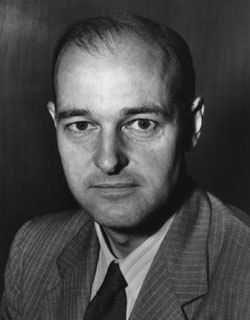
Other influential contributions included a 1950 article by Louis Halle titled "On a Certain Impatience with Latin America." Halle's work established an anticommunist intellectual framework that shifted U.S. policy away from encouraging democracy in postwar Latin America, later serving as a justification for U.S. efforts to overthrow the left-leaning government in Guatemala.
The journal's prestige is further evidenced by the fact that eleven U.S. secretaries of state have authored essays within its pages.
Modern Era and Digital Evolution (1991–Present)
Following the Cold War and the events of September 11, 2001, the journal's readership expanded significantly. By April 2021, the print magazine reached 303,000 readers, while its website attracted 1.2 million unique monthly visitors.
In the Summer 1993 issue, Samuel P. Huntington published "Clash of Civilizations?", arguing that future global conflicts would be driven by cultural divisions rather than ideological or economic differences.
The journal has not been without controversy. In 2003, a review by Kenneth Maxwell regarding Peter Kornbluh's book The Pinochet File sparked a dispute over Henry Kissinger's ties to the regime of Chilean dictator Augusto Pinochet. Maxwell alleged that CFR members pressured editor James Hoge to allow William D. Rogers, an associate of Kissinger, to have the final word in the exchange, bypassing standard editorial policy.
International tensions have also played out in the journal's pages. In 2007, former Ukrainian Prime Minister Yulia Tymoshenko published "Containing Russia," accusing Vladimir Putin of expansionism. While Russian Foreign Minister Sergei Lavrov attempted to respond, he ultimately withdrew his article, citing editorial censorship.
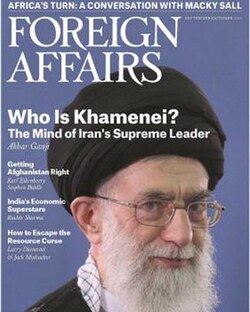
To modernize its reach, the Council launched ForeignAffairs.com in 2009. In early 2013, the magazine underwent a redesign to appeal beyond the foreign policy establishment, introducing cover photographs and extensive interviews with leading newsmakers.
Key Facts
- Founded: The Council on Foreign Relations was founded in 1921; the journal launched on September 15, 1922.
- Core Purpose: To provide a continuous conference on international questions affecting the United States.
- Defining Publication: George F. Kennan's doctrine of containment was publicized here, shaping Cold War policy.
- Reach: As of April 2021, the website sees 1.2 million unique monthly visitors.
- Notable Contributors: Eleven U.S. secretaries of state have written for the publication.
| Year | Event/Milestone | Significance |
|---|---|---|
| 1922 | First Issue Published | Established the journal as a quarterly for international relations. |
| 1947 | Kennan's Containment Piece | Defined the U.S. strategic approach to the Cold War. |
| 1993 | "Clash of Civilizations?" | Proposed cultural identity as the primary source of global conflict. |
| 2009 | Launch of ForeignAffairs.com | Expanded content delivery to a digital-first audience. |
| 2013 | Visual Redesign | Introduced cover images and newsmaker interviews to broaden appeal. |
Frequently Asked Questions
Who founded Foreign Affairs?
The journal was established by the Council on Foreign Relations (CFR), which was founded in 1921 by a group of diplomats, financiers, scholars, and lawyers.
What is the "doctrine of containment"?
Publicized by George F. Kennan in the July 1947 issue of Foreign Affairs, the doctrine of containment was the strategic policy of preventing the expansion of Soviet influence during the Cold War.
How has the journal's format changed over time?
Originally a quarterly print magazine with a plain light blue cover, it launched a comprehensive website in 2009 and transitioned to using cover photographs and high-profile interviews in 2013.
Who was the first editor of Foreign Affairs?
Professor Archibald Cary Coolidge of Harvard University was the first editor, while Hamilton Fish Armstrong served as the managing editor in New York.
What was the "Clash of Civilizations" theory?
Proposed by Samuel P. Huntington in 1993, this theory argued that the primary source of conflict in the post-Cold War world would be cultural rather than economic or ideological.