Football Laws of the Game: Official Rules and Regulations
Association football is governed by a structured set of regulations known as the Laws of the Game. These seventeen laws provide the essential stipulations and guidelines that ensure consistency across all levels of play, regardless of gender. While the laws are designed for universal application, modifications are permitted for specific groups, including juniors, seniors, and individuals with physical disabilities. The broad framing of these laws allows referees the flexibility to apply them based on the specific nature of a match.
Although published by FIFA, the Laws of the Game are maintained by the International Football Association Board (IFAB). While most of the world adheres to these standards, some variations exist; for example, the NCAA and NFHS in the United States utilize rulesets that differ from the IFAB Laws.
Key Facts
- Governing Body: Maintained by IFAB and published by FIFA.
- Team Size: Maximum of 11 players per team, with a typical minimum of 7 to start a match.
- Match Duration: Two 45-minute halves, totaling 90 minutes of ordinary time.
- Standard Ball: Spherical, weighing 410–450g with a circumference of 68–70cm.
- Officiating: Led by a referee with final authority, assisted by two assistant referees and often a fourth official.
- Technology: Goal-line technology and Video Assistant Referees (VAR) are used in high-level matches to correct clear errors.
Players, Equipment, and Officials
A standard team consists of up to eleven players, including one mandatory goalkeeper. The goalkeeper is the only player permitted to use their hands or arms, provided they remain within their own penalty area. While coaches employ various strategic positions for outfield players, these roles are not formally defined by the Laws.
Player kits must include a shirt, shorts, socks, footwear, and shin guards. For safety, jewelry and watches are forbidden. Goalkeepers must wear colors that distinguish them from other players and match officials. Medical professionals also recommend athletic supporters with protective cups for male players, and optional headgear is permitted for injury prevention.
Substitutions allow teams to replace players due to injury, fatigue, or tactical needs. In most professional leagues, five substitutions are allowed per 90 minutes, with an additional substitution permitted if the game enters extra time. Once substituted, a player typically cannot return to the match.
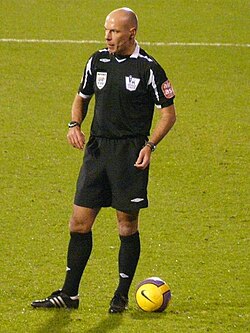
The match is managed by a referee who holds full authority to enforce the laws. They are supported by two assistant referees and a fourth official. To minimize controversy, high-level games employ goal-line technology and Video Assistant Referees (VAR). VAR is used to review four specific scenarios: mistaken identity in card issuance, goal violations, direct red card decisions, and penalty decisions.
The Ball and the Pitch
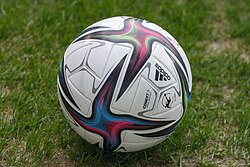
The modern football is synthetic and spherical, with a weight between 410 and 450 grams and a circumference of 68 to 70 cm. It is inflated to a pressure of 0.6 to 1.1 standard atmospheres at sea level.
The pitch is a rectangular field. For international adult matches, the length ranges from 100–110 meters and the width from 64–75 meters. Non-international pitches offer more flexibility (90–120m length and 45–90m width), provided the field does not become square.

The boundaries consist of touchlines (long sides) and goal lines (short sides). A goal is centered on each goal line, measuring 7.32 meters wide and 2.44 meters high. The penalty area extends 16.5 meters from the goalposts and into the pitch, serving as the zone where goalkeepers can handle the ball and where certain fouls result in a penalty kick.

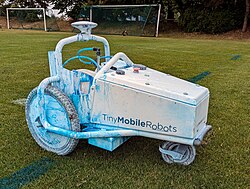
Historically, pitch lines were marked by hand using chalk machines; however, modern stadiums often utilize programmable robots that apply spray paint automatically.
Match Duration and Tie-Breaking
A standard match lasts 90 minutes, split into two 45-minute halves with a 15-minute interval. Because the clock does not stop when the ball is out of play, the referee adds stoppage time (or injury time) to the end of each half to compensate for delays caused by substitutions or injuries. Due to extreme heat, cooling breaks of 3 minutes may be granted if the wet-bulb globe temperature exceeds 32°C.
In knockout competitions, draws are settled through various methods:
- Extra Time: Two additional 15-minute periods.
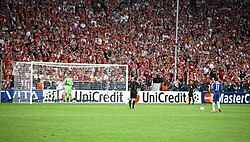
- Penalty Shoot-out: Used if the score remains tied after extra time to determine who progresses.
- Two-Legged Matches: Teams play home and away; the aggregate score decides the winner. The away goals rule may be used as a tie-breaker in some competitions.
Ball Status and Restarts
The ball is considered "in play" from the kick-off until it leaves the field or the referee stops play. There are eight methods to restart the game:
- Kick-off: Starts each half or follows a goal.
- Throw-in: Occurs when the ball crosses the touchline.
- Goal kick: Awarded to the defense when the attack kicks the ball over the goal line.
- Corner kick: Awarded to the attack when the defense kicks the ball over the goal line.
- Indirect free kick: Awarded for non-penal fouls; a goal cannot be scored directly from this kick.
- Direct free kick: Awarded for penal fouls; a goal can be scored directly.
- Penalty kick: Awarded for a penal foul inside the defender's penalty area.
- Dropped-ball: Used when the referee stops play for injuries or external interference.
Misconduct and Sanctions
Fouls occur when a player commits an offense while the ball is in play. Penal fouls (like tripping or deliberate handling) result in direct free kicks or penalties. The referee can issue a yellow card (caution) or a red card (dismissal). Two yellow cards equal one red card. A dismissed player cannot be replaced, leaving their team shorthanded.
Referees may apply the advantage rule, allowing play to continue if the fouled team maintains a beneficial position. If the advantage does not materialize within a few seconds, the referee may call play back to penalize the original foul.
Off-field misconduct, such as doping, match-fixing, or financial mismanagement, is handled by football associations. Sanctions can include fines, point deductions (e.g., 12 points for entering financial administration in the English Football League), or expulsion from competitions.
Summary of Game Specifications
| Feature | Requirement/Dimension |
|---|---|
| Max Players per Team | 11 |
| International Pitch Length | 100–110 m |
| International Pitch Width | 64–75 m |
| Goal Dimensions | 7.32 m (W) x 2.44 m (H) |
| Ball Weight | 410–450 g |
| Standard Match Time | 90 minutes (2 x 45 min) |
Frequently Asked Questions
Who is responsible for maintaining the Laws of the Game?
The Laws of the Game are maintained by the International Football Association Board (IFAB), although they are published by FIFA.
What is the difference between a direct and indirect free kick?
A goal can be scored directly from a direct free kick without the ball touching another player. In contrast, an indirect free kick requires the ball to touch another player before a goal can be awarded.
How does VAR assist the referee?
Video Assistant Referees (VAR) use video replays to help the head referee correct "clear and obvious" mistakes regarding goals, penalty decisions, direct red cards, and mistaken identity.
What happens if a player receives two yellow cards?
A second yellow card in the same match automatically results in a red card, leading to the player's immediate dismissal from the game without the possibility of being replaced by a substitute.
Why is stoppage time added to a match?
Stoppage time is added at the referee's discretion to compensate for time lost due to substitutions, injuries, or other interruptions, ensuring the game maintains its intended duration.