Understanding Flesh Flies: Biology, Taxonomy, and Impact
The family Sarcophagidae, commonly known as flesh flies, plays a complex and often controversial role in our ecosystem. Derived from the Ancient Greek words sárx (flesh) and phageîn (to eat), their name reflects their specialized biological niche. Unlike many other flies that lay eggs, flesh flies have evolved a unique reproductive strategy that allows them to thrive in environments ranging from decaying organic matter to the bodies of living organisms.
While they are often viewed through the lens of disease or scavenging, these insects are diverse members of the order Diptera (true flies) with intricate life cycles and specialized behaviors that include parasitism and kleptoparasitism.
Key Facts
- Reproduction: They are ovoviviparous, meaning they deposit live or hatching maggots instead of eggs.
- Diversity: The family contains approximately 2,500 species across 108 genera.
- Diet: Adults feed on nectar, fluids, and organic substances; larvae consume carrion, dung, or other insects.
- Subfamilies: They are divided into three main groups: Sarcophaginae, Miltogramminae, and Paramacronychiinae.
- Identification: Reliable species identification often requires examining the dissected genitalia of males.
Scientific Classification and Taxonomy
Flesh flies belong to the class Insecta and the order Diptera. Within this order, they fall under the subsection Calyptratae and the superfamily Oestroidea. The family is organized into three distinct subfamilies:
The Three Subfamilies
- Sarcophaginae: The most well-known group, consisting of scavengers that feed on small carrion (such as dead insects or snails) and occasionally larger vertebrate carcasses.
- Miltogramminae: Specialized kleptoparasites, which means they steal food or resources from other organisms—specifically solitary bees and wasps.
- Paramacronychiinae: A diverse group that includes predators of Lepidoptera (moths and butterflies), predators of bumblebee immatures, and generalist scavengers.
Diagnostic Characteristics
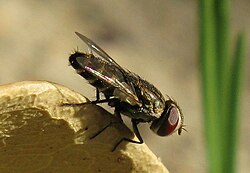
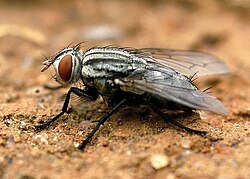
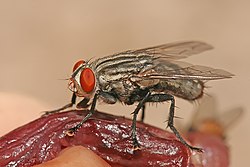
Identifying a flesh fly requires looking at specific anatomical markers. Members of the subfamily Sarcophaginae typically range from 4.1 to 22.9 mm in length. They are characterized by black and gray longitudinal stripes on the thorax and a checkered pattern on the abdomen. Other visible traits include red eyes and a bristled abdomen.
For more technical identification, entomologists look for specific bristle arrangements and wing structures:
- Bristle Patterns: The presutural bristle is positioned lower than the notopleural bristle. There are four notopleural bristles arranged in a short-long-short-long pattern from front to rear.
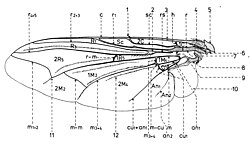
- Wing Venation: The vein M1 +2 is always present, and the cubitulus is strongly bent at a right angle or an acute angle.
- The Arista: The arista (a hair-like structure on the antenna) is typically plumose (feathery) on its basal half, though it can occasionally be pubescent or glabrous (smooth).
Biology and Life Cycle
The life cycle of the flesh fly is driven by a need for protein. While adults primarily consume fluids from animal bodies, nectar, sweet foods, and organic waste, the juveniles (maggots) require high-protein environments to develop. This is why they are frequently found near carrion, dung, compost piles, and pit latrines.
Their feeding habits vary significantly by subfamily. While many are scavengers of decaying vegetable matter and excrement, others act as internal parasites of insects, such as Orthoptera (grasshoppers and crickets). This specialized diet ensures that the larvae have immediate access to the nutrients required for growth.
Health and Disease Associations
Flesh flies are associated with several medical and veterinary concerns. They can act as vectors for the leprosy bacilli. In humans, the consumption of larvae can lead to intestinal pseudomyiasis (the presence of larvae in the digestive tract).
In the veterinary field, certain species like Wohlfahrtia magnifica can cause myiasis (infestation of living tissue by fly larvae) in animals, particularly sheep. This can lead to serious complications, including blood poisoning or asymptomatic leprosy infections.
Summary of Sarcophagidae Subfamilies
| Subfamily | Primary Feeding Habit | Key Biological Role |
|---|---|---|
| Sarcophaginae | Carrion, dung, and decaying matter | Scavengers and insect predators |
| Miltogramminae | Resources of solitary Hymenoptera | Kleptoparasites |
| Paramacronychiinae | Lepidoptera, bumblebees, and organic matter | Predators, parasitoids, and scavengers |
Frequently Asked Questions
What makes flesh flies different from most other flies?
The primary difference is that flesh flies are ovoviviparous. Instead of laying eggs, they deposit live or hatching maggots directly onto their food source, such as carrion or dung.
Can flesh flies be identified easily by sight?
While you can identify general characteristics like thoracic stripes and checkered abdomens, reliably identifying a specific species usually requires a professional examination of the dissected genitalia of male flies.
Are all flesh flies harmful to humans?
While they can carry disease-causing bacilli and cause intestinal pseudomyiasis if larvae are ingested, many species are primarily scavengers that play a role in decomposing organic matter.
What is kleptoparasitism in flesh flies?
Kleptoparasitism is a behavior seen in the Miltogramminae subfamily, where the flies steal food or resources from other insects, such as solitary bees and wasps.
Where are flesh flies most commonly found?
They are frequently found in environments rich in organic decay, including near carrion, animal dung, compost piles, and pit latrines.