Flag Officers: The History and Heraldry of Senior Military Command
In the hierarchy of global armed forces, a flag officer is a commissioned officer of sufficient seniority to be entitled to fly a personal flag. This flag serves as a visual marker of the officer's position and the authority from which they exercise command, typically displayed on their flagship (the lead ship of a fleet or squadron).
While the term is used internationally, its application varies. In the United States, it primarily refers to senior officers in the Navy holding admiral ranks, though the inclusion of the rank of commodore has fluctuated over time.
Key Facts

- Definition: A senior commissioned officer entitled to fly a personal flag to denote command.
- US Navy Origins: The rank of Admiral was initially avoided in the early US republic as it was considered "too royal."
- Five-Star Ranks: Created during World War II to ensure US commanders were not outranked by British Field Marshals and Admirals of the Fleet.
- Army Integration: The US Army began authorizing general officer flags in 1903, initially as "boat flags" for naval visits.
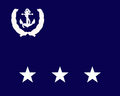
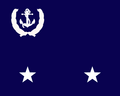
- Modern Standardization: In 1985, the US Navy and Coast Guard aligned the Rear Admiral (Lower Half) rank to a one-star flag to match the Brigadier General rank of other services.
The Evolution of US Navy Flag Ranks

From the inception of the US Navy in 1775 until 1857, Captain was the highest attainable rank. The young republic viewed the title of Admiral as an emblem of monarchy. By 1852, the structure consisted of Captain, Senior Captain, and Commander-in-Chief of a Squadron.
During the early 1800s, commodores utilized broad pennants—usually blue and swallow-tailed, following British Royal Navy traditions—to signal their command. A notable example occurred in 1808 when Commodore William Bainbridge flew such a pennant from the USS President.

The Mid-19th Century Transition
In 1857, Congress introduced the temporary rank of flag officer for senior captains leading squadrons. These officers used solid-colored rectangular flags: blue for the senior officer, red for the second, and white for the third. This system evolved into the permanent ranks of commodore and rear admiral by 1862.

The Era of Restricted Promotion (1865–1915)
Between 1865 and 1915, the rank of Admiral was reserved as a reward for exceptional gallantry in battle rather than a standard promotion. Only two men achieved this rank during this period: David Dixon Porter in 1870 and George Dewey in 1899.
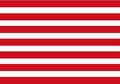
Heraldic Shifts and the 1870s
From 1870 to 1876, the Navy replaced the simple star system with complex flags featuring 13 stripes and stars. By 1876, the system shifted again; for instance, Admiral Porter's flag featured four stars arranged in a diamond shape.
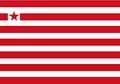
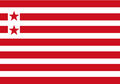
Expansion to Other Military Branches

US Army General Officers
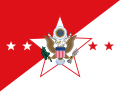
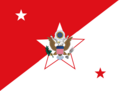
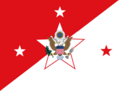
The War Department first authorized flags for Army general officers in 1903. Originally designed as "boat flags" for visits to naval vessels, they were expanded in 1923 for use on automobiles and in offices. Line officers used scarlet flags with one to four stars, while general staff officers used flags in their specific branch colors with branch insignia.

US Marine Corps and Coast Guard
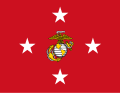
The Marine Corps first provided a flag for its commandant (then a major general) in the 1920s. This design was updated in 1942 and 1945 as the commandant's rank rose to lieutenant general and then full general.

The US Coast & Geodetic Survey (C&GS) introduced a director's flag in 1934. As the organization evolved into the Environmental Science Services Administration Corps and later the NOAA Corps, the flag system adapted, eventually splitting Rear Admirals into one-star and two-star versions in 1985.

Modern Rank Structures and Special Designations

The Five-Star Rank
To maintain parity with Allied commanders during World War II, Congress authorized the five-star ranks of General of the Army and Fleet Admiral in 1944. General Henry H. Arnold became General of the Air Force in 1947. These flags ceased active use following the death of General Omar Bradley in 1981.

Service Chiefs and Joint Chiefs
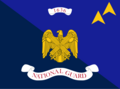
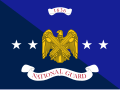
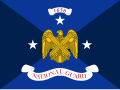
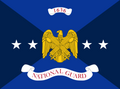
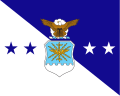
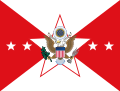
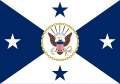
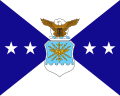
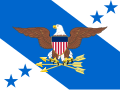
The chiefs of each service possess unique flags. The US Army was the pioneer, creating a Chief of Staff flag in 1917. Other services followed: the Navy in 1964, the Air Force in 1977, the Coast Guard in 1979, and the Space Force in 2020.

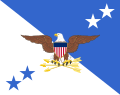
The Chairman of the Joint Chiefs of Staff (CJCS) first received a special flag in 1950 under General Omar Bradley, with a corresponding flag for the Vice Chairman introduced in 1986.

Summary of Flag Officer Evolution

| Era/Year | Key Change | Primary Symbol/Flag |
|---|---|---|
| 1775–1857 | Captain as highest rank | No Admiral flags (avoided "royal" titles) |
| 1857–1865 | Temporary Flag Officer rank | Solid colors (Blue, Red, White) |
| 1870–1876 | Complex stripe system | 13 stripes with stars |
| 1903 | Army General flags | Scarlet flags (1-4 stars) |
| 1944 | Five-Star ranks created | Five stars in a pentagon (Navy) |
| 1985 | Rank alignment | Rear Admiral (Lower Half) becomes 1-star |
Frequently Asked Questions
















































Why did the US Navy avoid the rank of Admiral until 1857?
The early United States republic felt that the title of Admiral was too closely associated with monarchy and "too royal" for a nation without a king.
What is a broad pennant?
A broad pennant is a swallow-tailed flag, traditionally blue, used by commodores to signify their command of a squadron.
Why were five-star ranks created during World War II?
They were established to ensure that high-ranking American commanders were not outranked by their British counterparts, such as Field Marshals and Admirals of the Fleet.
How do Army general officer flags differ from line officer flags?
Line officers use scarlet flags with stars based on rank, while general staff officers use flags in their specific branch colors featuring branch insignia and one or two stars.
When did the US Space Force introduce its chief's flag?
The Chief of Space Operations received a dedicated flag shortly after the service's creation in 2020.