Fishtail Points: The Ancient Projectile Tools of Paleoindian South America
During the twilight of the Late Pleistocene, a distinct style of stone tool emerged across the landscapes of South America. Known as Fishtail points (or Fell points), these sophisticated projectile points represent the earliest widespread lithic style in the region. Dating back approximately 13,000 to 12,000 years, these tools provide a critical window into the lives of the highly mobile hunter-gatherers who navigated the ancient Americas.
These artifacts were more than just spearheads; they were multifunctional instruments used for cutting and hunting. Their presence across vast distances suggests a complex society capable of long-range movement and resource management during a period of dramatic environmental and biological change.
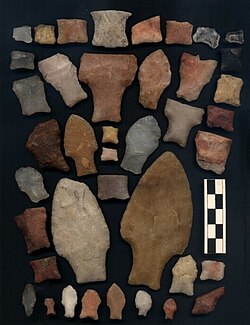
Key Facts
- Time Period: Late Pleistocene, roughly 13,000 to 12,000 years ago.
- Primary Use: Multifunctional tools used for hunting big game and as cutting implements.
- Defining Shape: Characterized by broad shoulders, indented stems, and flared bases.
- Geographic Reach: Found from Ecuador in the north to Tierra del Fuego in the south.
- Megafauna Link: Strongly associated with the hunting of extinct mammals like the Hippidion.
Chronology and Origins
The exact timeline of Fishtail points remains a subject of academic debate. Some researchers propose a short chronology (12,800–12,200 years Before Present), while others argue for a long chronology (13,500–10,200 years BP). Regardless of the specific window, they are contemporaneous with the Clovis points used in North America during their early stages.
Archaeologists believe Fishtail points may have evolved from Clovis points or perhaps from similar styles discovered in Central America and along the Gulf Coast of North America, indicating a shared technological heritage across the hemisphere.
Design and Manufacturing
The name "Fishtail" describes the tool's unique morphology: broad shoulders that taper into an indented stem and a flared base, resembling a fish's tail. The alternative name, "Fell point," was coined by Junius Bird after Cueva Fell (Fell's Cave) in southern Patagonia, where the first specimens were discovered.
Crafting these points required advanced skill. Artisans used a combination of percussive flaking (striking the stone) and pressure flaking (applying targeted pressure to remove small chips). While most were bifacially thinned (worked on both sides), some unifacial examples exist. Many points were fluted—a process where a long flake is removed from the length of the point to create a groove at the base, facilitating attachment to a shaft.
Material Composition
The choice of stone varied by region, reflecting the available local geology:
- Uruguay: Primarily silcrete (54%), followed by chert (10%), jasper (9%), quartzite (7%), opal (7%), and quartz (5%).
- Argentine Pampas (Tandilia Range): Local quartzite was the dominant material, used in over 75% of finds.
Usage and Versatility
Fishtail points were versatile tools. While many were hafted to spears—potentially used with spear throwers to increase velocity and distance—others served as knives or cutting tools. A single point might have been used for multiple purposes throughout its lifespan.
When a point became damaged, it was rarely discarded. Instead, it was often recycled into other lithic tools, such as burins (stone chisels) or scrapers. These early humans also utilized blades as part of their broader toolkit.
Distribution and Mobility
The highest concentration of Fishtail points is found in the open regions of Patagonia and the Pampas. However, their distribution is remarkably wide, extending north into the Andes as far as Ecuador and across various Brazilian states, including Amazonas, Bahia, Goiás, and Mato Grosso. In the south, they reach the furthest edges of Tierra del Fuego.
The people who made these tools were exceptionally mobile. Evidence shows they transported raw materials and finished tools over hundreds of kilometers. In one documented instance, stone was moved 482 kilometers (300 miles) from its source, suggesting either vast migratory patterns or established exchange networks between different groups.
The Link to Megafauna Extinction
The peak abundance of Fishtail points coincides with the extinction of the Late Pleistocene megafauna—the giant mammals that once roamed South America. This correlation suggests that these highly mobile hunter-gatherers played a causal role in the disappearance of these species.
Direct evidence of this relationship is found at several key sites:
- Piedra Museo (Argentina) and Cueva del Medio (Chile): Points were found alongside the extinct equine Hippidion saldiasi, with cut marks on the bones indicating butchery. Remains of the extinct ground sloth Mylodon and living llamas (Lama) were also present.
- Paso Otero 5 (Argentina): This site contains burned bones of a diverse array of giants, including the elephant-sized Megatherium americanum and Lestodon, the rhinoceros-like Toxodon, the camel-like Macrauchenia, and the extinct llama Hemiauchenia.
Once the megafauna vanished, the Fishtail style disappeared, replaced by smaller projectile points better suited for hunting smaller prey.
| Feature | Details |
|---|---|
| Alternative Name | Fell point |
| Estimated Age | 13,000 – 10,200 years BP (disputed) |
| Key Materials | Silcrete, Quartzite, Chert, Jasper |
| Primary Regions | Pampas, Patagonia, Andes, Brazil |
| Associated Prey | Hippidion, Megatherium, Toxodon, Mylodon |
Frequently Asked Questions
What is the difference between a Fishtail point and a Clovis point?
While both are Paleoindian projectile points, Fishtail points are characterized by their flared bases and indented stems. While some Fishtail points are fluted like Clovis points, they are distinct in their overall shape and are primarily associated with South American contexts.
Why are they called "Fell points"?
They are called Fell points after Cueva Fell (Fell's Cave) in southern Patagonia, the location where the first examples of this tool style were discovered.
Did Fishtail points cause the extinction of megafauna?
Evidence suggests a strong correlation. The peak use of these points coincides with the extinction interval of large mammals, and butchery marks on extinct species like Hippidion indicate that these tools were used to hunt them.
Were these tools only used for hunting?
No. While they were used as spearheads for big-game hunting, they were multifunctional. Many served as knives or cutting tools, and damaged points were often recycled into burins or scrapers.
How far did the people who used Fishtail points travel?
They were highly mobile hunter-gatherers. Evidence of stone transport shows they moved materials up to 482 kilometers from the original outcrop, indicating significant migration or trade.