First Seminole War: Andrew Jackson's Controversial Conquest of Florida
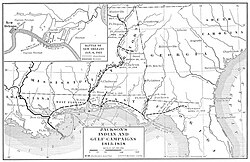
The First Seminole War was not merely a border skirmish, but a calculated move toward American expansion. For years, General Andrew Jackson had signaled his desire to annex Florida, which at the time served as a backwater province of the Spanish Empire. This region was a complex mosaic of Indigenous peoples, refugees from displaced tribes, and maroons—fugitive slaves who had escaped to Florida, some as early as the American Revolutionary War.
While diplomatic talks between the United States and Spain were ongoing, Jackson viewed the territory through a lens of military necessity and personal vendetta. He sought to settle unfinished business with the Red Stick survivors of the Creek War (1813–1814), many of whom had sought refuge just across the Alabama border in Florida.
The Path to Invasion
Tensions escalated as white settlers moved into the region, leading to frequent clashes over cattle and horses between settlers, Creek refugees, and the developing Seminole community. The tipping point occurred in the spring of 1818 with the Scott massacre, a violent slaughter of U.S. soldiers and their families along the Apalachicola River.
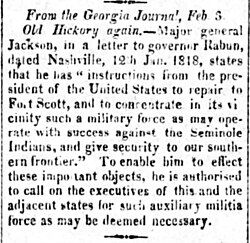
Although Edmund P. Gaines was the official commander of U.S. troops in the south, he had been reassigned to Amelia Island. Seizing the initiative, Jackson decided to invade Florida without authorization from his superiors or the federal government. On January 8, 1818, Jackson wrote to President James Monroe, suggesting that the government give a "wink and a nod" of approval via a secret channel—specifically through John Rhea, a member of Congress.
A Campaign of Insubordination
Jackson's subsequent actions were characterized by what historians describe as illegal and insubordinate behavior. Despite orders to request militia from the governors of Georgia and Alabama, Jackson instead assembled a force of Tennessee volunteers—veterans of his previous campaigns who were personally loyal to him. This ensured he had a force capable of suppressing any potential "mutiny" from Georgian officials.
The military campaign was brutal. Jackson's troops sacked and burned at least 300 houses belonging to Seminole and Black families along Lake Miccosukee and the Apalachicola River. They also demolished refugee settlements near the Suwannee River, indiscriminately killing and terrorizing the inhabitants.
The Capture of Pensacola and St. Mark's
Jackson captured the Spanish fort at St. Mark's and later Pensacola, actions that were explicitly prohibited by his orders. He justified the seizure of St. Mark's by claiming the Spaniards were too weak to defend it and that the U.S. needed it as a supply depot. However, these actions effectively meant Jackson had declared war on a foreign power without the approval of Congress.
The Political Fallout and the "Rhea Letter"
The capture of Pensacola came as a complete surprise to President Monroe and his cabinet. Secretary of State John Quincy Adams' journals confirm that the administration was blindsided. While Secretary of State John C. Calhoun argued that Jackson had set a dangerous precedent and should be publicly reprimanded, the Monroe administration feared that punishing Jackson would undermine U.S. leverage in the ongoing negotiations for the Adams–Onís Treaty.
For years, Jackson's defenders suggested that Monroe's failure to answer his January letter constituted a tacit approval. A 2008 discovery of a letter from Jackson to his wife, Rachel, mentioned a letter from John Rhea. Historians suggest that Rhea may have sent a vague message of friendship that Jackson misinterpreted—or chose to interpret—as a license for conquest. Jackson likely destroyed the letter once he realized it did not actually provide the legal vindication he needed.
Key Facts
- Primary Motive: Annexation of Florida and the removal of Red Stick Creek refugees and maroons.
- Trigger Event: The Scott massacre on the Apalachicola River.
- Legal Status: The invasion was unauthorized by Congress and exceeded Jackson's military orders.
- Human Cost: Hundreds of homes destroyed and numerous Seminole and Black refugees killed or detained.
- Diplomatic Result: The campaign pressured Spain, contributing to the eventual transfer of Florida via the Adams–Onís Treaty.
| Entity | Role/Perspective | Key Objective |
|---|---|---|
| Andrew Jackson | U.S. General | Annexation of Florida and elimination of hostile refugees. |
| James Monroe | U.S. President | Diplomatic acquisition of Florida while avoiding open war. |
| Spain | Colonial Power | Securing the northern boundary of Mexico; reluctant cession of Florida. |
| Seminoles/Maroons | Inhabitants | Survival and autonomy in the Florida wilderness. |
Frequently Asked Questions
Was Andrew Jackson authorized to invade Florida?
No. Jackson's invasion was self-authorized and premeditated. His orders were to repair to the border and request militia if necessary, but they explicitly prohibited making war on a foreign power (Spain) without congressional approval.
Who were the "maroons" mentioned in the conflict?
Maroons were fugitive slaves who had escaped from the United States and established independent settlements in the Florida wilderness, some dating back to the American Revolutionary War.
What was the significance of the Scott massacre?
The Scott massacre, involving the slaughter of U.S. soldiers and their families on the Apalachicola River, served as the immediate precipitating incident that Jackson used to justify his "blitzkrieg" action through Florida.
How did the U.S. government react to Jackson's illegal actions?
The administration was divided. While Secretary of State John C. Calhoun wanted Jackson publicly reprimanded for insubordination, President Monroe and John Quincy Adams ultimately defended him to avoid damaging diplomatic negotiations with Spain.
What was the role of John Rhea in this conflict?
John Rhea was a member of Congress and a close associate of Jackson. Jackson attempted to use Rhea as a secret channel to get a "wink and a nod" of approval from President Monroe for the seizure of East Florida.