Filiates: A Historical Journey Through Ancient Cestrine and Modern Epirus
The town of Filiates, located in the region of Epirus, possesses a rich and complex history that mirrors the broader geopolitical shifts of the Balkans. From its origins as a center for ancient Greek tribes to its role as a crossroads of Ottoman, Albanian, and Greek cultures, Filiates has evolved through centuries of migration, conflict, and cultural transformation.
Ancient Foundations: The Era of Cestrine
In antiquity, the region surrounding Filiates was inhabited by the Chaonians, an Epirot Greek tribe. The area was known as Cestrine (or Kestrine), separated from the neighboring Thesprotia by the River Thyamis. The region derived its name from the ancient town of Cestria, which was referred to by various names over time, including Cammania, Filiates, Ilion, Epirus, and Troia.
According to the geographer Pausanias in his work Description of Greece, Cestrine was named after Cestrinus, the son of Helenus, though it was previously called Cammania. Historians believe the original site of the ancient town of Cestria likely lies across the current border in Albania.
Medieval Transition and Ottoman Rule
By the 15th century, Filiates transitioned into the Ottoman era, becoming part of the Sanjak of Ioannina (an administrative division of the Ottoman Empire). During the 17th and 18th centuries, a significant portion of the local population converted to Islam, altering the town's demographic landscape.
Historical records from the 19th century highlight the town's mixed composition. In 1856, Panagiotis Aravantinos noted the presence of 200 Muslim and 30 Christian families. By 1878, Vassilis Zotos reported a total population of approximately 4,000 people, consisting of 3,000 Muslims (about 500 families) and 1,000 Christians (about 100 families).
The mid-19th century was marked by instability; during the suppression of the Greek revolt of 1854 in Epirus, armed groups of Cham Albanians caused extensive damage to the town.
The Rise of Albanian Nationalism and Education
The early 20th century saw a surge in Albanian cultural identity. In 1907, Qamil Çami began secretly teaching written Albanian. By August 25, 1908, he and other rilindas (national awakening activists) established the first Albanian-language school in Filiates, where Çami served as headmaster. This educational effort was funded by local figures such as Musa Demi and notable Cham Albanians like Rasih Dino.
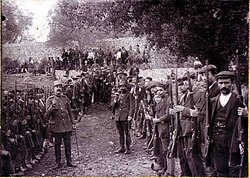
As the Ottoman Empire dissolved around 1911, Albanians in Filiates formed çetes—armed guerrilla groups fighting for autonomy. During this volatile period, the local Greek population generally remained tolerant of these actions, provided they did not exhibit chauvinist tendencies.
Interwar Period and Demographic Shifts
From the mid-19th century onward, population movements began to weaken the Muslim elite, leading to a gradual Hellenization (the process of becoming Greek in language and culture) of formerly Albanian-majority towns. While Filiates remained primarily Albanian-speaking during the interwar period, it became increasingly Greek-speaking after 1939.
Tensions regarding education persisted during the 1920s and 30s. In 1930, a Cham Albanian committee petitioned the Greek government and later the League of Nations for the right to use Albanian in public schools and to open private institutions. Similarly, in 1928, representatives from Paramythia, Karvounari, and Filiates requested the opening of two self-funded Muslim schools. The Greek authorities officially rejected these requests, fearing they would be used for anti-Greek propaganda, though some operated unofficially.
World War II and the Departure of the Cham Community
The most turbulent chapter of Filiates' modern history occurred during the Greek-Italian War. Between October 28 and November 14, 1940, the town was burned by collaborationist Cham Albanian bands. The region remained home to a Cham Albanian community until 1944.
During the liberation of Greece, a large portion of the Cham community fled due to their collaboration with Nazi forces. In September 1944, as Axis forces withdrew, the EDES resistance (National Republican Greek League) overcame the remaining collaborator units in the town. Following five days of chaos and destruction, the remaining Cham community fled to Albania, with their leaders retreating alongside German troops. This period resulted in the destruction of nearly all Cham Albanian monuments in Filiates.
Key Facts
- Ancient Name: Known as Cestrine (or Kestrine), named after Cestrinus.
- Ancient Tribe: Inhabited by the Chaonians, an Epirot Greek tribe.
- Ottoman Administration: Part of the Sanjak of Ioannina starting in the 15th century.
- Demographics (1878): Total population of 4,000 (3,000 Muslims and 1,000 Christians).
- Education: First Albanian-language school opened on August 25, 1908.
- WWII Impact: Town burned in 1940; Cham community fled to Albania in 1944.
| Era | Key Identity/Control | Significant Event |
|---|---|---|
| Antiquity | Chaonians (Greek) | Establishment of Cestria/Cestrine |
| 15th - 19th Century | Ottoman Empire | Integration into Sanjak of Ioannina |
| Early 20th Century | Albanian National Awakening | Opening of first Albanian school (1908) |
| Interwar Period | Greek State | Gradual Hellenization of the town |
| World War II | Axis Occupation / Resistance | Burning of town (1940) and exodus of Chams (1944) |
Frequently Asked Questions
Who were the original inhabitants of the Filiates area?
The area was originally inhabited by the Chaonians, an Epirot Greek tribe, and the region was known in antiquity as Cestrine.
When did Filiates come under Ottoman rule?
Filiates came under Ottoman rule in the 15th century and was incorporated into the Sanjak of Ioannina.
What was the significance of the year 1908 for the town?
On August 25, 1908, the first Albanian-language school in Filiates was opened, led by headmaster Qamil Çami and funded by local rilindas.
Why did the Cham Albanian community leave Filiates in 1944?
The community fled to Albania during the liberation of Greece because a large part of the population had collaborated with Nazi forces, leading to clashes with the EDES resistance.
What happened to the Albanian monuments in Filiates?
Almost all Cham Albanian monuments in the town were destroyed during the events of World War II.