Ferromagnetism: The Science of Permanent Magnets and Magnetic Materials
Most of us are familiar with the simple pull of a refrigerator magnet, but the physics behind this attraction is a complex interplay of quantum mechanics and material science. Ferromagnetism is the property of certain materials—most notably iron—that allows them to exhibit significant magnetic permeability and coercivity, enabling them to become permanent magnets.
At its core, ferromagnetism is the strongest form of magnetism. While other materials may respond weakly to magnetic fields through paramagnetism, diamagnetism, or antiferromagnetism, these effects are typically so subtle they require laboratory instruments to detect. Ferromagnetism, however, creates the powerful, observable forces we encounter in everyday technology.
Key Facts
- Ferromagnetic materials are strongly attracted to magnets and can be transformed into permanent magnets.
- Common examples include iron, cobalt, nickel, and various rare-earth metals.
- Magnetic permeability refers to how easily a material is magnetized by an external field.
- Magnetic coercivity is the measure of a material's resistance to becoming demagnetized.
- The Curie temperature is the critical point above which a material loses its ferromagnetic properties.
The Mechanics of Magnetism
Permeability and Coercivity
When a material like a steel plate is placed near a magnet, it experiences induced magnetization. This is described as magnetic permeability. Whether that plate remains magnetic after the external magnet is removed depends on its coercivity—a property influenced by the material's chemical composition and heat treatment.
Soft vs. Hard Magnetic Materials
Scientists categorize ferromagnetic materials into two primary types based on their coercivity:
- Soft Materials: These have low coercivity (e.g., annealed iron) and do not retain magnetization easily.
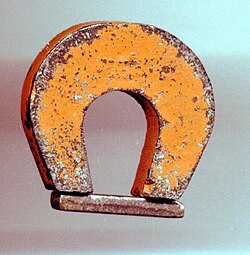
- Hard Materials: These have high coercivity and are used to create permanent magnets. Examples include alnico (an iron alloy) and ferrites.
The Quantum Origin of Ferromagnetism
Classical physics cannot explain why some materials are magnetic. According to the Bohr–Van Leeuwen theorem, magnetism is a quantum mechanical phenomenon. Every electron possesses a magnetic moment based on its spin state. While the Pauli exclusion principle usually causes these moments to cancel each other out, some atoms maintain a net magnetic moment due to incomplete cancellation.
Exchange Interaction
In ferromagnetic materials, a powerful force called the exchange interaction causes neighboring atomic dipoles to align parallel to one another, regardless of an external field. In iron, this force is approximately 1,000 times stronger than the standard dipole-dipole interaction, leading to spontaneous magnetization.
Magnetic Domains and Structure
If all atomic spins in a piece of iron align, why isn't every nail a powerful magnet? The answer lies in magnetic domains (or Weiss domains). These are tiny regions where spins are aligned, but the domains themselves point in different directions, canceling each other out on a macroscopic scale.
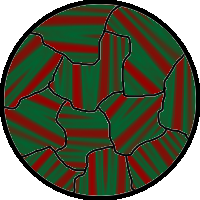
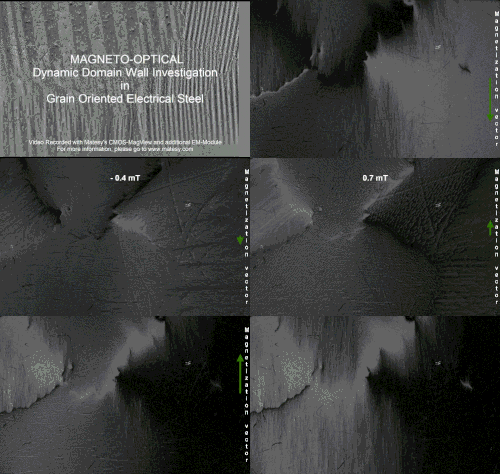
When a material is magnetized, these domain walls move, and the domains align in a single direction. This state is metastable, meaning it can persist for millions of years, as seen in ancient magnetite samples from the ocean floor.

Advanced Materials and Alloys
Modern engineering has produced specialized magnetic materials. Rare-earth magnets utilize lanthanide elements to achieve exceptionally high magnetic moments. Additionally, asperomagnets (amorphous metallic alloys) are created through rapid quenching to produce isotropic properties, resulting in low hysteresis loss and high electrical resistivity.
Comparative Magnetic Properties
The following table outlines the Curie temperatures (the temperature at which ferromagnetism ceases) for various materials.
| Material | Curie Temperature (K) |
|---|---|
| Cobalt (Co) | 1388 |
| Iron (Fe) | 1043 |
| Hematite (Fe2O3) | 948 |
| Nickel (Ni) | 627 |
| Neodymium Magnet (Nd2Fe14B) | 593 |
| Gadolinium (Gd) | 292 |
| Dysprosium (Dy) | 88 |
Unusual and Induced Ferromagnetism
Recent scientific breakthroughs have expanded our understanding of where ferromagnetism can occur. In 2009, MIT physicists achieved ferromagnetism in a lithium gas cooled to less than 150 nanokelvin. In 2018, researchers found that body-centered tetragonal ruthenium exhibits ferromagnetism at room temperature.
Furthermore, electrically induced ferromagnetism has been observed. Scientists have successfully used voltage to induce ferromagnetic properties in the surface layer of iron pyrite (fool's gold), a material that is naturally diamagnetic.
Frequently Asked Questions
What is the difference between ferromagnetism and ferrimagnetism?
In ferromagnetism, magnetic moments align parallel to one another. In ferrimagnetism, moments are arranged in two antiparallel sublattices with different magnitudes, which still results in a net magnetization.
How can a permanent magnet be demagnetized?
Demagnetization can occur by heating the material (annealing), subjecting it to strong physical vibrations (hammering), or applying a rapidly oscillating magnetic field using a degaussing coil.
What is the role of the Curie temperature?
The Curie temperature is the threshold above which the thermal energy becomes strong enough to overcome the exchange interaction, causing the material to lose its spontaneous magnetization and become paramagnetic.
Why are rare-earth magnets so strong?
Rare-earth magnets contain lanthanide elements that possess large magnetic moments in well-localized f-orbitals, allowing for much higher magnetic strength than standard iron magnets.
What are magnetic domains?
Magnetic domains are microscopic regions within a ferromagnetic material where all atomic spins are aligned. In an unmagnetized piece of metal, these domains point in random directions, canceling each other's effects.