Fernando Botero: The Master of Volume and Boterismo
Fernando Botero was more than just a painter and sculptor; he was a global cultural icon who redefined the perception of form and volume in modern art. Born in Medellín, Colombia, Botero became the most recognized artist from Latin America during his lifetime. His unique aesthetic, characterized by the depiction of people and objects in exaggerated, large volumes, became so influential that it earned its own name: Boterismo.
Whether used for lighthearted humor or biting political criticism, Botero's signature style transcended borders, placing his works in some of the world's most prestigious locations, from the Champs-Élysées in Paris to Park Avenue in New York City.
Key Facts
- Style: Known as "Boterismo," featuring exaggerated volume and proportions.
- Nationality: Colombian (born in Medellín).
- Major Works: Mona Lisa, Age Twelve, The Presidential Family, and the Abu Ghraib series.
- Recognition: Received the International Sculpture Center's Lifetime Achievement in Contemporary Sculpture Award in 2012.
- Philanthropy: Donated vast collections to the Museo Botero in Bogotá and the Museum of Antioquia in Medellín.
- Lifespan: 1932–2023.
Early Life and Artistic Foundations
Botero's journey began in Medellín, where he received his primary education at the Ateneo Antioqueño and secondary education at the Jesuit School of Bolívar. His early artistic curiosity was diverse; for two years, he attended a school for matadors, an experience that heavily influenced his early drawings of bullfighting scenes.
His path was not without conflict. A passionate defender of Pablo Picasso, Botero was expelled from school after writing an essay in defense of Picasso's art. Despite this, his talent was evident early on; at age 16, he began publishing illustrations in El Colombiano, using the earnings to fund his high school education at the Liceo de Marinilla de Antioquia.
Botero's early professional years were spent as a set designer and newspaper illustrator. His formative years were deeply influenced by European art, leading him to study at the San Fernando Academy and spend significant time in the Louvre in Paris and with Renaissance masters in Florence.
The Evolution of Boterismo
While Botero gained national prominence in 1958 by winning first prize at the Salón de Artistas Colombianos, his international reputation surged after the Museum of Modern Art (MoMA) in New York acquired his Mona Lisa, Age Twelve in 1961.
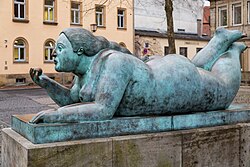
Botero's transition into sculpture began around 1964. Initially limited by finances, he experimented with acrylic resin and sawdust. However, he found these materials too porous and eventually pivoted to bronze in the mid-1970s. His bronze works, characterized by the same volumetric exaggeration as his paintings, were first exhibited at the Grand Palais in Paris in 1977.
Art as Political Commentary
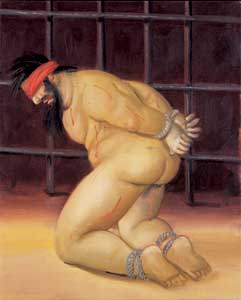
Botero often used his art to address the turmoil of his homeland and the world. In 2004, he donated a series of works depicting Colombian violence (1999–2004) to the National Museum of Colombia. Perhaps his most poignant political statement was the Abu Ghraib series, created between 2004 and 2005. This collection of over 85 paintings and 100 drawings served as a "permanent accusation" of the abuses committed by U.S. forces against prisoners during the Iraq War.
Tragedy and Resilience
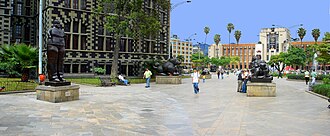
Botero's life was marked by personal and national tragedy. In 1974, his four-year-old son, Pedro, was killed in a car accident in Spain. This loss inspired the painting Pedrito a Caballo. On a national scale, Botero faced the violence of Colombia's drug wars. In 1995, a bomb exploded under one of his sculptures in Medellín's Plaza San Antonio, killing 23 people. In a powerful gesture of resilience, Botero insisted the damaged sculpture remain as a monument to the country's "imbecility and criminality," placing an intact replica beside it.
Legacy and Market Value
Botero's generosity left a lasting mark on Colombia. He donated 123 of his own pieces and 85 works from his personal collection (including pieces by Picasso and Chagall) to the Museo Botero in Bogotá. He also provided 119 pieces to the Museum of Antioquia, creating the famous Botero Plaza.
In the art market, Botero's work continues to command premium prices. His painting The Musicians (1979) sold for $5,132,000 in November 2023, while his sculpture Horse (1992) reached $4.9 million in November 2024.
| Category | Details |
|---|---|
| Primary Style | Boterismo (Exaggerated Volume) |
| Key Mediums | Oil on canvas, Bronze sculpture |
| Major Themes | Political criticism, Motherhood, Still life, Colombian identity |
| Highest Painting Sale | $5,132,000 (The Musicians) |
| Highest Sculpture Sale | $4.9 million (Horse) |
Frequently Asked Questions
What is Boterismo?
Boterismo is the signature artistic style of Fernando Botero, characterized by the depiction of human figures and objects in large, exaggerated volumes. This style is used to convey a range of emotions, from humor and sensuality to political satire.
Why did Botero paint the Abu Ghraib series?
Botero created the series as a response to reports of abuses of prisoners by United States forces at Abu Ghraib prison during the Iraq War. He viewed the work as a way of "painting out the poison" and as a permanent accusation of these human rights violations.
How did Botero react to the bombing of his sculpture in Medellín?
Rather than removing the destroyed piece, Botero decided to leave the damaged sculpture in place as a monument to the criminality and imbecility of the violence in Colombia, donating a replica to stand alongside it.
Which museums hold significant Botero collections?
Significant collections are housed in the Museo Botero in Bogotá and the Museum of Antioquia in Medellín. Additionally, the Berkeley Art Museum holds a large portion of the Abu Ghraib series, and MoMA in New York owns Mona Lisa, Age Twelve.
What was Botero's relationship with Pablo Escobar?
Botero was angered to discover that the drug lord Pablo Escobar possessed two of his paintings. In response, Botero created works such as The Death of Pablo Escobar and Pablo Escobar Dead.