The Fascinating World of Felidae: A Guide to the Cat Family
The family Felidae, commonly known as cats, represents one of the most diverse and specialized groups of mammals on Earth. Whether it is the massive tiger prowling the jungle or the tiny rusty-spotted cat in the undergrowth, all members of this family are known as felids. These animals are defined by their incredible predatory skills, unique physical adaptations, and a lineage that stretches back millions of years.
As obligate carnivores—meaning they must consume meat to survive and obtain essential nutrients—felids have evolved into highly efficient hunters. Most species are solitary predators that rely on stalking or ambushing their prey, making them masters of stealth in environments ranging from dense forests and savannas to arid deserts and snowy mountains.
Key Facts
- There are currently 41 extant species of felids living today.
- All felids are obligate carnivores, requiring meat for survival.
- Most cats possess retractile claws that can be pulled back into the paw.
- Felids are digitigrade, meaning they walk on their toes rather than the soles of their feet.
- The tiger is the largest living cat species, while the rusty-spotted cat is among the smallest.
- Cats lack the taste receptors necessary to detect sweetness.
Physical Characteristics and Adaptations
Anatomy and Movement
Felids are built for agility and power. They possess lithe, flexible bodies supported by strong, muscular limbs. Most species are digitigrade, a walking style where the animal stands on its digits (toes), which allows for quieter and faster movement. Their paws typically feature five toes on the forefeet and four on the hind feet, with compact, three-lobed cushions on the plantar pads to aid in silent stalking.
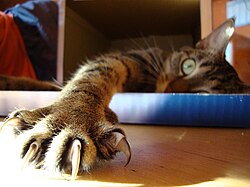
One of the most defining features of the family is their claws. Most felids have protractile claws, which are actively extended by contracting muscles in the toe and passively retracted. This mechanism protects the claws from wear while hunting. The only major exception to this rule is the cheetah (Acinonyx).
Sensory Superpowers
To be successful predators, felids rely on highly developed senses. Their eyes are relatively large and positioned to provide excellent binocular vision, which is essential for depth perception when chasing prey. Many species possess a tapetum lucidum, a reflective layer behind the retina that enhances night vision by reflecting light back through the eye. This makes their eyes appear to shine in the dark and makes them roughly six times more light-sensitive than humans.
Their sense of touch is equally vital, provided by highly sensitive whiskers (vibrissae) located above the eyes, on the cheeks, and on the muzzle. These whiskers help felids navigate in low-light conditions and assist in capturing prey. Additionally, their ears are large and sensitive, particularly in smaller species, allowing them to detect the high-frequency sounds made by small rodents.
Diet and Dental Structure
The dentition of a felid is specialized for a life of meat-eating. They typically have 30 teeth with a specific dental formula: 3.1.3.1 for the upper jaw and 3.1.2.1 for the lower jaw. Their teeth include carnassial teeth—specialized teeth adapted for tearing and cutting through flesh. While their canine teeth are prominent, they reached exceptional, massive sizes in the extinct "saber-toothed" lineages.
Felids also possess a vomeronasal organ located in the roof of the mouth, which allows them to "taste" scents in the air. This is often seen during the flehmen response, where a cat curls its lip to facilitate scent analysis. Interestingly, despite their keen sense of smell, they cannot detect the taste of sugar due to a lack of sweet taste receptors.
Classification and Diversity
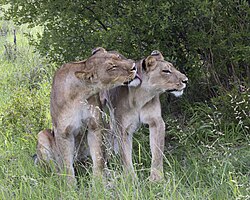
Modern biological science divides the living members of Felidae into two primary subfamilies: Pantherinae and Felinae. This classification is based on molecular biology and morphological data, such as the structure of the hyoid apparatus (a bone structure in the throat) and the protective sheaths around their claws. The Pantherinae subfamily includes the "big cats" like lions and tigers, while the Felinae subfamily contains the remaining 34 species, including domestic cats, lynxes, and cougars.
| Subfamily | Common Examples | Key Characteristics |
|---|---|---|
| Pantherinae | Tiger, Lion, Leopard, Jaguar, Neofelis | Includes the largest species; some have specialized anatomy for roaring. |
| Felinae | Domestic Cat, Cheetah, Cougar, Lynx, Serval | Includes the majority of species; includes the Acinonychinae lineage. |
Felids exhibit the greatest diversity in fur patterns of all terrestrial carnivores. Their coats can range from solid black (melanism) to various patterns of spots, stripes, and rosettes. Fur density and length also vary significantly based on climate; for instance, the snow leopard has thick, long hair for cold environments, while tropical species have much shorter fur.
Size Extremes
The size variation within the family is staggering. The tiger is the largest, reaching lengths of up to 390 cm and weights exceeding 325 kg. In contrast, the black-footed cat and the rusty-spotted cat represent the smaller end of the spectrum, with the rusty-spotted cat weighing as little as 0.9 kg.
Evolutionary History
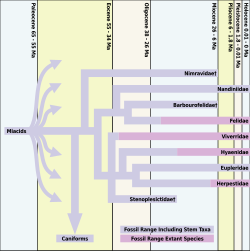
The history of the cat family began during the Oligocene epoch, approximately 25 to 35 million years ago. The earliest known cats, such as Proailurus, emerged after the Eocene–Oligocene extinction event. These early ancestors eventually gave rise to two main lineages: the modern subfamilies we see today and the extinct Machairodontinae, popularly known as the "saber-toothed cats."
The Machairodontinae were dominant predators for much of the Miocene and Pliocene, characterized by their massive upper canine teeth adapted for hunting large herbivores. However, they began to decline during the Pleistocene, eventually going extinct between 12,000 and 10,000 years ago. This decline is attributed to environmental changes, shifting prey availability, and competition with both emerging pantherine lineages and early humans.
Frequently Asked Questions
What makes a cat an "obligate carnivore"?
An obligate carnivore is an animal that is biologically required to eat meat to maintain its health. Unlike omnivores, which can eat a variety of plant and animal matter, felids depend on specific nutrients found only in animal tissue.
Why do cat eyes shine in the dark?
This phenomenon is caused by the tapetum lucidum, a reflective layer behind the retina. It reflects light back through the eye, increasing the amount of light available to the photoreceptors and significantly improving night vision.
Can all cats roar?
No. The ability to roar is linked to a specially adapted larynx and hyoid apparatus. Only members of the genus Panthera—specifically lions, leopards, tigers, and jaguars—are truly able to roar. Other cats, like the domestic cat or the cheetah, typically purr instead.
Why can't cats taste sweetness?
Evolutionarily, cats have lost the genetic ability to detect sugar. Because they are obligate carnivores that rely on protein and fat, they lack the sweet taste receptors found in many other mammals.
What is the difference between a felid and a feliform?
Feliformia is a broader suborder that includes all "cat-like" carnivores, such as hyenas and mongooses. Felidae is the specific family within that suborder that contains only the true cats.