Fair Grounds Race Course: A Legacy of American Thoroughbred Racing
Located in the heart of New Orleans, Louisiana, the Fair Grounds Race Course stands as a monument to the enduring spirit of American equestrian sport. As a premier thoroughbred racetrack and racino—a facility combining horse racing with casino gaming—it serves as a cornerstone of the region's sporting culture. Currently operated by the Churchill Downs Louisiana Horseracing Company, LLC, the venue is renowned for its historic atmosphere and high-stakes competition.
The site holds a distinguished place in sporting history. Following the closure of Freehold Raceway in 2024, the Fair Grounds is now the oldest horseracing site in the United States still in operation. Its legacy is not only one of speed and competition but of resilience, having survived fires, hurricanes, and shifting legislative landscapes over nearly two centuries.
Key Facts
- Established: 1837 (Racing began April 10, 1838).
- Ownership: Churchill Downs Inc.
- Course Layout: One-mile dirt track and a seven-furlong turf oval.
- Premier Event: The Louisiana Derby (Grade II).
- Historical Status: Oldest operating horseracing site in America.
- Dual Use: Host site for the annual New Orleans Jazz & Heritage Festival.
The Early Years: From Louisiana Race Course to Fair Grounds
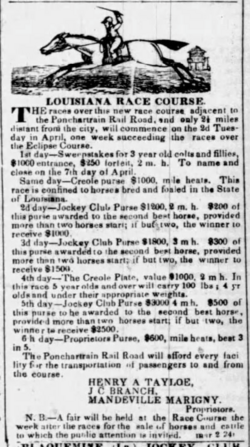
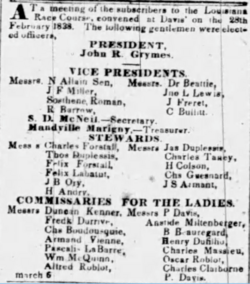
The origins of the track date back to 1838, when Bernard de Marigny, Julius C. Branch, and Henry Augustine Tayloe organized races at the Louisiana Race Course on Gentilly Road. Tayloe brought a deep pedigree to the venture; his family was a founding dynasty of American racing, responsible for importing Diomed (the first Epsom Derby winner) and breeding the foundational American thoroughbred, Sir Archy.
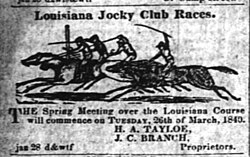
The inaugural Spring Meeting of the Louisiana Jockey Club began on April 10, 1838. These early events were highly structured, featuring specific weight requirements based on the age of the horse. For example, the "Creole Purse" was reserved for horses bred and owned within Louisiana, with weights ranging from 86 lbs for three-year-olds to 124 lbs for aged horses.
Evolution of the Venue
The track underwent several name changes and periods of instability throughout the 19th century. It was renamed the Union Race Course in 1852, then the Creole Race Course in 1859, before finally becoming the Fair Grounds in 1863. Despite the turmoil of the American Civil War, racing continued at the site.
The early 20th century brought further challenges. Racing was banned in New Orleans in 1908, though it returned in 1915. The venue also faced physical devastation, including a grandstand fire in 1919. In a rare departure from equestrian events, the track hosted a single auto race in 1921.
Modern Era and Infrastructure
The mid-20th century saw a period of revitalization. After being saved from subdivision developers in 1941, the track resumed full operations following World War II. The Fair Grounds Racing Hall of Fame was established in 1971 to honor the sport's legends, and a turf course was added in 1981 to diversify the racing surface.
The facility has faced significant setbacks, including a seven-alarm fire in 1993 that destroyed the grandstand and the catastrophic impact of Hurricane Katrina. Following the hurricane, the track was closed for over a year, reopening on Thanksgiving Day 2006. Today, the facility features a modern grandstand and clubhouse, as well as a dedicated slot-machine gaming facility that opened in 2008.
Physical Attributes and Layout
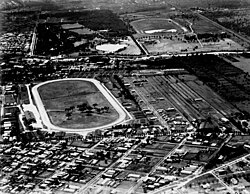
The Fair Grounds is unique among North American dirt courses because it has no chutes (short straightaways used for starting races). The facility consists of a one-mile dirt track and a seven-furlong turf oval, providing a versatile environment for various race distances.
Racing Excellence and Notable Events
The Fair Grounds is a critical stop on the Road to the Kentucky Derby. Its most prestigious event, the Louisiana Derby (Grade II), serves as a primary preparatory race for three-year-old thoroughbreds seeking points to qualify for the Kentucky Derby.
| Grade II Races | Grade III Races |
|---|---|
| Louisiana Derby | Lecomte Stakes |
| Fair Grounds Oaks | Fair Grounds Handicap |
| New Orleans Handicap | Mineshaft Handicap |
| Mervin H. Muniz Jr. Memorial Handicap | - |
| Rachel Alexandra Stakes | - |
| Risen Star Stakes | - |
Beyond graded stakes, the track hosts numerous ungraded events such as the Black Gold Stakes and the Pan Zareta Stakes. The infield also serves as a final resting place for legendary horses, including the 1924 Kentucky Derby winner, Black Gold, and the mare Pan Zareta.
Frequently Asked Questions
What makes the Fair Grounds Race Course historically significant?
It is the oldest horseracing site in the United States still in operation, with racing dating back to April 10, 1838.
Which race is the most prestigious held at the Fair Grounds?
The Louisiana Derby (Grade II) is the most prestigious race, serving as a key preparatory event for the Kentucky Derby.
Who currently owns and operates the track?
The track is owned by Churchill Downs Inc. and operated by the Churchill Downs Louisiana Horseracing Company, LLC.
Does the Fair Grounds host events other than horse racing?
Yes, the venue is the annual location for the New Orleans Jazz & Heritage Festival, typically held in late April and early May.
What is unique about the track's physical design?
Unlike most dirt courses in North America, the Fair Grounds track does not have chutes.