European Social Models: Comparing Welfare Systems and Economic Efficiency
The European social model is a conceptual framework used to describe the distinct approach European nations take toward employment regulation and social protection. Often contrasted with the more market-driven systems of the United States and Canada, this model is built on the conviction that economic progress and social progress are inseparable. It seeks to balance global competitiveness with social solidarity to ensure a stable and inclusive society.
While no single, uniform model exists across the continent, European welfare states generally share a commitment to political responsibility for employment conditions, universal social protections, social inclusion, and democratic governance. Common features include universal healthcare, free higher education, and robust welfare programs covering retirement pensions, unemployment insurance, and public housing.
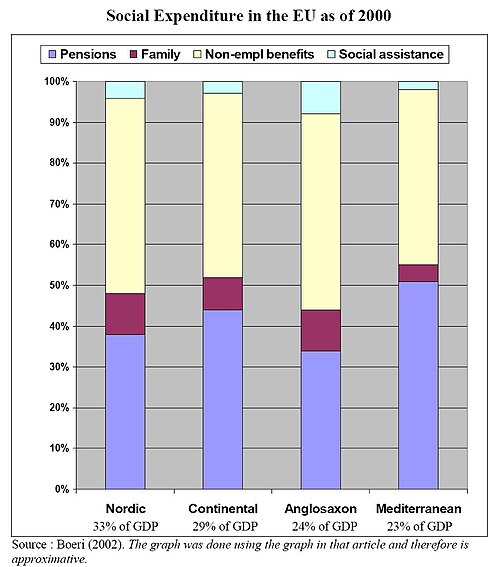
Key Facts
- Core Philosophy: Economic competitiveness and social solidarity are viewed as mutually reinforcing.
- Diverse Approaches: Europe is categorized into five primary models: Nordic, Continental, Anglo-Saxon, Mediterranean, and Eastern European.
- Primary Goals: The Treaty of the European Community emphasizes promoting employment, improving working conditions, and combating social exclusion.
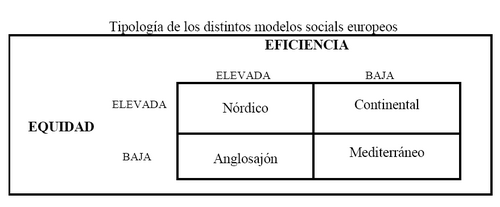
- Evaluation Metrics: Social models are typically measured by their efficiency (employment rates) and equity (poverty reduction).
The Five European Welfare Models
Depending on the focus of the state—whether it emphasizes universal citizenship, social insurance, or last-resort assistance—European countries fall into different welfare regimes.
The Nordic (Social Democratic) Model
Practiced in Denmark, Finland, Iceland, Norway, and Sweden, this model is characterized by universal provision based on citizenship. It relies heavily on government support to promote individual autonomy and reduce dependence on family obligations. By "de-commodifying" welfare, it ensures well-being is less tied to market forces, while simultaneously using active labor market policies to maintain high employability.
The Continental (Christian Democratic) Model
Found in Austria, Belgium, France, Germany, Luxembourg, the Netherlands, and Switzerland, this model emphasizes "security." It devotes a higher share of expenditure to pensions and disability benefits. Unlike the Nordic model, its subsidies are often not conditioned on employability.
The Anglo-Saxon (Liberal) Model
Implemented in Ireland and the United Kingdom, this model features lower overall social expenditure. It focuses on social assistance of last resort, where subsidies are primarily directed toward the working-age population and are strictly conditioned on previous employment.
The Mediterranean Model
Common in Greece, Italy, Portugal, and Spain, this model developed later (1970s-80s) and is characterized by lower expenditures and a heavy reliance on pensions. It often features rigid employment protection legislation and a strong role for the family in providing social support.
The Eastern European Model
This model covers formerly communist states, including Poland, Romania, the Czech Republic, and the Baltic states, reflecting a transition toward Western welfare structures.
Comparative Analysis: Efficiency and Equity
To determine the success of these models, economists analyze three primary criteria: poverty reduction, protection against labor market risks, and rewards for labor participation.
Reduction in Poverty
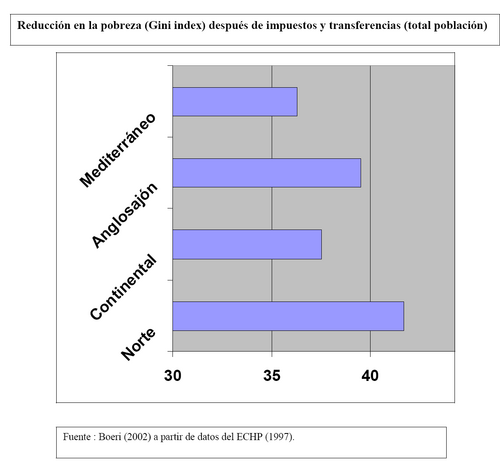
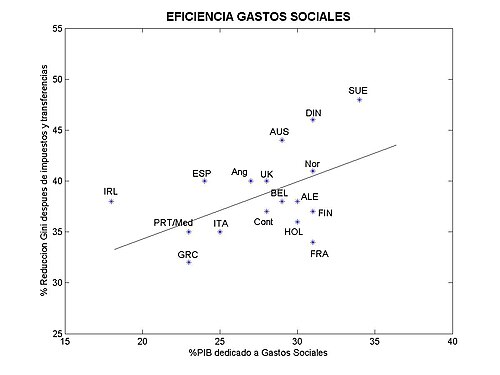
Poverty reduction is often measured by the change in the Gini index (a measure of statistical dispersion representing income inequality) after taxes and transfers. While higher spending generally correlates with lower poverty, efficiency varies. The Nordic and Anglo-Saxon models are considered more efficient, achieving higher poverty reduction relative to their spending levels compared to the Continental model.
Protection Against Labor Market Risks
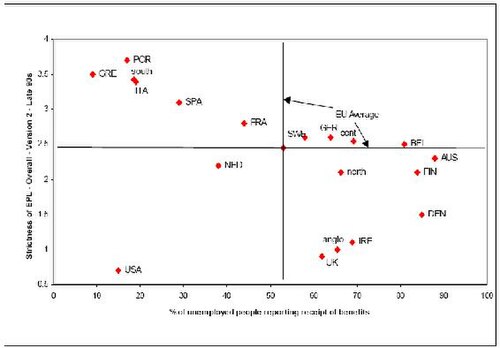
Protection is generally split into two categories: employment protection (legislation that increases firing costs) and worker protection (unemployment benefits). There is a notable trade-off between these two:
- Mediterranean: High employment protection, low unemployment benefit coverage.
- Nordic: Lower employment protection, high unemployment benefit coverage.
- Anglo-Saxon: Low employment protection, high reliance on benefits.
- Continental: Higher than average levels of both.
Rewards for Labor Participation
The employment-to-population ratio serves as a key indicator of labor incentives. The Nordic and Anglo-Saxon models typically maintain the highest employment rates, whereas the Continental and Mediterranean models have struggled to meet targets such as the 70% employment rate goal set by the 2001 Lisbon Strategy.
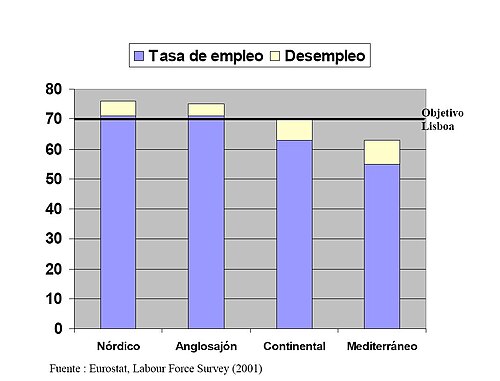
Summary of Social Model Performance
| Model | Primary Focus | Efficiency (Employment) | Equity (Poverty Reduction) |
|---|---|---|---|
| Nordic | Universalism & Citizenship | High | High |
| Continental | Social Security & Pensions | Moderate/Low | Moderate |
| Anglo-Saxon | Last-Resort Assistance | High | Moderate |
| Mediterranean | Pensions & Family Support | Low | Low |
Frequently Asked Questions
What is the main difference between the Nordic and Anglo-Saxon models?
The Nordic model focuses on universal provision and high government support to ensure citizen well-being regardless of market forces. In contrast, the Anglo-Saxon model emphasizes minimal state intervention, providing social assistance as a last resort and conditioning benefits on employability.
How does the Mediterranean model handle unemployment?
The Mediterranean model relies heavily on rigid employment protection legislation to keep workers in their jobs, but it offers a lower share of unemployment benefits compared to Northern European models.
What is the Gini index in the context of social models?
The Gini index is used to measure income inequality. In this context, it helps evaluate how effectively a social model reduces poverty through the redistribution of wealth via taxes and social transfers.
Which model is considered the most successful overall?
Based on the criteria of both efficiency (high employment rates) and equity (low poverty risk), the Nordic model is generally regarded as the best performing.
Why is the Continental model considered less efficient?
The Continental model is viewed as less efficient because it maintains high levels of social expenditure but does not achieve a proportionally high reduction in poverty compared to the Nordic or Anglo-Saxon models.