European Robin
The European robin (Erithacus rubecula) is one of the most recognizable and beloved birds in Europe. Known for its striking orange-red breast and curious nature, this small passerine has a rich history in both scientific study and cultural folklore. From its complex evolutionary journey to its unique ability to navigate using the Earth's magnetic field, the robin is far more than just a garden visitor.
Key Facts
- Scientific Name: Erithacus rubecula
- Family: Muscicapidae (Old World flycatchers)
- Conservation Status: Least Concern (IUCN 3.1)
- Average Length: 12.5–14.0 cm
- Distinctive Feature: Orange-toned red breast and face
- National Status: Voted the national bird of the United Kingdom in 1960 and 2015
Taxonomy and Evolution
First described by Carl Linnaeus in 1758 as Motacilla rubecula, the bird was later moved to the genus Erithacus by Georges Cuvier in 1800. The name rubecula is a Latin diminutive meaning "red," while Erithacus originates from Ancient Greek.
Historically, the European robin was classified within the thrush family (Turdidae). However, modern molecular phylogenetic studies have reassigned it to the Muscicapidae family, known as the Old World flycatchers. Recent analysis in 2023 confirmed that the European robin is the sole European member of a tropical African subfamily (Cossyphinae), occupying a basal position within that group.
Canary Islands Subspecies
Research conducted in 2003 suggests a fascinating divergence in the Canary Islands. Genetic data indicates that robins on Gran Canaria diverged from their European relatives approximately 2.3 million years ago, while those on Tenerife diverged about 1.8 million years ago. This suggests a colonization pattern where the birds first arrived at Gran Canaria before spreading to neighboring islands.
Physical Description
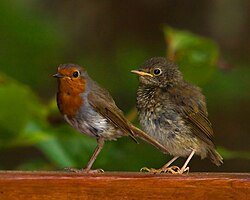
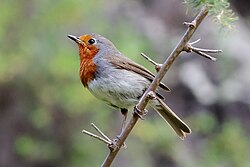
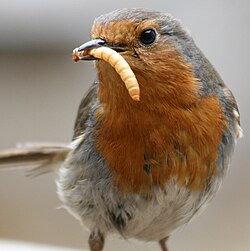
The adult European robin typically measures between 12.5 and 14.0 cm in length and weighs between 16 and 22 grams. Both males and females share identical plumage, featuring a characteristic orange breast and face bordered by bluish-grey on the neck and chest. Their upperparts are brown (or olive-tinged in British subspecies), with a whitish belly and brown legs.
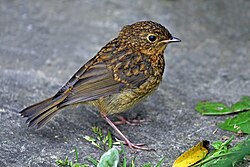
Juveniles differ significantly from adults; they are freckled brown all over and lack the iconic red breast. As they mature into first-winter immatures, they begin to resemble adults but retain more obvious yellow-brown tips on their wing covert feathers.
Distribution and Habitat
While native to Europe, there were several attempts to introduce the European robin to other parts of the world during the late 19th century. These efforts were unsuccessful in Australia, New Zealand, and North America (including New York, Oregon, and British Columbia), where the birds failed to establish permanent populations.
Behavior and Ecology
The European robin faces high mortality rates during its first year of life, resulting in an average life expectancy of 1.1 years. However, individuals that survive this critical period can live much longer, with one recorded instance of a robin reaching 19 years of age. They are subject to parasites such as the moorhen flea (Dasypsyllus gallinulae) and the acanthocephalan Apororhynchus silesiacus.
Diet and Foraging
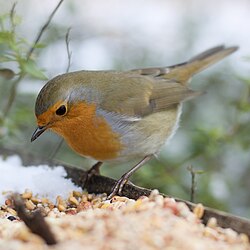
Robins are opportunistic feeders, consuming a variety of insects and seeds to maintain their energy, especially during harsh winters when low temperatures can increase mortality rates.
Nesting and Breeding
Robins are highly adaptable nesters. While they often use crevices, sheltered banks, or manmade nest boxes (preferably open-fronted and placed within 2 meters of the ground), they have been known to nest in unusual objects. These include bicycle handlebars, discarded kettles, watering cans, and even hats. Nests are typically constructed from moss, leaves, and grass, lined with hair and feathers.
Magnetoreception and Navigation
One of the most scientifically intriguing aspects of the European robin is its use of magnetoreception—the ability to detect the Earth's magnetic field for orientation during migration. Experiments have shown that weak radio-frequency interference can disrupt this ability. Because this interference does not affect traditional iron compasses, researchers believe robins utilize a radical-pair mechanism, a quantum-level biological process, to navigate.
![Very weak radio-frequency interference prevents migratory robins from orienting correctly to the Earth's magnetic field. Since this would not interfere with an iron compass, the experiments imply that the birds use a radical-pair mechanism.[45]](/images/18/34/1834300c362c232cb1fff64a2caea677ddf8a068e2ea421771adb8ef5d48b7c1.webp)
Cultural Significance
The robin holds a prominent place in British and European culture. A well-known folk tale suggests the bird's red breast was stained by the blood of Christ during the crucifixion. In more modern times, the robin has become a symbol of Christmas, appearing frequently on greeting cards and postage stamps since the mid-19th century.
In the United Kingdom, the robin is widely regarded as the unofficial national bird, winning public polls in both 1960 and 2015. Its image and name are also popular in sports; several English and Welsh teams, such as Bristol City and Swindon Town, are nicknamed "the Robins," symbolizing the bird's agility.

Summary Table
| Feature | Details |
|---|---|
| Average Length | 12.5–14.0 cm |
| Weight | 16–22 g |
| Wingspan | 20–22 cm |
| Primary Diet | Insects, seeds |
| Family | Muscicapidae |
| Conservation Status | Least Concern |
Frequently Asked Questions
How can you tell a juvenile robin from an adult?
Juvenile robins are spotted brown and white all over and lack the characteristic orange-red breast of the adults. The red plumage appears gradually as they mature.
Where do European robins build their nests?
Robins are very flexible; they nest in holes, crevices, and sheltered banks, as well as manmade objects like nest boxes, flower pots, and even bicycle handlebars.
How do robins navigate during migration?
Robins use magnetoreception to orient themselves using the Earth's magnetic field. Evidence suggests they use a quantum-based radical-pair mechanism to achieve this.
Is the European robin the national bird of the UK?
While not officially designated by the government, the robin was voted the unofficial national bird of the United Kingdom in public polls in 1960 and 2015.
Why are some sports teams called "the Robins"?
Teams like Bristol City and Swindon Town use the nickname because their primary colors are red, and the robin is thought to symbolize agility on the field.