European People: Demographics, Diaspora, and Population Trends
The term European serves as an umbrella designation for individuals belonging to any ethnic, racial, or national group with origins in the European continent. While the term primarily describes those currently residing in Europe, its application extends to the vast European diaspora—people of European descent living outside the continent. In certain contexts, such as within the European Union, the term may also specifically identify holders of EU citizenship.
Beyond the continent, the label is often used to describe demographic groups in the Americas and Oceania, where people of European ancestry constitute a majority of the population despite being part of non-European national groups. This includes populations in Africa who are of European descent.

Key Facts
- Total Population: Estimated at 744 million people as of 2025.
- Most Populous Country: Russia (with 110 million people residing in European Russia).
- Largest Entirely European Country: Germany, with a population of 83 million.
- European Diaspora: Over 480 million people outside Europe have European ancestry.
- Fertility Rate: The average European fertility rate was 1.50 children per woman in 2020.
Geography and Population Dynamics
Europe is a continent defined by distinct land boundaries, stretching from the Ural Mountains in the east to the Caucasus Mountains in the south.
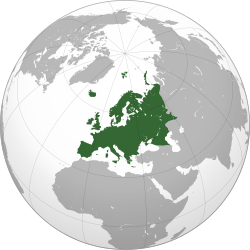
As of 2025, the total population of Europe is estimated to be 744 million. The continent has also seen significant movement through migration. According to a 2024 report by the International Organization for Migration, Europe hosted approximately 87 million international migrants in 2020. The primary origins for non-European migrants include Asia (50%), Africa (20%), and Latin America and the Caribbean (15%).
Migration Patterns and Trends
Migration to Europe varies by region. In Western Europe, irregular migration has seen significant numbers of people arriving from countries such as Egypt, Syria, Tunisia, China, India, Russia, Pakistan, Venezuela, Turkey, Algeria, and Afghanistan. In Eastern Europe, the top countries of origin include Syria, Afghanistan, and Pakistan.
Recent history has also been marked by significant intra-European movement. Following the 2022 Russian invasion of Ukraine, Europe experienced its largest refugee crisis since World War II, triggering a massive wave of migration within the continent.
The European Diaspora and Global Ancestry
The European diaspora refers to populations of European origin living outside of Europe. As of 2015, an estimated 480 million people worldwide were identified as part of this diaspora. Many of these populations are several generations removed from their European roots due to historic emigration patterns following the Age of Discovery.
The expansion of European-origin populations into the "New World" occurred alongside the growth of colonial empires, specifically those of the British, French, Spanish, and Portuguese. Today, the Americas and Oceania hold the largest concentrations of people with European ancestry outside of Europe.
Countries with Largest European-Descent Populations
A 2015 analysis highlights the significant presence of European ancestry in several non-European nations:
- United States (223 million)
- Brazil (91 million)
- Argentina (38 million)
- Canada (25 million)
- Australia (20 million)
Demographic Classification
In modern academic and social contexts, most Indigenous Europeans are racially classified as White. Historically, between the 18th and 20th centuries, a now-disproven concept known as the Caucasian race was used to group populations from Europe, West Asia, North Africa, Central Asia, and South Asia. While this term is generally avoided in modern academic discourse, it remains in use in certain official capacities, such as United States census data, to classify people of European, Middle Eastern, or North African ancestry.
Summary of European Demographics
| Category | Statistic/Detail |
|---|---|
| Total European Population (2025 est.) | 744 million |
| International Migrants in Europe (2020) | 87 million |
| Global Diaspora (2015 est.) | 480 million |
| Average Fertility Rate (2020) | 1.50 children per woman |
| Largest Diaspora Country | United States (223 million) |
Frequently Asked Questions
What is the difference between a European and the European diaspora?
A European typically refers to someone residing in Europe or holding European Union citizenship, whereas the European diaspora refers to people of European ancestry living in other parts of the world, such as the Americas or Oceania.
Which country has the largest population in Europe?
Russia is the most populous country in Europe, with 146 million people total, 75% of whom (110 million) live in the European portion of the country.
Which country entirely within Europe is the most populous?
Germany is the most populous country located entirely within the boundaries of the European continent, with a population of 83 million.
Where are the largest populations of European descent located outside of Europe?
The largest populations are found in the Americas and Oceania, with the United States, Brazil, Argentina, Canada, and Australia hosting the highest numbers.
What are the primary origins of migrants in Europe?
As of 2020, the majority of non-European migrants in Europe originated from Asia (50%), followed by Africa (20%), and Latin America and the Caribbean (15%).