Eurasian Nuthatch
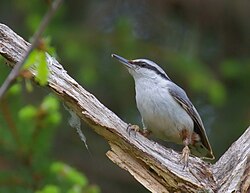
The Eurasian nuthatch (Sitta europaea) is a distinctive small bird known for its agility on tree trunks and its unique habit of hacking at nuts wedged into crevices. First described by Carl Linnaeus in 1758, this species is a member of the Sittidae family. Its name is derived from the Ancient Greek sittē and the Latin europaea, reflecting its widespread presence across the European continent and beyond.
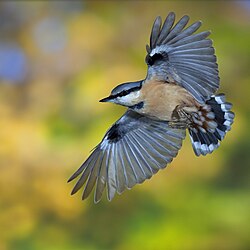
These birds are characterized by their ability to move efficiently across bark using short leaps, notably without using their tails for support. In flight, they exhibit a fast, short-duration pattern with round wings, a pointed head, and a short, square tail.
Key Facts
- Conservation Status: Least Concern (IUCN 3.1).
- Global Population: Estimated between 45.9 and 228 million individuals.
- Distinctive Behavior: Masonry of nest entrances using mud, clay, or dung.
- Lifespan: Typically two years, with a recorded maximum of 12 years and 11 months in the UK.
- Range: Temperate Eurasia, from Great Britain to Japan.
Taxonomy and Evolution
Modern phylogenetic research using nuclear and mitochondrial DNA has refined our understanding of the Sitta genus. The Eurasian nuthatch is closely related to the Kashmir nuthatch (S. cashmirensis) and the chestnut-vented nuthatch (S. nagaensis). Interestingly, while the Siberian nuthatch was long considered a subspecies of the Eurasian nuthatch, recent studies place it on a distinct evolutionary branch.
Subspecies Groups
Researchers have identified three primary groups of subspecies based on genetic data and physical appearance:
- European Nuthatch: Includes all European and Near East subspecies, featuring either buff or white bellies.
- Asian Nuthatch: White-bellied subspecies found from Kazakhstan to Korea and Japan.
- Eastern Nuthatch: Subspecies located in North and East China and Taiwan.
| Subspecies Group | Appearance | Range | Examples |
|---|---|---|---|
| caesia group | Buff breast, white throat | Most of Europe, North Africa, Middle East | S. e. caesia, S. e. hispaniensis |
| europaea group | White breast | Scandinavia, Russia, Japan, Northern China | S. e. europaea |
| sinensis group | Buff breast and throat | South and East China, Taiwan | S. e. sinensis, S. e. formosana |
Physical Description
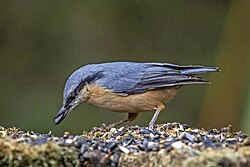
The nominate subspecies, S. e. europaea, typically measures 14 cm in length with a wingspan between 22.5 and 27 cm, weighing between 17 and 28 g. Adults feature blue-grey upperparts, a prominent black eye-stripe, and a whitish throat. Their lower belly and flanks are orange-red, often mottled with white near the undertail.
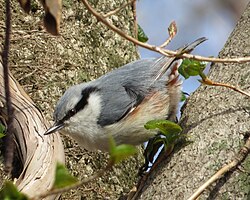
While most subspecies are similar, S. e. arctica is notably larger and paler, possessing a white forehead and a reduced eye-stripe.
Distribution and Habitat
The Eurasian nuthatch is a resident bird found across temperate Eurasia. Its range extends from Great Britain (excluding Ireland) to Japan, generally following the 16–20 °C July isotherms. While primarily a lowland bird in the north, it inhabits higher altitudes in mountainous regions, reaching up to 3,300 m in Taiwan and 2,100 m in Japan.
Breeding and Nesting
Nuthatches are monogamous and maintain year-round breeding territories. Territory sizes vary significantly by environment, from 2–10 hectares in Europe to over 30 hectares in the conifer forests of Siberia. While pairs often stay together for life, genetic studies indicate that approximately 10% of offspring may be fathered by males from adjacent territories.
The nest is typically located in a tree cavity, such as an old woodpecker hole, between 2 and 20 meters above ground. A unique behavior of the nuthatch is masonry: if the entrance hole is too large, the birds plaster it with mud, clay, or dung to reduce the size. This is believed to be an adaptation to prevent predation and competition from birds like common starlings.
![Nuthatches are more reluctant to occupy a nest box than other tree hole nesting birds.[18]](/images/85/2e/852e17a483654e05dbae4651d18f79e1a94654247b639b0f707aa384000653e2.jpg)
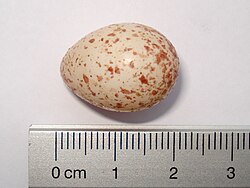
The female lays a clutch of 6 to 9 red-speckled white eggs (occasionally up to 13), which she incubates for 13 to 18 days. Both parents feed the altricial chicks until they fledge after 20 to 26 days.
Diet and Foraging
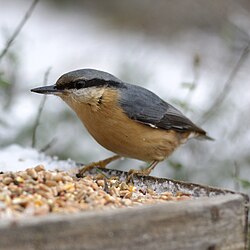
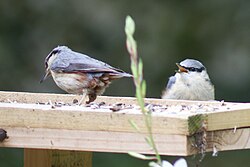
As their name suggests, nuthatches are well-known for their consumption of seeds and nuts. They use their stout, dark grey bills to hack into food sources, often wedging them into bark crevices to make them easier to open.
Frequently Asked Questions
Why do Eurasian nuthatches plaster their nest entrances?
They use mud, clay, and dung to shrink the entrance of their nest cavities. This behavior helps protect the eggs and chicks from predators and prevents larger birds, such as starlings, from taking over the nest.
What is the typical lifespan of a Eurasian nuthatch?
The typical lifespan is approximately two years, although some individuals live much longer. The oldest known wild bird in the UK reached 12 years and 11 months.
How do nuthatches differ from other tree-climbing birds?
Unlike woodpeckers or treecreepers, nuthatches do not use their tails for support when climbing trees; instead, they move using short, agile leaps.
Are Eurasian nuthatches endangered?
No, they are classified as Least Concern by the IUCN due to their massive global population (estimated up to 228 million) and vast breeding range across Eurasia.