Brown-headed Nuthatch: The Tiny Tool-User of Southeastern Pine Forests
The brown-headed nuthatch (Sitta pusilla) is a small, inquisitive songbird endemic to the pine forests of the Southeastern United States. Known for its bold personality and remarkable intelligence, this species is one of the smallest nuthatches in the world. From its distinctive "rubber duck" call to its surprising ability to use tools, the brown-headed nuthatch is a fascinating subject for birdwatchers and ornithologists alike.
Key Facts
- Conservation Status: Least Concern (IUCN 3.1).
- Habitat: Pine forests across the Southeastern US.
- Size: Total length of 9–11 cm; one of the world's smallest nuthatches.
- Diet: Seeds (especially sunflower seeds) and suet, as well as insects.
- Unique Behavior: Uses bark, twigs, and pine needles as tools to find insects.
- Social Structure: Exhibits cooperative breeding and social grooming.
Physical Characteristics and Identification
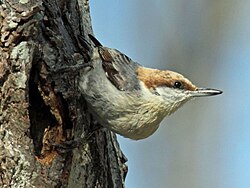
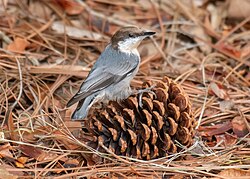
The brown-headed nuthatch is characterized by its compact size, measuring 9–11 cm (3.5–4.3 in) in length with a wingspan of 16–18 cm (6.3–7.1 in) and a body mass between 10–12 g (0.35–0.42 oz). It is roughly the same size as the pygmy nuthatch.
Visually, the bird is distinguished by a brown cap, a narrow black eyeline, and buff-white cheeks, chin, and belly. Its wings are a bluish-gray, and a small white spot is visible at the nape of the neck. To forage, it utilizes a sharp, black, nail-like beak designed to pound open seeds.
Vocalizations
One of the most unmistakable traits of the brown-headed nuthatch is its voice. Its primary call is a sharp "whee-hyah," which sounds remarkably like a rubber duck toy and is surprisingly loud given the bird's small size. While in flight, they emit softer "pit pit pit" calls and various other squeaking noises.
Behavior and Intelligence
The brown-headed nuthatch is noted for its bold and inquisitive nature, often making it approachable to humans. It is a frequent visitor to backyard feeding stations, where it shows a strong preference for suet cakes and sunflower seeds.
Tool Usage and Foraging
In a rare display of avian intelligence, this species has been observed using tools. They frequently use small chips of bark, twigs, and pine needles held in their beaks to dig for insects, demonstrating a level of problem-solving uncommon in many songbirds.
Social Dynamics and Breeding
The social life of the brown-headed nuthatch is complex. They engage in cooperative breeding, where groups of 3–5 adults provide care for a single nest. While some adults in these groups were previously thought to be non-breeding, genetic assessments suggest some may actually breed with individuals in neighboring territories. Other social behaviors include male-female duets and social grooming.
When it comes to nesting, these birds prefer the tops of short snags (standing dead trees).
Taxonomy and Distribution
While the brown-headed nuthatch is widespread in the Southeastern US, genetic studies have revealed lower genetic diversity among populations in south Florida, likely due to habitat fragmentation.
Historically, the Bahama nuthatch (S. p. insularis) was considered a subspecies. However, it has since been reclassified as a separate species. This change was supported by studies on vocalizations, which found significant differences in calls. Furthermore, call-response experiments—used to identify cryptic species (species that look identical but are genetically or behaviorally distinct)—showed that continental and Bahama populations do not respond aggressively to each other's calls.
| Feature | Details |
|---|---|
| Length | 9–11 cm (3.5–4.3 in) |
| Weight | 10–12 g (0.35–0.42 oz) |
| Wingspan | 16–18 cm (6.3–7.1 in) |
| Primary Habitat | Southeastern US Pine Forests |
| Diet | Sunflower seeds, suet, insects |
| Conservation Status | Least Concern |
Frequently Asked Questions
What makes the brown-headed nuthatch unique among birds?
The brown-headed nuthatch is particularly unique for its use of tools, such as bark and pine needles, to forage for insects, and its cooperative breeding habits where multiple adults care for one nest.
How can I identify a brown-headed nuthatch by sound?
Listen for a loud, sharp "whee-hyah" call that sounds like a rubber duck. They also make softer "pit pit pit" sounds while flying.
Is the Bahama nuthatch the same as the brown-headed nuthatch?
No. Although it was once considered a subspecies, the Bahama nuthatch is now classified as a separate species due to differences in vocalizations and a lack of aggressive response to the continental population's calls.
What do brown-headed nuthatches eat at feeders?
They are highly fond of sunflower seeds and suet cakes, making them frequent visitors to feeding stations in their range.
Where do these birds typically build their nests?
The brown-headed nuthatch prefers to build its nests at the top of short snags.