Euglossini: The Extraordinary World of Orchid Bees
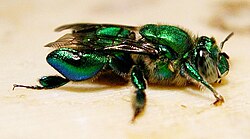
In the lush forests of Central and South America, a group of insects performs one of the most unique biological rituals in the animal kingdom. Known as Euglossini, or more commonly, orchid bees, these members of the Apidae family are famous for their brilliant metallic colors and their specialized relationship with tropical orchids.
Unlike many other bees that live in highly organized colonies, most orchid bees are solitary. While they belong to the corbiculate group—a clade of bees that includes honeybees and bumblebees—they are unique because they do not all exhibit eusociality (the complex social structure seen in honeybees). Instead, they exist in a variety of social states, ranging from solitary to communal.
Key Facts
- Diversity: Approximately 200 described species.
- Distribution: Primarily Central and South America, with some species established in Florida, Arizona, and Texas.
- Appearance: Most species feature brilliant metallic colors, including green, gold, and blue.
- Unique Behavior: Males collect volatile chemical compounds to create complex fragrances.
- Ecological Role: They are essential pollinators for specific orchid subtribes.
Classification and Diversity
The tribe Euglossini is comprised of five distinct genera: Aglae, Euglossa, Eulaema, Eufriesea, and Exaerete. While most of these bees are active foragers, the genera Exaerete and Aglae are kleptoparasites, meaning they survive by stealing resources from the nests of other orchid bees.
| Rank | Taxon |
|---|---|
| Kingdom | Animalia |
| Phylum | Arthropoda |
| Class | Insecta |
| Order | Hymenoptera |
| Family | Apidae |
| Tribe | Euglossini |
The Mystery of Fragrance Collection
One of the most fascinating aspects of orchid bee biology is the behavior of the males. While females focus on gathering pollen and nectar to provision nests, males spend much of their time collecting volatile compounds—aromatic chemicals that evaporate easily at room temperature.
These males visit various plants, most notably orchids in the subtribes Stanhopeinae and Catasetinae. These specific orchids do not produce nectar; instead, they offer fragrant compounds. As the male collects these scents, a specialized structure called a pollinarium (a mass of pollen) attaches to his body, ensuring he carries the genetic material to the next flower.
How Fragrances are Stored
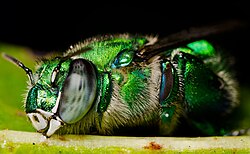
The process of collecting these scents is a marvel of biological engineering. The bees use specialized brushes on their forelegs to pick up the chemicals. They then transfer the scents by rubbing these brushes against combs on their middle legs. Finally, the chemicals are pressed into grooves on the edge of the hind legs, where they are squeezed into a sponge-like cavity inside the hind tibia.
Why Collect Scents?
For a long time, scientists believed these collected fragrances acted as pheromones to attract females. However, modern research suggests a different purpose. It is now believed that the scents serve as a signal of genetic quality. Because collecting these complex chemical mixes requires immense effort and time, a male with a rich, complex scent profile demonstrates to females that he is highly fit. This is an example of Zahavi's handicap principle, similar to how a peacock uses its heavy, bright tail to signal strength.
Ecological Impact and Unusual Behaviors
The relationship between orchid bees and their environment is highly specific. Different species of bees are attracted to different chemical profiles, which helps ensure that orchids are cross-pollinated by the correct insect species. This specificity prevents the waste of pollen and maintains the health of the tropical ecosystem.
Interestingly, some species exhibit even more startling behaviors. The male of Eufriesea purpurata has been observed collecting large quantities of insecticides, such as aldrin and DDT, from human structures in Brazil. Remarkably, these bees appear to collect these substances without suffering any harm.
Frequently Asked Questions
Do female orchid bees collect fragrances?
No, fragrance collection is a behavior primarily associated with males. Females focus on gathering nectar and pollen to provide food for their offspring and materials like mud and resin for nest building.
Where are orchid bees found?
They are native to Central and South America. However, some species have expanded their range, such as Euglossa dilemma in Florida, and species of Eulaema and Eufriesea in parts of the United States like Arizona and Texas.
What do orchid bees eat?
Females consume nectar and pollen from a wide variety of plants. Males visit various flowers—including those in the Araceae, Gesneriaceae, Solanaceae, and Euphorbiaceae families—to collect the volatile chemicals they need for their displays.
How do scientists study these bees?
Researchers often use synthetic chemical compounds as bait to attract and collect males. These baits include scents that are familiar to humans, such as methyl salicylate and eugenol, as well as less pleasant odors like skatole.
Why are orchid bees so colorful?
Most species, with the exception of the genus Eulaema, are characterized by brilliant metallic coloration, typically appearing in shades of green, gold, and blue.