Etruscan Religion: Divination, Deities, and the Sacred Disciplina
The religious landscape of the Etruscan civilization was a complex system of polytheism, ritual, and a profound belief in the readability of the natural world. While the Etruscans shared some mythological similarities with their Greek and Roman neighbors through syncretism—the blending of different beliefs—their approach to the divine remained distinct and individual. Because almost no sacred texts survived the passage of time, our understanding of their faith is reconstructed primarily through archaeological finds and the accounts of later Roman authors.
Key Facts
- Polytheistic Nature: The Etruscans worshipped a vast array of deities, including a primary trinity of Tinia, Uni, and Menrva.
- The Disciplina: Their religious practice was governed by the Etrusca Disciplina, a corpus of sacred texts providing instructions on communicating with gods.
- Divination Experts: Specialized priests known as haruspices interpreted signs from nature and animal entrails.
- Sacred Texts: The Liber Linteus is the only surviving Etruscan religious text, serving as a ritual calendar.
- Roman Legacy: Many Etruscan customs were absorbed into Roman culture after the Roman-Etruscan Wars.
Historical Evolution
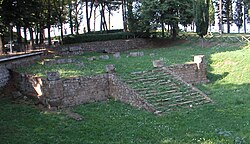
The roots of Etruscan spirituality trace back to the Villanovan culture. Early evidence from the 9th century BCE, such as the Pian d'Civita shrine in Tarquinia and the Piazza d'Armi in Veii, reveals the beginnings of organized sanctuary sites. During this era, funeral practices typically involved cremation in urns accompanied by grave goods.
By the 6th century BCE, these practices evolved into monumental architecture. Sanctuaries grew to include major temples and evidence of animal sacrifice, reflecting a more formalized and expensive system of offerings.
During the Orientalizing Period (750/700–600 BC), the Etruscans adopted several Greek gods and heroes, adapting them into their own system. For example, Artemis became Aritimi, Minerva became Menrva, and Hercules became Hercle. This culminated in a primary trinity of Tinia, Uni, and Menrva, who were often venerated in tripartite temples.
The Art of Divination and the Etrusca Disciplina
Central to Etruscan life was the belief that the will of the gods could be negotiated and understood through the observation of natural signs. This system was codified in the Etrusca Disciplina, a collection of sacred books. According to tradition, these revelations were delivered by two seers: Tages, a prophetic child born from the earth, and Vegoia, a female figure.
Haruspicy and the Piacenza Liver
The practice of haruspicy (the inspection of animal entrails) was a cornerstone of their divinatory art, which they called ziχ neθsrac. This was performed by specialized priests called haruspices (or sacerdotes in Latin). In the city of Tarquinii, a college of 60 such priests existed to manage these inquiries.
One of the most significant archaeological artifacts illustrating this practice is the Piacenza liver. This bronze model of a sheep's liver is divided into 40 cells, each inscribed with the names of gods, serving as a map for priests to interpret divine messages.
The Liber Linteus
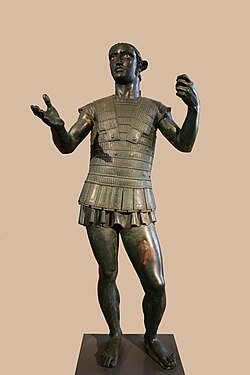
The only surviving original text is the Liber Linteus, found wrapped around the Zagreb mummy. Although only about 800 words remain, it appears to be a brontoscopic calendar—a guide for interpreting thunder—detailing specific ritual activities.
Deities, Spirits, and the Afterlife
The Etruscan pantheon was divided into different spheres of influence. The Liber Linteus suggests a distinction between the Gods of Light (aiser si) and the Gods of Darkness (aiser seu). Deities resided in sacred places called fanu or luth, where worshippers would leave offerings known as fler.
Regarding the afterlife, art from after the 5th century BCE depicts the deceased traveling to the underworld. In the François Tomb in Vulci, the spirit of the dead is referred to as hinthial, meaning "one who is underneath."
Women in Etruscan Religious Life
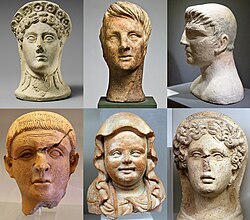
Evidence suggests that women played active roles in Etruscan religious practice. Inscriptions from Campo della Fiera in Orvieto reveal that affluent women made significant offerings to deities. One such inscription records a dedication to a deity or group named Tlusχval from a woman named Kanuta.
Scholars also point to the term hatrencu, found in tomb inscriptions in Vulci, as a likely designation for a priestess, indicating that women may have held official religious offices.
Roman Conquest and Assimilation
Following the Roman-Etruscan Wars (264 BCE), the Etruscan civilization was gradually absorbed into the Roman Republic. The Roman Senate adopted many elements of the Etrusca Disciplina, and the role of the haruspices persisted in Rome for centuries, often maintained by noble families claiming Etruscan descent.
By the late Roman Republic, these practices began to fade, facing satire from figures like Marcus Tullius Cicero. While some members of the Julio-Claudian dynasty, including Emperor Claudius, maintained knowledge of the language and religion, the distinct Etruscan tradition eventually ceased.
| Category | Etruscan Term/Concept | Description |
|---|---|---|
| Sacred Texts | Etrusca Disciplina | The corpus of rules for communicating with gods. |
| Priests | Haruspices | Experts in interpreting animal entrails and natural signs. |
| Primary Trinity | Tinia, Uni, Menrva | The three most important deities in the pantheon. |
| Sacred Space | Fanu / Luth | The abode of a god or a temple. |
| Underworld Spirit | Hinthial | The spirit of the deceased. |
Frequently Asked Questions
What was the Etrusca Disciplina?
The Etrusca Disciplina was a collection of sacred books and rules that governed the relationship between humans and the gods. It provided detailed instructions on how to interpret natural signs, such as lightning and animal entrails, to determine the divine will.
Who were Tages and Vegoia?
Tages and Vegoia were the two primary seers credited with revealing the foundations of the Etruscan religion. Tages was a prophetic child born from tilled land, while Vegoia was a female figure of prescience.
How did the Etruscans use the Piacenza liver?
The Piacenza liver was a bronze model of a sheep's liver used as a tool for haruspicy. It was divided into 40 sections with the names of gods, allowing priests to map where a sign appeared on a real liver to identify which deity was communicating.
Did women have a role in Etruscan religion?
Yes. Archaeological evidence, including votive inscriptions and the term hatrencu, suggests that women made significant offerings and may have served as priestesses.
What happened to Etruscan religion after the Roman conquest?
The Romans assimilated many Etruscan beliefs and practices into their own culture. The Roman Senate continued to use haruspices for a long period, though the religion eventually fell out of favor and was satirized during the late Republic.