Estadio Único Madre de Ciudades
The Estadio Único Madre de Ciudades is a premier multi-purpose sporting venue located in Santiago del Estero, Argentina. Serving as the largest stadium in the province, this modern facility was designed to elevate the region's profile as a hub for international sports and tourism. From hosting the Argentina national football team to international rugby tests, the stadium represents a significant architectural and sporting investment in northern Argentina.
The stadium's name, which translates to "Mother of Cities Stadium," is a tribute to the city of Santiago del Estero. Founded on July 25, 1553, it is the oldest city in Argentina and was historically referred to as the "Madre de Ciudades" by the Spanish Empire before further expansion into the northern territories.
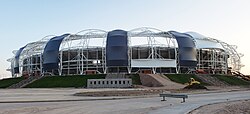
Key Facts
- Location: Belgrano Avenue, Santiago del Estero, Argentina.
- Capacity: 30,000 spectators (expandable to 42,000).
- Construction Cost: AR$ 1,500 million.
- Field Dimensions: 105 x 70 meters of natural grass.
- Ownership: Government of Santiago del Estero.
- Key Tenants: Central Córdoba, C.A. Mitre, and the Argentina national football and rugby teams.
Design and Architecture
Designed by architect Enrique Lombardi of Luciani Asociados Arquitectos, the stadium was the result of a local competition won in 2010. The structure is characterized by its cylindrical shape and fully covered grandstands, ensuring spectator comfort regardless of weather conditions.
The facility is strategically situated on the banks of the Dulce River, north of the city. It is well-integrated into the local infrastructure, connected via a station to the Tren al Desarrollo (Development Train) and located near the city's botanical garden and Carretero Bridge. The design adheres to the strict standards set by FIFA, CONMEBOL, and the Argentine Football Association (AFA).
Beyond the pitch, the complex includes several high-end amenities:
- A sports museum and a dedicated press area.
- VIP sectors and an on-site restaurant.
- A covered parking lot with space for 400 vehicles.
- A main access plaza featuring a 5-meter bronze statue of football legend Diego Maradona.
Construction and Opening
The project was initiated following an agreement signed on April 13, 2018, between Governor Gerardo Zamora and AFA President Claudio Tapia. Construction began in June 2018 and was completed in May 2020. The stadium was officially inaugurated on March 4, 2021, in a ceremony attended by Argentine President Alberto Fernández.
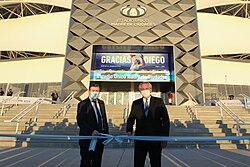
While the stadium was originally intended to host matches for the 2020 Copa América, the COVID-19 pandemic forced the tournament's rescheduling and eventual relocation to Brazil. Despite this setback, the venue quickly established itself as a key site for national team qualifiers and domestic cup finals.
Sporting Events and Competitions
Football
The stadium's first major event was the 2019 Supercopa Argentina, held on March 4, 2021, where River Plate defeated Racing Club. It has since become a frequent host for the Copa Argentina, Supercopa Argentina, and the Trofeo de Campeones. In 2023, it played a pivotal role in the FIFA U-20 World Cup, hosting multiple group stage matches and knockout rounds.
Rugby
The venue has also expanded its utility into rugby union. It hosted its first international rugby match on July 16, 2022, during a test series between Argentina and Scotland. It later hosted a high-profile Rugby Championship match between Argentina and South Africa in September 2024.
| Feature | Detail |
|---|---|
| Full Name | Estadio Único Madre de Ciudades |
| Architect | Enrique Lombardi (Luciani Asociados Arquitectos) |
| Builder | MIJOVI Astori |
| Surface | Grass |
| Opening Date | March 4, 2021 |
| Max Capacity | 42,000 (expandable) |
Controversies
The construction of the stadium was not without criticism. Some press outlets and critics questioned the expenditure of AR$ 1,500 million during a national economic crisis and debt restructuring period. Concerns were raised regarding the priority of the project given the high poverty rates (approximately 70%) and unemployment levels in Santiago del Estero.
Governor Gerardo Zamora defended the project, stating that the stadium serves as a catalyst for tourism and positions the province as a "headquarters for international football," while creating both direct and indirect employment opportunities during its construction.
Frequently Asked Questions
Why is the stadium called "Madre de Ciudades"?
The name is a tribute to the city of Santiago del Estero, the oldest city in Argentina. Because it served as a base for the Spanish Empire before they founded other cities in northern Argentina, it earned the nickname "Mother of Cities."
Who are the primary tenants of the stadium?
The stadium is home to football clubs Central Córdoba and C.A. Mitre, and it frequently hosts the Argentina national football and rugby teams.
What is the maximum capacity of the venue?
The stadium currently has a seating capacity of 30,000, but it is designed to be expandable up to 42,000 spectators.
Did the stadium host the Copa América?
Although it was confirmed as a host venue for the 2021 Copa América, the tournament was eventually moved to Brazil due to the COVID-19 pandemic.
What special features are found in the stadium plaza?
The main access plaza features a prominent 5-meter (16 ft) bronze statue of the legendary footballer Diego Maradona.