Estadio Club Sportivo Barracas: The Historic Heart of Argentine Sport
In the vibrant neighborhood of Barracas, Buenos Aires, there once stood a venue that served as a cornerstone for South American athletics. The Estadio Club Sportivo Barracas was more than just a football pitch; it was a multipurpose arena that hosted international legends, pioneered sporting terminology, and witnessed the evolution of Argentine sport during the early 20th century.
Owned by Club Sportivo Barracas, the stadium was constructed following the club's promotion to the Primera División (the top tier of Argentine football) in 1916. Located at the intersection of Iriarte and Luzuriaga, the facility featured a grass surface and a capacity of 37,000 spectators. In its early days, the field was simply delimited by poles and chains, with a one-meter wall separating the fans in the grandstands from the action on the pitch.
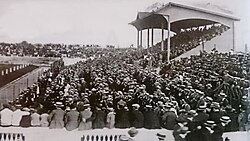
Key Facts
- Location: Barracas, Buenos Aires, Argentina.
- Operational Years: Opened May 25, 1920; demolished in 1937.
- Capacity: 37,000 spectators.
- Major Tenants: Sportivo Barracas and the Argentina national football team (1920–1932).
- Legacy: Birthplace of the terms "Olympic goal" (Gol olímpico) and "Olympic lap" (vuelta olímpica).
A Legacy of Football and International Competition
The stadium opened to the public on May 25, 1920, for the 1919 Tie Cup final, where Boca Juniors defeated Uruguayan Nacional 2–1. Its official inauguration followed shortly after on June 11, 1920, during a friendly tournament featuring Sportivo Barracas, Newell's Old Boys, and Tiro Federal.
Throughout the 1920s, the venue became a preferred site for high-stakes international football. It hosted the 1920 Copa Newton and the 1921 and 1925 Copa América tournaments. The stadium also welcomed prestigious European clubs, including RCD Espanyol (featuring the legendary goalkeeper Ricardo Zamora), Real Madrid, FC Barcelona, and Torino.
The Birth of the "Olympic Goal"
One of the most enduring contributions of Estadio Sportivo Barracas to global sports culture occurred on October 2, 1924, during a match between Argentina and Uruguay. Following Uruguay's gold medal win at the Paris Olympics, the team celebrated by circling the field—an act known as la vuelta de los olímpicos, which evolved into the modern term vuelta olímpica (Olympic lap).
During this same match, Cesáreo Onzari scored a goal directly from a corner kick. This was made possible by a rule change implemented by the International Board on June 14, 1924. This feat became known as a Gol olímpico (Olympic goal), a term still used across Latin America and parts of Europe today.
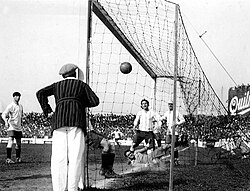
Beyond Football: A Multisport Hub
While football was the primary draw, the stadium was a versatile space for various athletic disciplines. In April 1924, it hosted Argentina's first open-air boxing match, where Luis Ángel Firpo defeated Al Reich before a massive crowd of 60,000 people.
By the early 1930s, the venue expanded its offerings to include basketball, hurling, and rugby union. The Sportivo Barracas rugby team, competing in the Second Division, began playing their home matches there in 1929.
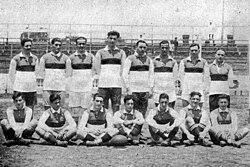
Stadium Summary and Timeline
| Category | Details |
|---|---|
| Full Name | Estadio Club Sportivo Barracas |
| Address | Iriarte and Luzuriaga, Barracas, Buenos Aires |
| Opened | May 25, 1920 |
| Demolished | 1937 |
| Surface | Grass |
| Capacity | 37,000 |
The Final Years
The stadium's era came to an end in 1937. Following the disaffiliation of Sportivo Barracas from the Argentine Football Association, the structure was demolished. The final official match took place on December 11, 1937, with Sportivo Barracas securing a 4–3 victory over Sportivo Buenos Aires.
Frequently Asked Questions
What is an "Olympic goal" (Gol olímpico)?
An Olympic goal is a goal scored directly from a corner kick without touching any other player. The term originated at Estadio Sportivo Barracas after Cesáreo Onzari achieved this feat during a match against Uruguay on October 2, 1924.
Who were the primary tenants of the stadium?
The stadium was primarily used by Club Sportivo Barracas (football and rugby) and served as a home venue for the Argentina national football team from 1920 until 1932.
Did the stadium host sports other than football?
Yes. The venue hosted rugby union, basketball, hurling, and boxing. Notably, it hosted the first open-air boxing match in Argentina in 1924.
When was the stadium demolished?
The stadium was demolished in 1937, the same year that Club Sportivo Barracas disaffiliated from the Argentine Football Association.
Which famous European teams played at the venue?
Several prestigious clubs played there, including Real Madrid, FC Barcelona, RCD Espanyol, and Torino.