Erminio Blotta: The Resilient Journey of a Self-Taught Sculptor
The story of Erminio Blotta is one of profound resilience, artistic passion, and the immigrant experience. A self-taught sculptor of Italian origin, Blotta navigated the challenges of poverty, a devastating physical injury, and the transition between three different countries to leave an indelible mark on the artistic landscape of South America.
Early Life and Artistic Beginnings
Born on November 8, 1892, in Morano Calabro, Calabria, Italy, Blotta arrived in Argentina as a young child in 1894. His family settled in Rosario, Santa Fe Province, joining a larger wave of Italian immigration. The eldest of nine children, Blotta did not follow a traditional academic path in the arts; instead, he was an apprentice for the Ferrocarril Central Argentino railway company.
It was during this time that he began modeling figurines with clay, discovering a natural aptitude for sculpture. He further refined his skills working in a medal workshop under Marcos Vanzo, where he created funeral portraits and plaques. By 1909, he sought formal guidance by studying with the sculptor José Nardi.
Between 1909 and 1912, a restless spirit led Blotta to travel to Montevideo, Uruguay, and Buenos Aires. Upon returning to Rosario, he opened an exhibition gallery with the help of friends and a private benefactor, showcasing his first bronze bass-reliefs (sculptures where figures project slightly from a flat background).
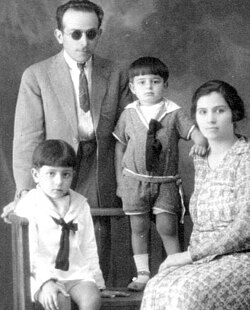
Despite his growing talent, Blotta faced significant financial hardship, living in conventillos (cheap pensions) for four years. In 1915, through the support of surgeon Artemio Zeno, he established a workshop that became a hub for poor intellectuals, artists, and members of the anarchist movement.
The Tragedy and Triumph of Blindness
In November 1917, a catastrophic accident altered the course of Blotta's life. While working on a monument to Juan Bautista Alberdi, a chip of marble broken by an assistant shattered Blotta's glasses, sending splinters into both eyes. After months of total blindness, he underwent surgery performed by Dr. Pedro Lagleyze, which restored sight only to his left eye.
To aid his recovery, Dr. Lagleyze sent him to Villeta, Paraguay. While there, Blotta found a new community and met Carmen de Jesús Prieto Ruiz, a schoolteacher whom he married on September 4, 1918. His time in Paraguay was artistically fruitful; he collected aboriginal Tupi-Guarani art and created several works that remain in Paraguayan cities today. His connection to the nation was so deep that he was eventually named an Honorary Citizen of Paraguay.
Professional Career and Artistic Evolution
Blotta returned to Rosario in 1920. While he is best known for his sculpture, he was a versatile intellectual. Between the 1910s and 1930s, he served as a literary commentator for the newspaper La Nación in Buenos Aires, writing under the name "Herminio Blotta."
His artistic style evolved over the decades. While his youth was defined by work in marble and stone, by the mid-1920s, he shifted toward clay models that were subsequently cast in bronze. Records indicate he produced over 200 such works. To support himself, he also worked as a draftsman for the Ports Direction of Rosario and collaborated on a scale model of the thalweg (the deepest part of a river channel) of the Paraná River.
Alongside colleague Pedro Cresta, Blotta also produced hundreds of bronze objects for headstones, blending his commercial funeral art with his lifelong passion for sculpting.
Key Facts
- Origin: Born in Morano Calabro, Italy; immigrated to Argentina in 1894.
- Training: Self-taught, starting with clay figurines during a railway apprenticeship.
- Major Adversity: Lost sight in one eye due to a marble chip accident in 1917.
- Paraguayan Connection: Honorary Citizen of Paraguay; influenced by Tupi-Guarani art.
- Output: Created over 200 bronze works and numerous funeral art pieces.
- Legacy: Works located in Argentina, Spain, and Israel.
| Category | Details |
|---|---|
| Lifespan | November 8, 1892 – January 23, 1976 |
| Primary Mediums | Clay, Bronze, Marble, Stone |
| Key Locations | Rosario (Argentina), Villeta (Paraguay), Montevideo (Uruguay) |
| Notable Collaborators | Marcos Vanzo, Pedro Cresta |
| Posthumous Honor | Street renamed "Escultor Blotta" in Rosario (1978) |
Legacy and Global Reach
Erminio Blotta's influence extended far beyond his home in Rosario. His sculptures are distributed across various Argentine provinces, including Santa Fe, Buenos Aires, Mendoza, Córdoba, Tucumán, Entre Ríos, and Chaco. Internationally, his work can be found in Santiago de Compostela, Spain, and at the Mefalsim kibbutz in Israel.
Blotta passed away in 1976 at the age of 83, surrounded by his family. Today, his memory is preserved in Rosario not only through his art but also through a one-block passage renamed "Escultor Blotta," located just steps away from his monument to J. B. Alberdi.
Frequently Asked Questions
How did Erminio Blotta learn to sculpt?
Blotta was largely self-taught. He began by modeling clay figurines while working as an apprentice for the Ferrocarril Central Argentino railway company and later gained experience in a medal workshop and through studies with sculptor José Nardi.
What caused Blotta's partial blindness?
In 1917, while working on a monument to Juan Bautista Alberdi, a chip of marble broke his glasses, and the resulting glass splinters wounded both of his eyes. He eventually recovered sight in only his left eye after surgery.
What was Blotta's connection to Paraguay?
Blotta moved to Villeta, Paraguay, to recover from his eye injury. During this time, he married Carmen de Jesús Prieto Ruiz, studied Tupi-Guarani art, and created several local works. He was later named an Honorary Citizen of Paraguay.
Did Blotta do anything other than sculpture?
Yes, Blotta was a multifaceted professional. He was a literary commentator for La Nación newspaper, a draftsman for the Ports Direction of Rosario, and a plaster artisan for a scale model of the Paraná River.
Where can you find his work today?
His works are located throughout several Argentine provinces, as well as in Spain (Santiago de Compostela) and Israel (Mefalsim kibbutz).