Eocene Epoch: The Greenhouse World of the Paleogene
The Eocene was a pivotal epoch in Earth's history, spanning from approximately 56.00 to 33.9/33.7 million years ago (Ma). As part of the Paleogene period within the Cenozoic era, the Eocene represents a time of dramatic climatic shifts, the rise of modern mammal orders, and a world that was significantly warmer than today.
This era began with a sudden spike in global temperatures and ended with the first permanent ice sheets forming in Antarctica, marking the transition from a "greenhouse" world to an "icehouse" world.
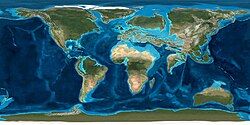
Key Facts
- Time Span: 56.00 to 33.9/33.7 million years ago.
- Defining Start: Marked by a strong negative anomaly in carbon isotope (δC) values during the Paleocene-Eocene Thermal Maximum (PETM).
- Defining End: Marked by the last appearance (LAD) of planktonic foraminifers Hantkenina and Cribrohantkenina.
- Climate: Transitioned from extreme global warmth to significant cooling.
- Key Lifeforms: Diversification of early mammals, flightless birds like Gastornis, and diverse angiosperm forests.
Chronology and Stratigraphy
The Eocene is formally divided into several ages, which help geologists track the evolution of the planet. These subdivisions are ratified by the International Commission on Stratigraphy (ICS).
The Eocene Timeline
The epoch is divided into the following ages, from oldest to youngest:
- Ypresian
- Lutetian
- Bartonian
- Priabonian
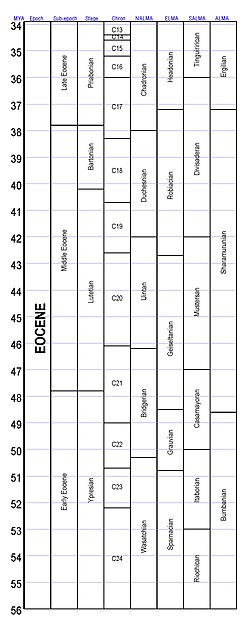
Boundary Definitions
The lower boundary of the Eocene is defined by the Paleocene-Eocene Thermal Maximum (PETM), a period of rapid carbon release and warming. The Global Boundary Stratotype Section and Point (GSSP) for the start of the Eocene is located at the Dababiya section in Luxor, Egypt. The upper boundary, marking the end of the Eocene, is defined at the Massignano quarry section in Ancona, Italy.
Climate and Environment
The Eocene is most famous for its extreme warmth. During the Early Eocene, the planet experienced an "equable climate," where the temperature difference between the poles and the equator was much smaller than it is today.
![Climate change during the last 65 million years[51]](/images/a7/c6/a7c6b71a1e96524c35c5540955245f3e26459c49eadb8c1cdb0b539d407b3adb.png)
The Greenhouse Effect and Cooling
High levels of atmospheric carbon dioxide and methane contributed to a humid, subtropical environment that extended far into high latitudes. However, this trend did not last. Throughout the Middle and Late Eocene, the Earth began a gradual cooling process. This culminated in the Eocene-Oligocene transition, where the first permanent Antarctic ice sheets formed, fundamentally altering global ocean circulation and climate.
Flora and Vegetation
The warmth of the Eocene supported high-diversity forests. In regions like the Clarno Nut Beds, vegetation consisted of humid subtropical forests dominated by angiosperms (flowering plants). Fossil evidence, such as seeds from the Nyssaceae and Lauraceae families found in the London Clay, highlights the lush nature of these ancient ecosystems.
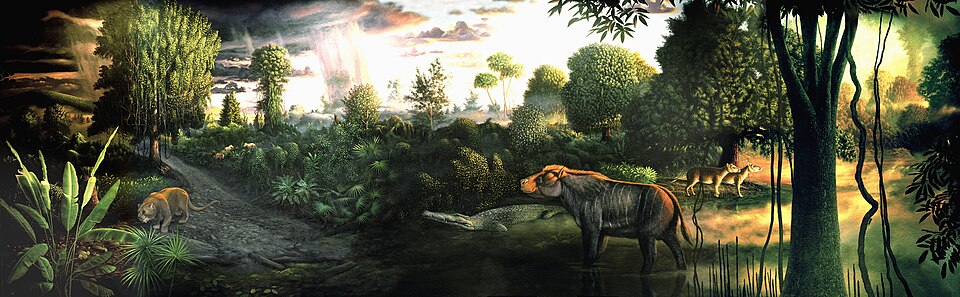
Fauna: The Rise of Modern Animals
The Eocene was a golden age for mammalian diversification. Following the extinction of the non-avian dinosaurs, mammals filled vacant ecological niches, evolving into a wide array of forms.
Mammals and Vertebrates
Notable mammals of the Eocene include Andrewsarchus, a large carnivorous or omnivorous artiodactyl, and Leptictidium, a small, likely bipedal mammal. The era also saw the emergence of early primatomorphs, some of which reached as far north as Ellesmere Island in the Arctic.
Birds, Reptiles, and Marine Life
- Birds: The epoch featured Gastornis, a massive flightless bird, and early relatives of the roller, such as Primobucco.
- Reptiles: Crocodyliforms like Borealosuchus were prevalent, and fossils of Hummelichelys show evidence of crocodile bite marks.
- Marine Life: The oceans were home to diverse sharks, including the otodontid Otodus sokolovi and the mackerel shark Xiphodolamia.
Eocene Summary Table
| Feature | Details |
|---|---|
| Time Period | 56.00 – 33.9/33.7 Ma |
| Period/Era | Paleogene / Cenozoic |
| Key Climate Event | Paleocene-Eocene Thermal Maximum (PETM) |
| Major Flora | Angiosperm-dominated subtropical forests |
| Key Fauna | Early mammals, Gastornis, Andrewsarchus |
| End Marker | Formation of permanent Antarctic ice sheets |
Frequently Asked Questions
What was the PETM?
The Paleocene-Eocene Thermal Maximum (PETM) was a rapid global warming event at the start of the Eocene, characterized by a massive release of carbon into the atmosphere and oceans, leading to a strong negative anomaly in carbon isotope values.
How did the Eocene climate differ from today?
The Eocene was significantly warmer and more "equable," meaning there was less temperature variation between the equator and the poles. Subtropical forests existed in regions that are now polar or temperate.
Which animals were dominant during the Eocene?
Mammals underwent massive diversification during this time. Large flightless birds like Gastornis and early ancestors of modern ungulates and primates were prominent.
What caused the Eocene to end?
The Eocene ended as the Earth transitioned from a greenhouse state to an icehouse state, marked by a significant cooling trend and the establishment of permanent ice sheets in Antarctica.
Where can Eocene fossils be found today?
Famous fossil sites include the London Clay in the UK, the Messel pit in Germany, Bolca in Italy, and Wadi El Hitan in Egypt.