Encyclopædia Britannica Eleventh Edition: A Pre-War Scholarly Time Capsule
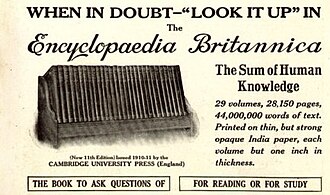
The Encyclopædia Britannica Eleventh Edition, published between 1910 and 1911, stands as one of the most significant reference works in history. Spanning 29 volumes, this edition represents a pivotal moment in the publication's evolution, marking its transition from a British-centric work to a more global, American-influenced publication.
While modern scholarship often views the content as outdated, the Eleventh Edition is prized today as a historical time capsule. It captures the scientific knowledge, historical interpretations, and scholarly attitudes of the era immediately preceding World War I.
Key Facts
- Publication Date: 1910–1911.
- Scope: 29 volumes containing approximately 40,000 entries.
- Publisher: Horace Everett Hooper via Cambridge University Press.
- Legal Status: Now in the public domain and available digitally.
- Key Innovation: First edition to be published as a complete set rather than volume-by-volume.
The Transition to an American Influence
The journey to the Eleventh Edition began when Horace Everett Hooper acquired the rights to the 9th edition. After a brief partnership with The Times to produce the Tenth Edition in 1902, Hooper negotiated with Cambridge University Press for the 1910–1911 release.
Although it is often viewed as a quintessentially British work, the Eleventh Edition integrated substantial American influences. This included a significant increase in Canadian and American content and the adoption of American marketing strategies to boost sales. To coordinate this effort, a New York office was established, and North Americans comprised roughly 14% of the contributors (214 out of 1,507 scholars).
Format Innovations and Content
The Eleventh Edition introduced several groundbreaking changes to the Britannica format. For the first time, the entire set was released simultaneously. To ensure accuracy, print types were kept in galley proofs (preliminary versions of a publication) and updated continuously until the final printing.
Other notable firsts included:
- The introduction of a comprehensive index volume featuring a categorical index.
- The removal of long, treatise-length articles in favor of a higher volume of shorter entries, increasing the total from 17,000 to 40,000.
- The inclusion of biographies of living people.
- The integration of sixteen English-translated maps from Stielers Handatlas, printed by Justus Perthes in Gotha, Germany.
Subject Distribution
The intellectual breadth of the work is reflected in its content distribution, with geography and science taking the lead.
| Subject | Percentage of Content |
|---|---|
| Geography | 29% |
| Science | 17% |
| History | 17% |
| Literature | 11% |
| Fine Art | 9% |
| Social Science | 7% |
| Psychology | 1.7% |
| Philosophy | 0.8% |
Legacy and Later Editions
In 1920, Hooper sold the rights to Sears, Roebuck and Company, finalizing the transition to an American publication. The Eleventh Edition served as the foundation for the Twelfth (1922) and Thirteenth (1926) editions, which primarily added supplemental volumes to cover events like World War I. Even the Fourteenth Edition (1929) relied on the Eleventh as its base. It wasn't until the Fifteenth Edition in 1974 that the Britannica was completely reimagined with modern information presentation.
Culturally, the edition has been praised by figures such as Jorge Luis Borges and referenced by T.S. Eliot. Sir Kenneth Clark noted that the work reflects a tradition where information was often "coloured by prejudice," making it a fascinating study of early 20th-century thought.
Public Domain and Digital Access
Because the Eleventh Edition is in the public domain, it is widely available online. One of the most prominent versions is the Project Gutenberg Encyclopedia, which was renamed to avoid trademark conflicts with the Britannica brand. Other digital archives, such as HathiTrust and Wikisource, also provide access to the original text.
Users are cautioned that while the work is a masterpiece of its time, its reliability for modern factual research is problematic. Interpretations of history and science have evolved; for instance, modern views on the Visigoths differ sharply from the 1911 perspective, which directed readers to the entry for Alaric I to understand the tribe's social customs.
Frequently Asked Questions
Why is the Eleventh Edition considered a "time capsule"?
It preserves the specific scientific theories, historical biases, and scholarly perspectives of the world immediately before the outbreak of World War I.
Who was the primary publisher of the 1910–1911 edition?
The edition was published by Horace Everett Hooper in coordination with Cambridge University Press.
How did the Eleventh Edition differ from previous versions in terms of format?
It was the first to be published as a complete set rather than volume-by-volume, the first to include a categorical index, and the first to feature biographies of living people.
Is the 1911 Encyclopædia Britannica still accurate?
While some facts remain true, many entries are outdated. New theories and perspectives have fundamentally changed how the information is interpreted today.
Where can I read the Eleventh Edition for free?
It is available through the Project Gutenberg Encyclopedia, Wikisource, and the Internet Archive.