Encyclopaedia of Islam: The Definitive Academic Reference for Islamic Studies
The Encyclopaedia of Islam (commonly abbreviated as EI) stands as the preeminent academic reference work for the study of Islam and the Islamic world. Published by Brill in Leiden, Netherlands, this monumental project provides an exhaustive repository of knowledge covering the religious, social, and political dimensions of Islamic civilization from its origins to the modern era.
Because of its depth and the prestige of its contributors, the EI is widely regarded as the standard reference tool in the field of Islamic studies. It is not merely a collection of dictionary entries but a series of scholarly research pieces, many of which are signed by recognized specialists and accompanied by detailed bibliographies.
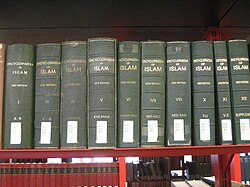
Key Facts
- Publisher: Brill (Leiden, Netherlands).
- Scope: Covers the Arabo-Islamic empire, Iran, Central Asia, the Indian sub-continent, Indonesia, and the Ottoman Empire.
- Editions: Three major editions (EI1: 1913–1938; EI2: 1954–2008; EI3: 2007–present).
- Content: Includes articles on distinguished Muslims, dynasties, sciences, political institutions, geography, and monuments.
- Format: Originally print; the third edition is available online.
Evolution of the Editions
The First Edition (EI1)
Published between 1913 and 1938, the first edition was modeled after the Pauly-Wissowa Realencyclopädie der classischen Altertumswissenschaft. Coordinated by Leiden University under the International Union of Academies, it was released in English, French, and German. This edition consisted of four volumes and a supplement, focusing heavily on the geography, ethnography, and biography of Muslim peoples.
The Shorter Encyclopaedia of Islam (SEI)
In 1953, an abridged version known as the Shorter Encyclopaedia of Islam was published. This version focused primarily on law and religion. Its influence extended globally through translations into Turkish, Arabic, and Urdu.
The Second Edition (EI2)
The second edition, spanning 1954 to 2005, represented a significant expansion in both content and perspective. While the first edition was produced almost exclusively by European scholars, EI2 incorporated a growing number of contributors from Muslim and Middle Eastern backgrounds. Although these scholars were typically trained in Western-style universities, their inclusion shifted the tone and the types of questions addressed within the work.
EI2 placed a special emphasis on social and economic topics and became available in electronic formats (CD-ROM and web) starting in 1999.
The Third Edition (EI3)
Launched in 2007, the third edition is a dynamic, online-first project with printed "Parts" released four times a year. Managed by five Executive Editors—Kate Fleet, Gudrun Krämer, Denis Matringe, John Nawas, and Everett K. Rowson—EI3 expands the scope to include:
- Comprehensive coverage of Islam in the 20th century.
- Expanded geographical focus on all areas where Islam is a prominent aspect of society.
- Detailed attention to Muslim minorities worldwide.
- Integration of social science perspectives alongside traditional humanistic research.
Academic Reception and Criticism
The Encyclopaedia of Islam is praised for its authority and comprehensiveness. Many scholars view its signed articles as the best available treatment of their respective subjects. However, the work has not been without criticism. Historian Richard Eaton, in his 2003 work India's Islamic Traditions, 711–1750, argued that the project historically subscribed to an Orientalist view—a Western academic approach to the East—by treating Islam as a monolithic, "bounded, self-contained entity" rather than a diverse and evolving tradition.
Summary of Editions
| Edition | Publication Period | Primary Languages | Key Characteristics |
|---|---|---|---|
| EI1 | 1913–1938 | English, French, German | Foundational; primarily European scholars. |
| SEI | 1953 | English (translated to others) | Abridged; focused on law and religion. |
| EI2 | 1954–2008 | English, French | Expanded scope; included Muslim scholars. |
| EI3 | 2007–Present | English | Online access; 20th-century focus; social science integration. |
Frequently Asked Questions
What is the primary purpose of the Encyclopaedia of Islam?
It is a comprehensive reference work designed to facilitate the academic study of Islam, providing detailed information on the history, geography, people, and institutions of the Islamic world.
Who publishes the Encyclopaedia of Islam?
The work is published by Brill, a prestigious academic publisher based in Leiden, Netherlands.
How does the second edition differ from the first?
Beyond a massive expansion of content, the second edition (EI2) included scholars of Muslim and Middle Eastern backgrounds, moving away from the exclusively European interpretation found in EI1.
Is the Encyclopaedia of Islam available digitally?
Yes. The second edition became available electronically in 1999, and the third edition (EI3) is primarily available as an online resource.
What does the third edition add to the previous versions?
EI3 includes extensive coverage of the 20th century, focuses on Muslim minorities globally, and incorporates social science methodologies alongside humanistic perspectives.