Encyclopaedia of Islam: Evolution of the Definitive Scholarly Resource
The Encyclopaedia of Islam stands as one of the most ambitious academic undertakings in the study of Islamic civilization. Since its inception, it has served as a primary reference for scholars worldwide, evolving from a European-centric dictionary into a global, multidisciplinary project. Published by the academic publisher Brill, the work has transitioned through three major editions, each reflecting the changing methodologies and perspectives of the field.
Key Facts
- EI1: Published between 1913 and 1938; modeled on the Pauly-Wissowa Realencyclopädie.
- SEI: An abridged version released in 1953 focusing on law and religion.
- EI2: Published from 1960 to 2005; expanded content and included scholars of Muslim backgrounds.
- EI3: Launched in 2007; available online with a focus on the 20th century and social sciences.
- Publisher: Brill (Leiden), with coordination historically linked to Leiden University.
The First Edition (EI1) and the Shorter Encyclopaedia
The first edition, known as EI1, was created under the International Union of Academies and coordinated by Leiden University. It was modeled after the Pauly-Wissowa Realencyclopädie der classischen Altertumswissenschaft, a comprehensive reference for classical antiquity. Published between 1913 and 1938, EI1 consisted of four volumes and a supplement, available in English, German, and French.
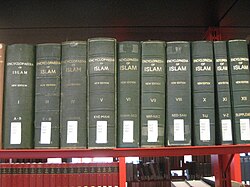
Because EI1 was produced almost exclusively by European scholars, it represents a specifically European interpretation of Islamic civilization. While not necessarily incorrect, the questions it addressed often differed from the traditional inquiries posed by Muslims themselves. In 1953, an abridged version titled the Shorter Encyclopaedia of Islam (SEI) was published, focusing primarily on religion and law. The SEI's influence extended globally through translations into Arabic, Turkish, and Urdu.
The Second Edition (EI2): A Shift in Perspective
The second edition, EI2, began in 1954 and reached completion in 2005, with final indexes published through 2007. This edition marked a significant expansion in both volume and intellectual scope. Beyond the increase in content, EI2 integrated the contributions of hundreds of scholars from Muslim and Middle Eastern backgrounds.
While these contributors were typically trained in Western-style universities rather than traditional centers like al-Azhar or Qom, their inclusion shifted the tone of the work. This integration of diverse scholarly perspectives provided a more nuanced approach to the study of Islamic civilization. By 1999, EI2 became accessible in electronic formats, including CD-ROM and web-based versions.
The Third Edition (EI3): Modernity and Global Scope
The EI3 began publication in 2007 and represents the most current iteration of the project. Unlike its predecessors, it is primarily available online, with printed "Parts" released four times a year. The editorial structure is robust, featuring five Executive Editors—Kate Fleet, Gudrun Krämer, Everett Rowson, John Nawas, and Denis Matringe—supported by twenty Sectional Editors.
The scope of EI3 has been significantly broadened to include:
- Comprehensive coverage of Islam in the twentieth century.
- Expanded geographical focus to include all regions where Islam is a prominent or dominant societal aspect.
- Dedicated attention to Muslim minorities globally.
- The integration of social science perspectives alongside traditional humanistic research.
Edition Comparison Summary
| Edition | Publication Period | Primary Focus/Characteristic | Format |
|---|---|---|---|
| EI1 | 1913–1938 | European interpretation; Geography, Ethnography, Biography | Print (English, French, German) |
| SEI | 1953 | Abridged; Law and Religion | Print (Multiple translations) |
| EI2 | 1960–2005 | Expanded content; Inclusion of Muslim scholars | Print and Electronic |
| EI3 | 2007–Present | 20th century; Social sciences; Global minorities | Online and Periodic Print |
Frequently Asked Questions
How does EI2 differ from EI1 in terms of authorship?
While EI1 was produced almost entirely by European scholars, EI2 incorporated a growing proportion of scholars from Muslim and Middle Eastern backgrounds, changing the tone and perspective of the entries.
What is the Shorter Encyclopaedia of Islam (SEI)?
The SEI is an abridged version of the first edition published in 1953, focusing specifically on the areas of law and religion.
What new areas of study does EI3 cover?
EI3 expands its scope to include the twentieth century, Muslim minorities worldwide, and the application of social science methodologies in addition to humanistic perspectives.
Who is the publisher of the Encyclopaedia of Islam?
The Encyclopaedia of Islam is published by the Dutch academic publisher Brill.
In what languages was the first edition available?
The first edition (EI1) was published in English, German, and French.