Emperor Maximilian I: The Rise and Fall of the Second Mexican Empire
The story of the Second Mexican Empire is a dramatic tale of political ambition, foreign intervention, and a tragic clash of ideologies. At its center was Maximilian of Habsburg, an Austrian archduke who was invited to rule a nation far from his homeland, only to find himself caught between the demands of European powers and the fierce resistance of Mexican republicans.
The Path to the Throne
Following independence in 1821, Mexico was deeply fractured between liberal and conservative factions. While liberals championed a republic, conservatives viewed a monarchy as the only way to end decades of political chaos. By the late 1850s, liberals had gained the upper hand with the Constitution of 1857, which limited the power of the army and the Catholic Church. Defeated on the battlefield during the civil war of 1858–61, conservatives looked toward Europe for a savior.
Mexican monarchists, aided by diplomat José Hidalgo and the influence of Empress Eugénie de Montijo, identified Maximilian as the ideal candidate. As a member of the House of Habsburg, he possessed historical legitimacy, and his reputation as a capable administrator in Lombardy-Venetia made him attractive. Although he initially declined, the persistence of the Mexican royalists eventually won him over.
Meanwhile, the United States was preoccupied with its own Civil War, leaving it unable to enforce the Monroe Doctrine—the policy opposing foreign colonization in the Americas. This vacuum provided Napoleon III of France an opportunity to establish a client state in Mexico to serve as a buffer against U.S. expansion. Using a debt dispute as a pretext, France, Britain, and Spain launched an expedition in 1861.
The French Invasion and Accession
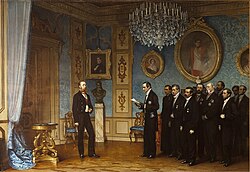
While Britain and Spain eventually withdrew, France continued its military campaign. Despite an initial setback at the Battle of Puebla on May 5, 1862, French forces eventually captured Mexico City in June 1863. A provisional government, the Assembly of Notables, formally invited Maximilian to take the throne.
Maximilian insisted on a national plebiscite (a direct vote by the people) to legitimize his rule. Although the vote was held in occupied territories and widely considered a farce, the results were proclaimed in his favor. To accept the crown, Maximilian had to sign a "Family Pact," renouncing his rights to the Austrian throne to satisfy his brother, Emperor Franz Joseph.
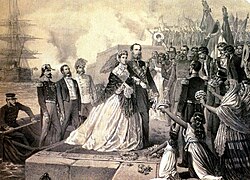
Maximilian and his wife, Carlota, arrived in Veracruz on May 29, 1864. While they were greeted with grandeur in the capital, the empire was unstable from the start. President Benito Juárez and the liberal forces refused to recognize the monarchy, maintaining a government-in-exile in the north.
A Moderate Vision in a Polarized Land
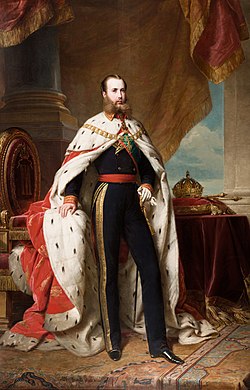
Surprisingly, Maximilian did not govern as the hardline conservative puppet his supporters had hoped. Instead, he sought a moderate path, granting amnesty to liberals and upholding many of the reforms from the Constitution of 1857. This alienated the very conservatives and clergy who had invited him.
The tension peaked when the papal nuncio demanded the reversal of liberal laws and the reinstatement of Catholicism as the sole religion. Maximilian refused, decreeing freedom of worship and confirming the sale of Church property. While he attempted to modernize the administration and the army, he remained heavily dependent on French military support, which was controlled by General Bazaine.
The Collapse of the Empire
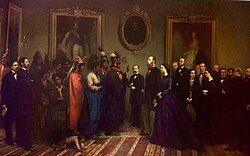
The tide turned after the American Civil War ended in 1865. The U.S. government provided financial and diplomatic support to Benito Juárez and pressured France to withdraw. As French troops began to leave in 1866, the empire's military situation deteriorated. In a desperate attempt to quell guerrilla warfare, Maximilian issued the Black Decree, which authorized the summary execution of anyone aiding the republicans. This brutal measure resulted in over 11,000 deaths and destroyed the Emperor's remaining popularity.
By 1867, Maximilian was besieged in the city of Querétaro. Despite the loyalty of some troops, he was betrayed by Colonel Miguel López, who opened the city gates to the Republican army. Maximilian was captured on May 16, 1867.
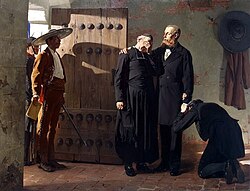
Trial and Execution
Maximilian was tried by a military court and found guilty of conspiring against the Mexican government and implementing the Black Decree. Despite pleas for clemency from European monarchs and figures like Victor Hugo, President Juárez refused to commute the sentence. Juárez believed a firm example was necessary to deter future foreign interventions.
On June 19, 1867, Maximilian was executed by firing squad at the Cerro de las Campanas. His final words expressed forgiveness for his enemies and a wish for the independence of Mexico.
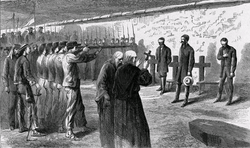
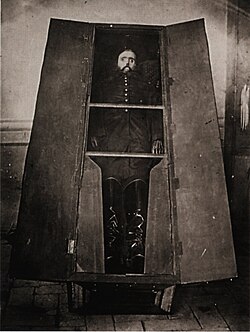
His body was embalmed and displayed before being repatriated to Austria six months later, where he was interred in the Imperial Crypt in Vienna.
Key Facts
- Reign: 1864–1867.
- Dynasty: House of Habsburg.
- Primary Backer: Napoleon III of France.
- Main Opponent: President Benito Juárez.
- Turning Point: The withdrawal of French troops in 1866.
- Fatal Policy: The Black Decree, leading to thousands of executions.
- End of Rule: Executed by firing squad in Querétaro on June 19, 1867.
| Feature | Details |
|---|---|
| Political Alignment | Moderate Monarchy (initially backed by Conservatives) |
| Foreign Support | French Empire (Military and Financial) |
| Key Conflict | Imperial forces vs. Republican forces (Juárez) |
| Major Reforms | Freedom of worship, political amnesty for liberals |
| Cause of Fall | French withdrawal and U.S. diplomatic pressure |
Frequently Asked Questions
Why did Napoleon III want to install a monarch in Mexico?
Napoleon III aimed to create a French client state in North America that would serve as a strategic buffer against the expansion of the United States and provide economic advantages for France.
Did the Mexican people actually want Maximilian?
While the conservative elite and some nobility supported him, the majority of the population remained loyal to the republic. The plebiscite used to justify his accession was widely considered a farce conducted under French military occupation.
Why did the Catholic Church turn against Maximilian?
Despite being invited by conservatives, Maximilian refused to reverse liberal reforms. He upheld the freedom of religion and the sale of Church property, which the Church viewed as an "ungodly" betrayal.
What was the Black Decree?
The Black Decree was a 1866 order that authorized the court-martial and execution of anyone found aiding republican guerrillas. It resulted in the deaths of over 11,000 people and severely damaged Maximilian's reputation.
Why did Benito Juárez refuse to spare Maximilian's life?
Juárez believed that executing the foreign emperor was a necessary political statement to prove that Mexico would not tolerate foreign invasions or the imposition of external rulers.