Einstein Family History: The Relatives and Legacy of Albert Einstein
While the world remembers Albert Einstein (1879–1955) as the revolutionary physicist who transformed our understanding of space and time, he was also part of a complex family network spanning several generations and countries. From the entrepreneurial spirit of his parents to the academic achievements of his children, the Einstein family history is a narrative of migration, business ventures, and personal struggle.
The family's recorded history extends back to the late 17th century with Albert's fourth-great-grandfather, Jakob Weil. Over the centuries, the lineage branched out, connecting to other families such as the Koch, Moos, and Overnauer families.
Key Facts
- Parents: Hermann Einstein and Pauline Koch.
- Siblings: One younger sister, Maria (Maja) Einstein.
- Children: Three children with first wife Mileva Marić: Lieserl, Hans Albert, and Eduard.
- Business: Hermann and his brother Jakob founded the electrical engineering firm Einstein & Cie.
- Ancestry: The family has Jewish roots, with ancestors including Löb Moses Sontheimer.
The Parents: Hermann and Pauline Einstein
Albert was born to Hermann Einstein and Pauline Koch. Hermann, born in 1847 in Buchau, Württemberg, was a salesman and electrician. Pauline, born in 1858 in Cannstatt, was a well-educated woman with a deep passion for the arts, particularly the piano. It was Pauline's influence that led Albert to begin violin lessons at the age of five.
The couple married on August 8, 1876. Initially living in Ulm, where Hermann partnered in a bed feathers company, they later moved to Munich in 1880. There, Hermann and his brother Jakob founded Einstein & Cie, an electrical engineering company. Hermann handled the commercial side of the business while Jakob served as the technician.
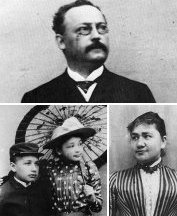
The family's fortunes shifted in 1894 when the factory moved to Pavia, Italy. However, the venture proved unsuccessful and was abandoned by 1896. Although Hermann started another electrical company in Milan that saw better success, his health declined, and he died of heart failure in 1902 at the age of 55.
Pauline's later years were marked by movement between Hechingen, Berlin, and Zurich. She eventually fell ill with cancer during World War I. In her final days, Albert brought her to Berlin to live with him and his second wife, Elsa, where Pauline passed away in February 1920.
Maria "Maja" Einstein
Albert's younger sister, Maria (known as Maja), was born in 1881. A scholar in her own right, Maja studied Romance languages and literature across Berlin, Bern, and Paris, eventually earning a doctorate from the University of Bern in 1909.
Maja married Paul Winteler and lived in Luzern and later Italy. Following the introduction of anti-Semitic laws by Benito Mussolini, Albert invited Maja to emigrate to the United States in 1939. She lived with Albert in Princeton, New Jersey, until her death in 1951, following a stroke and progressive arteriosclerosis.
The Children of Albert Einstein
Albert's relationship with his first wife, Mileva Marić, produced three children, each with a very different life path.
Lieserl Einstein
The existence of Albert's first child, Lieserl, remained unknown to biographers until 1986. Born in January 1902 in present-day Serbia, she was cared for by Mileva for a short time. Correspondence suggests she may have suffered from a developmental disability and likely died of scarlet fever in September 1903, though some theories suggest she may have been adopted.
Hans Albert Einstein
Born in 1904, Hans Albert followed in his father's academic footsteps. He earned a doctorate from ETH Zurich and later became a distinguished professor of Hydraulic engineering at the University of California, Berkeley, where he became a recognized expert in sediment transport.
Eduard "Tete" Einstein
The youngest son, Eduard, was born in 1910. His life was marked by hardship; following his parents' separation, he was raised primarily by his mother. Eduard spent much of his adult life at the Burghölzli psychiatric clinic in Zurich, where he died of a stroke in 1965 at age 55.
Family Summary Table
| Family Member | Relationship to Albert | Key Detail | Life Dates |
|---|---|---|---|
| Hermann Einstein | Father | Electrical engineer/merchant | 1847–1902 |
| Pauline Einstein | Mother | Talented pianist | 1858–1920 |
| Maria (Maja) | Sister | Doctor of Romance languages | 1881–1951 |
| Lieserl | Daughter | Existence discovered in 1986 | 1902–1903 |
| Hans Albert | Son | Professor of Hydraulic engineering | 1904–1973 |
| Eduard | Son | Lived in psychiatric care | 1910–1965 |
Frequently Asked Questions
Who was Albert Einstein's mother?
His mother was Pauline Einstein (née Koch), a well-educated woman from Cannstatt who was a talented piano player and encouraged Albert's early interest in music.
What business did Albert's father run?
Hermann Einstein and his brother Jakob founded an electrical engineering company called Einstein & Cie in Munich, though they later attempted to move the operation to Italy.
Who was Lieserl Einstein?
Lieserl was Albert Einstein's first child with Mileva Marić, born in 1902. Her existence was a secret until letters were discovered in 1986; she is believed to have died in infancy.
Did any of Albert's children follow his academic path?
Yes, his son Hans Albert Einstein became a prominent professor of Hydraulic engineering at the University of California, Berkeley.
Where did Maja Einstein spend her final years?
Maja emigrated from Italy to the United States in 1939 to escape anti-Semitic laws and lived with Albert in Princeton, New Jersey, until her death in 1951.