Eduardo Duhalde: The Political Journey of Argentina's 53rd President
Eduardo Alberto Duhalde is a prominent figure in Argentine politics, having navigated the complex landscape of the Justicialist Party (the Peronist party) for several decades. His career is marked by a steady ascent through local and provincial governance, culminating in his tenure as the 53rd President of Argentina during one of the nation's most volatile economic periods.
From his early days as a lawyer and mayor in Lomas de Zamora to his roles as Vice President and Governor of Buenos Aires, Duhalde's trajectory reflects the shifting tides of Argentine democracy and the internal power struggles of Peronism.
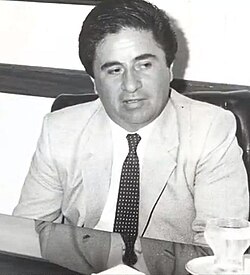
Key Facts
- Presidency: Served as President of Argentina from January 2, 2002, to May 25, 2003.
- Key Economic Action: Repealed the convertibility plan and oversaw the devaluation of the peso.
- Previous High Offices: Served as Vice President of Argentina (1989–1991) and Governor of Buenos Aires (1991–1999).
- Political Affiliation: A lifelong member of the Justicialist Party.
- Education: Graduated as a lawyer from the University of Buenos Aires in 1970.
Early Career and Local Governance
Born on October 5, 1941, in Lomas de Zamora, Eduardo Duhalde entered the political arena shortly after completing his law degree. By 1971, he was elected to the city legislature and quickly rose to lead the local branch of the Justicialist Party. In 1973, he was appointed intendente (mayor) of Lomas de Zamora, though his first term was cut short by the 1976 military coup d'état.
Following the restoration of democracy, Duhalde returned to the mayoralty in 1983, winning a narrow victory. During this period, he demonstrated his commitment to the democratic process by reporting a coup attempt against President Raúl Alfonsín to the president himself. His influence grew as he was elected as a national deputy in 1987, eventually serving as the vice president of the Argentine Chamber of Deputies.
Rise to National Power: Vice Presidency and Governorship
In 1989, Duhalde was elected Vice President of Argentina under President Carlos Menem. However, his ambitions led him to resign from this post in 1991 to run for Governor of Buenos Aires Province, a position he held until 1999. His tenure as governor was marked by a strategic battle over constitutional amendments to allow for his re-election, which he eventually secured via a provincial referendum.
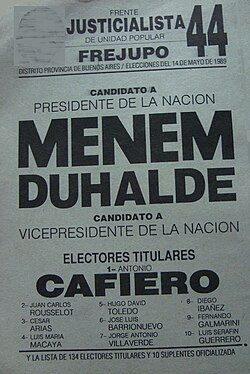
The late 1990s saw a deepening rivalry between Duhalde and President Menem. Despite Menem's attempts to maintain influence through the "Menem '99" campaign, Duhalde sought the presidency in 1999. He was ultimately defeated by Fernando de la Rúa, a loss that temporarily sidelined him from the national executive branch.
The Presidency and Economic Crisis (2002–2003)
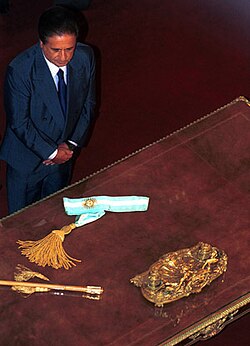
Duhalde's path to the presidency was unconventional. Following the resignation of Fernando de la Rúa during the December 2001 riots and the subsequent short-lived presidency of Adolfo Rodríguez Saá, Congress appointed Duhalde as president on January 2, 2002.
Economic Recovery and "Pesification"
Duhalde inherited a collapsed economy. His administration's primary goal was to stimulate industrial growth, leading to the creation of a dedicated ministry of production. To combat the crisis, he repealed the convertibility plan (which had pegged the peso to the US dollar), resulting in a massive currency devaluation. While the exchange rate jumped from 1:1 to 3:1, this move made exports more competitive and spurred employment, though it significantly increased the cost of living.
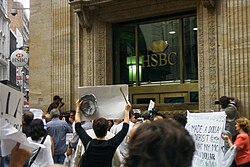
One of the most contentious issues was the corralito—a measure imposed by the previous administration that froze bank accounts to prevent a bank run. Duhalde initially promised that dollar depositors would receive dollars, but later admitted this was impossible due to insufficient reserves. This led to "pesification," where dollar accounts were converted to pesos at a 1.4 exchange rate.
Foreign and Domestic Policy
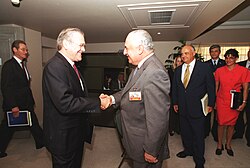
Internationally, Duhalde worked to stabilize Argentina's standing, maintaining relations with key partners including the United States and Spain. Domestically, his government absorbed provincial debts and bonds to centralize financial control and stabilize the state's fiscal position.
Later Political Years and Retirement
Duhalde was succeeded by Néstor Kirchner in May 2003. The relationship between the two men quickly soured as Kirchner sought to consolidate power and remove Duhalde's allies from government. This rivalry extended to the 2005 midterm elections, where their respective wives, Hilda González de Duhalde and Cristina Fernández de Kirchner, ran against each other for a senate seat, with Cristina Kirchner emerging victorious.
Duhalde attempted a political comeback in the 2011 presidential elections under the Unión Popular ticket but received only about 6% of the vote. Since then, he has largely retired from active politics, though he has made efforts to reconcile with his former rival, Carlos Menem.
Summary of Political Offices
| Office | Term Start | Term End | Key Role/Context |
|---|---|---|---|
| Mayor of Lomas de Zamora | 1973 | 1976 | First term; ended by coup |
| Mayor of Lomas de Zamora | 1983 | 1987 | Return to democracy |
| Vice President of Argentina | 1989 | 1991 | Under Carlos Menem |
| Governor of Buenos Aires | 1991 | 1999 | Two terms |
| President of Argentina | 2002 | 2003 | Appointed by Congress |
Frequently Asked Questions
How did Eduardo Duhalde become President of Argentina?
He was appointed by Congress in January 2002 following the resignations of Fernando de la Rúa and Adolfo Rodríguez Saá during a period of intense social and economic unrest.
What was the "corralito" and how did Duhalde handle it?
The corralito was a restriction on bank withdrawals designed to stop a bank run. Duhalde initially promised depositors they would get their dollars back but eventually implemented "pesification," converting dollar deposits into pesos at a specific exchange rate.
What was the impact of the currency devaluation during his term?
The devaluation of the peso made Argentine exports more lucrative and increased industrial activity and employment, though it simultaneously raised the cost of living for citizens.
What was his relationship with Néstor Kirchner?
While Duhalde supported Kirchner's candidacy, the two later became political rivals. Kirchner worked to reduce Duhalde's influence within the Justicialist Party, leading to public disputes and competing candidacies in later elections.
Did Eduardo Duhalde ever win a presidential election?
No. He was appointed president by Congress in 2002 and lost his subsequent bids for the presidency in 1999 and 2011.