Edge Cities: The Rise of the New Urban Frontier
In the traditional model of urban life, economic activity and social life centered around a single, dense downtown core. However, the 20th century introduced a transformative phenomenon: the edge city. These concentrated hubs of business, shopping, and entertainment emerge outside traditional central business districts, often transforming what were once quiet suburban or rural landscapes into bustling economic engines.
The concept was popularized by journalist Joel Garreau in his 1991 book, Edge City: Life on the New Frontier. Garreau identified these areas as a new standard of global urban growth, representing a departure from the 19th-century model of the centralized downtown. Today, these areas are known by various names, including suburban activity centers, megacenters, and suburban business districts.
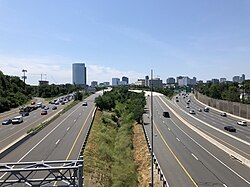
Key Facts
- Definition: A concentration of office, retail, and entertainment space located in previously suburban or rural areas.
- Core Criteria: Must have at least 5 million sq. ft. of office space and 600,000 sq. ft. of retail space.
- Employment: A true edge city contains more jobs than residential bedrooms.
- Scale: They are built at an automobile scale and often lack a traditional street grid.
- Global Presence: While prominent in the U.S., they are also major features in France, the UK, Mexico, and rapidly developing nations like India and China.
Defining the Edge City
According to Garreau, an area cannot simply be called an edge city because it is large. To meet the formal definition, a location must satisfy five specific rules:
- It possesses five million or more square feet of leasable office space.
- It possesses 600,000 square feet or more of leasable retail space.
- It has more jobs than bedrooms.
- The local population perceives it as a single, cohesive place.
- It was nothing like a city as recently as 30 years prior (often consisting of nothing more than residential areas or farmland).
Most edge cities develop near major freeway intersections or large airports. Unlike traditional downtowns, they rarely include heavy industry and are often governed by the surrounding county rather than being independent legal entities.
Varieties of Edge Cities
Garreau identified three distinct types of edge city development:
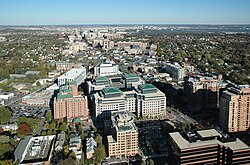
- Boomburbs: The most common type, which grows rapidly and incrementally around a highway interchange or shopping mall (e.g., Tysons, Virginia).
- Greenfields: Areas originally master-planned as new towns on the suburban fringe (e.g., Reston Town Center, Virginia).
- Uptowns: Older cities or satellite towns that evolve into major regional economic hubs (e.g., Arlington, Virginia).
The Evolution of Urban Landscapes
The rise of the edge city is deeply tied to the history of the automobile. Following the 1950s, increased car ownership and the migration of middle and upper-class residents to the suburbs incentivized businesses to move away from traditional downtowns. High land values in central cities and the advent of electronic communications—from fax machines to email—further enabled this decentralization.
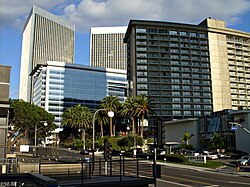
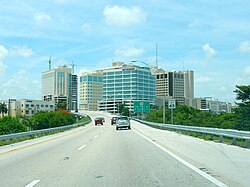
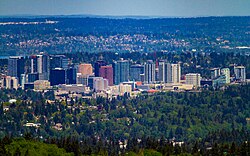
Architecturally, edge cities differ significantly from the pedestrian-friendly grids of older cities. They often feature mid-rise office towers surrounded by vast surface parking lots and manicured lawns. Their street networks are hierarchical, consisting of winding parkways and arterial roads designed for cars rather than pedestrians.
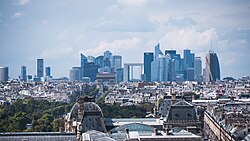
While some edge cities, like Canary Wharf in London or La Défense in Paris, were designed with integrated public transit from the start, many others struggle with mobility. Because they were built at an automobile scale, walking or using public transportation can be difficult.
Economic and Political Impact
Edge cities act as powerful economic drivers. They attract global corporations by offering cheaper land, advanced technological infrastructure, and a high quality of life for executives. This creates a "growth machine" that generates new jobs, hotels, and retail services, often drawing workers away from traditional metropolitan cores.
Politically, these areas are often managed by development commissions or homeowner associations. Some scholars refer to these as "shadow governments" because they can influence local taxation and legislation, often responding more to concentrated wealth than to a broad voter base.
The 21st Century: Densification and Sustainability
In recent years, the perception of edge cities has shifted. Once criticized for being unsustainable and hostile to pedestrians, many are now undergoing densification. Modern urban planning aims to transform these areas into more walkable, transit-oriented environments.
For example, Tysons, Virginia, is working toward becoming a dense urban center with a goal of having 75% of its development located within half a mile of metro stations. Meanwhile, in rapidly developing nations like India and the UAE, edge cities continue to emerge as major development forms as automobile ownership increases.
Summary of Edge City Characteristics
| Feature | Traditional Downtown (CBD) | Edge City |
|---|---|---|
| Primary Transport | Pedestrian/Transit-oriented | Automobile-oriented |
| Street Pattern | Dense, walkable grid | Hierarchical, winding parkways |
| Land Use | Mixed-use, high density | Office, retail, and large parking lots |
| Location | Central urban core | Suburban/Rural fringes near freeways |
Frequently Asked Questions
What is the main difference between a suburb and an edge city?
A suburb is primarily a residential area (a "bedroom community"), whereas an edge city is a major center of employment, retail, and commerce that contains more jobs than residential housing.
Why are edge cities often difficult to navigate without a car?
Most edge cities were designed at an automobile scale, featuring hierarchical street networks and arterial roads that often lack sidewalks or traditional pedestrian grids.
Can an edge city exist without a freeway?
While most develop near freeway intersections or major airports to facilitate movement, the lack of planned transit can lead to severe congestion if the intended road or rail infrastructure is never completed.
Are edge cities only found in the United States?
No. While the term was popularized in a U.S. context, edge cities have developed globally in places like France, Mexico, Canada, Australia, and in rapidly growing economies like China and India.
How are edge cities changing in the modern era?
Many are moving toward "transit-oriented development," focusing on densification, improved public transportation, and creating more walkable, urban-style neighborhoods.