Earth's Magnetic Field: The Geodynamo and the Magnetosphere
Earth is enveloped by a vast, invisible force known as the geomagnetic field. This magnetic field extends from the planet's deep interior far into space, where it serves as a critical shield against the solar wind—a continuous stream of charged particles emitted by the Sun. Without this protection, the solar wind and cosmic rays would likely strip away the upper atmosphere, including the ozone layer that guards the surface from harmful ultraviolet radiation.
The generation of this field is the result of a natural process called a geodynamo. This occurs in Earth's outer core, where heat escaping from the center causes convection currents in a molten mixture of iron and nickel. These moving conducting fluids create electric currents, which in turn generate the magnetic field that surrounds the planet.
![Computer simulation of Earth's field in a period of normal polarity between reversals.[1] The lines represent magnetic field lines, blue when the field points towards the center and yellow when away. The dense clusters of lines are within Earth's core.[2]](/images/39/7b/397ba5f4e165b63acd1fe4ededad492bc85708176a80958f6f68d19f8eddafb3.gif)
Key Facts
- Origin: Generated by the geodynamo process in the molten iron-nickel outer core.
- Surface Strength: Ranges from 25,000 to 65,000 nT (0.25 to 0.65 G).
- Age: Evidence suggests the field has existed for at least 3,450 to 3,700 million years.
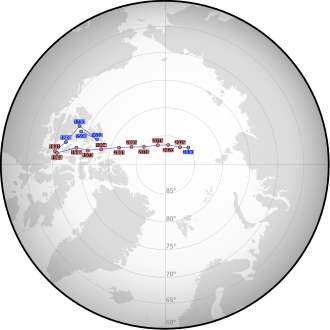
- Pole Movement: The North Magnetic Pole is currently drifting from Canada toward Siberia, accelerating up to 40 km per year.
- Reversals: Every few hundred thousand years on average, the magnetic poles abruptly switch places.
Characteristics and Intensity
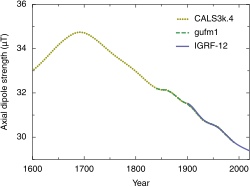
The intensity of the geomagnetic field, more accurately termed flux density, is measured in teslas (T) or gauss (G), where 1 G equals 100 μT. At the surface, the field typically ranges between 22 and 67 μT. To put this in perspective, a strong refrigerator magnet is significantly more powerful, with a field of approximately 10,000 μT.
Research indicates that this intensity is not static. A 2021 study from the University of Liverpool suggests that the field's strength cycles every 200 million years, driven by deep Earth processes. Additionally, measurements since 1832 show a relative decay of about 10% over the last 150 years.
Inclination and Declination
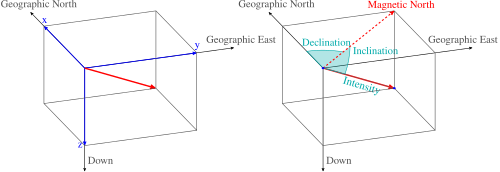
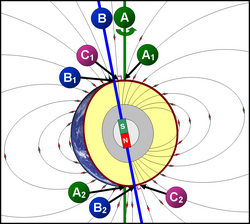
The field is often approximated as a magnetic dipole tilted at about 11° relative to Earth's rotational axis. Two primary measurements describe its orientation: inclination (the angle the field makes with the surface) and declination (the angle between magnetic north and true geographic north).
The magnetic equator is the line where inclination is zero, meaning the field is perfectly horizontal. At the North Magnetic Pole, the inclination is 90° downwards, while at the South Magnetic Pole, it is -90° (upwards).
The Complexity of Magnetic Poles
![A schematic illustrating the relationship between motion of conducting fluid, organized into rolls by the Coriolis force, and the magnetic field the motion generates.[53]](/images/d2/ad/d2ad7b15d3a4daa161d0c4ba8ae3e89e56369073b81bd21b00c01a77775da7d3.webp)
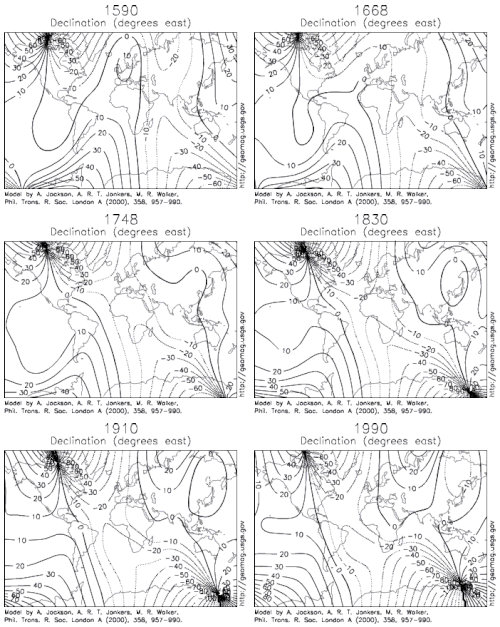
It is a common misconception that the magnetic poles align perfectly with the geographic poles. In reality, the North geomagnetic pole (located on Ellesmere Island, Canada) actually represents the South pole of the magnetic field. This is why the north end of a compass needle is attracted to it.
These poles are not stationary. They wander independently and are not directly opposite each other. The North Magnetic Pole has shown significant migration; in 1831 it was at Cape Adelaide in the Boothia Peninsula, but by 2001 it had moved to within 600 kilometers of Resolute Bay.
The Magnetosphere and Space Interaction
The magnetosphere is the region of space dominated by Earth's magnetic field. It extends tens of thousands of kilometers above the ionosphere. This region interacts dynamically with the solar wind, creating structures such as the bow shock and the magnetopause.
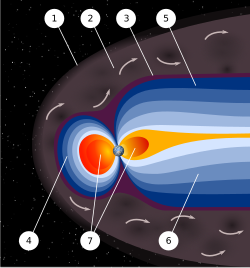
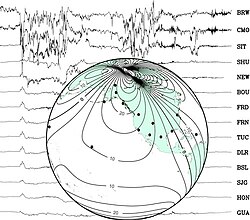
While the core provides the primary field, other factors contribute to short-term variations. Electric currents in the ionosphere, induced by the Sun, can deflect surface magnetic fields by as much as 1° daily, with strength variations of about 25 nT.
Geological Time and Field Reversals
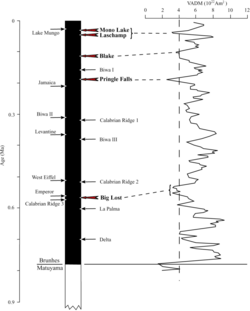
Over millions of years, the geomagnetic field undergoes dramatic changes. The most significant of these are polarity reversals, where the North and South Magnetic Poles switch places. These events leave a permanent record in volcanic rocks, which paleomagnetists use to study the historical movement of continents and ocean floors.

Recent simulations and observational models suggest that during these transitions, the rate of directional change can be extreme. Some data indicates rates of up to 10° per year—nearly 100 times faster than current changes.
Technical Modeling and Measurement
Scientists use spherical harmonics to model the field. The dipole component (the simplest bar-magnet shape) is the most prominent at the surface. Higher-order terms, such as quadrupole fields, drop off more rapidly with distance from the core. While core-generated features typically have wavelengths of 2,000 km or less, smaller-scale variations are attributed to crustal magnetic anomalies in the Earth's lithosphere.
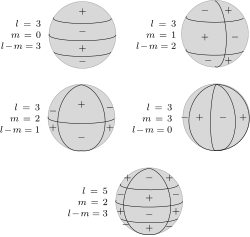
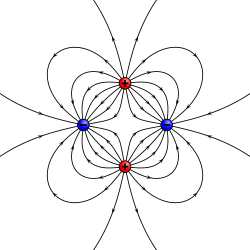
Modern detection relies on 3-axis vector magnetometers aboard satellites like Magsat and Ørsted. These tools have revealed a dynamic geodynamo and suggested the emergence of an alternate pole under the Atlantic Ocean west of South Africa.
![A model of short-wavelength features of Earth's magnetic field, attributed to lithospheric anomalies[72]](/images/3f/52/3f52de53495625afbb0ba45c05bcc38b4b6d05f13f069c52eb2687130a84a76d.png)
Summary of Geomagnetic Properties
| Property | Value / Description | Unit/Context |
|---|---|---|
| Surface Intensity | 25,000 to 65,000 | nT (nanotesla) |
| Dipole Tilt | ~11° | Relative to rotational axis |
| Cycle Period | ~200 million | Years (Intensity cycle) |
| Pole Drift Rate | Up to 40 | km per year (North Pole) |
| Earliest Evidence | 3,450 to 3,700 | Million years ago |
Frequently Asked Questions
What causes the Earth's magnetic field?
The field is generated by the geodynamo, a process where convection currents of molten iron and nickel in the outer core create electric currents as heat escapes from the core.
Why do the magnetic poles move?
The poles move because the fluid motions in the outer core that generate the field are dynamic and constantly shifting, causing the resulting magnetic poles to wander over time.
What happens during a magnetic reversal?
During a reversal, the North and South Magnetic Poles switch places. This process occurs at irregular intervals averaging several hundred thousand years and is recorded in the magnetic alignment of ancient rocks.
How does the magnetosphere protect Earth?
The magnetosphere deflects the solar wind and cosmic rays, preventing these charged particles from stripping away the upper atmosphere and the protective ozone layer.
Is the magnetic field getting weaker?
Measurements since 1832 indicate a relative decay of approximately 10% over the last 150 years, though the field also undergoes much longer intensity cycles of 200 million years.