Dyes: The Science, History, and Application of Colorants
Color is an integral part of human civilization, from the clothes we wear to the food we eat. At the heart of this visual experience are dyes—colored substances that are soluble in a solvent. This solubility allows them to chemically bind to the materials they color, distinguishing them from pigments, which are insoluble or nearly so in all solvents. While dyes are typically applied in aqueous solutions, they often require a mordant—a substance used to fix the dye to the fiber—to improve color fastness.
Historically, dyes were sourced from nature, including roots, berries, bark, leaves, fungi, and lichens. While some are still extracted from minerals or insects, the modern era is dominated by synthetic dyes derived from petrochemicals. These synthetic alternatives are preferred for their superior cost, resilience, and optical properties.
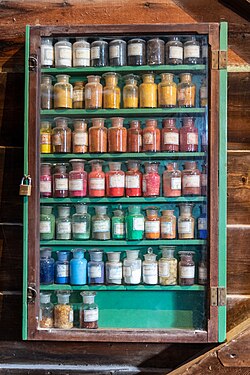
Key Facts
- Solubility: Dyes are soluble in solvents; pigments are not.
- Ancient Roots: Dyed fibers have been found dating back 36,000 years in the Republic of Georgia.
- Synthetic Breakthrough: The first synthetic dye, mauveine, was discovered in 1856 by William Henry Perkin.
- Dominant Class: Azo dyes make up over 50% of the dyes listed in the Colour Index.
- Environmental Impact: Approximately 700,000 tons of dyestuffs were produced annually as of 1990, contributing to waterway pollution.
The Evolution of Dyeing
The practice of dyeing is millennia old. Archaeological evidence suggests that India and Phoenicia have engaged in dyeing for over 5,000 years. For most of human history, these colors were obtained from animal, vegetable, or mineral sources with minimal processing.
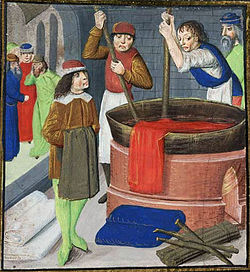
The landscape changed dramatically in 1856 when William Henry Perkin serendipitously discovered mauveine. This breakthrough sparked a surge in organic chemistry and the birth of the synthetic dyestuff industry, leading to the creation of other aniline dyes like fuchsine and safranine. This industrialization saw the rise of manufacturing plants in Manchester, England, and the eventual formation of Bayer AG in Germany.
Beyond textiles, the chemistry of dyes revolutionized medicine. In 1891, Paul Ehrlich observed that certain cells selectively absorbed specific dyes. He applied this logic to chemotherapy, using compounds to target syphilis and methylene blue to treat malaria, marking the first time chemicals were used to selectively kill bacteria within the human body.
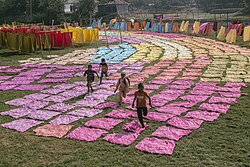
Classification of Dyes
A dye's color is determined by its absorption of light within the visible spectrum (380–750 nm). Because chemical structure dictates light absorption, dyes are classified in two primary ways: by their chemical structure and by their application technology.
Classification by Chemical Structure
Chemical structures define the hue and stability of the dye. Major classes include:
- Azo Dyes: The most common synthetic dyes, characterized by the azo group.
- Indigoid Dyes: Including indigo, the classic blue used in denim.
- Methine Dyes: Including cyanine and styryl dyes.
- Nitro and Nitroso Dyes: Known for yellow to brown hues and high light fastness; often used for polyester fibers.
- Other Classes: Anthraquinone, Dioxazine, Metal complex, Formazan, and Phthalocyanine dyes.
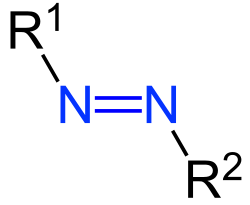

![Chemical structure of indigo dye, the blue coloration of blue jeans. Although once extracted from plants, indigo dye is now almost exclusively synthesized industrially.[22]](/images/0c/47/0c47dab1adaf6abfa55c3a916df46723e0597fa56acbc9a981f90984eadd3a1f.webp)


Classification by Application Technology
To ensure a dye adheres to a specific material, chemical groups are added to modify its properties. The Colour Index (C.I.) is the standard reference for these classifications, listing over 10,000 dyes.
- Mordant Dyes: Require a mordant to bind to the fiber.
- Direct Dyes: Applied directly to the material in an aqueous solution.
- Disperse Dyes: Crucial for polyester fibers; the majority are azo dyes.
- Vat Dyes: Including indigo, these are insoluble and require a chemical process to apply.
- Reactive Dyes: Form a chemical bond with the substrate.
- Acid Dyes: Water-soluble dyes used for proteins like wool or silk.
- Food Colorants: Strictly regulated additives (often marked with E numbers in the EU) used to maintain food appearance.
Specialized and Functional Dyes
Some dyes serve purposes beyond simple coloration. Functional dyes can convert light into heat, change the polarization of light, or induce electrical phenomena for use in laser printers. Vital dyes are used in biological staining to study living cells, while other specialized dyes are developed specifically for leather or as fluorescent brighteners for paper and textiles.
Environmental Impact and Treatment
The massive scale of the textile, printing, and paper industries has led to significant water pollution. To combat this, several degradation and treatment methods are employed:
- Adsorption and Filtration: Using membranes or absorbent materials to remove dyes.
- Biological Treatment: Using microorganisms to break down organic pollutants.
- Chemical Oxidation: Using ozone, hydrogen peroxide, or chlorine to break dye molecules. Advanced Oxidation Processes (AOPs) can fully mineralize these pollutants.
- Electrochemical and Photocatalytic Treatment: Using electrical currents or light-driven catalysts to degrade dyes.
| Dye Category | Primary Characteristic | Common Application |
|---|---|---|
| Natural Dyes | Derived from plants/minerals | Traditional textiles, organic clothing |
| Synthetic Dyes | Petrochemical based | Mass-market fashion, industrial plastics |
| Disperse Dyes | Non-ionic, low solubility | Polyester fibers |
| Vat Dyes | Insoluble in water | Denim (Indigo) |
| Food Dyes | Regulated additives | Processed foods and beverages |
Frequently Asked Questions
What is the difference between a dye and a pigment?
The primary difference is solubility. Dyes are soluble in a solvent and chemically bind to the material they color. Pigments are insoluble and typically sit on the surface of the material.
How was the first synthetic dye discovered?
The first synthetic dye, mauveine, was discovered by accident in 1856 by William Henry Perkin, which subsequently launched the modern organic chemistry and synthetic dye industries.
What is a mordant and why is it used?
A mordant is a substance used to set or fix a dye on a fiber. It improves the fastness of the dye, ensuring the color does not wash out or fade easily.
How do dyes contribute to pollution?
The textile and paper industries release large quantities of dyestuffs into waterways. Because many synthetic dyes are resilient, they can be difficult to break down, requiring advanced chemical or biological treatment to remove them from the environment.
What are azo dyes?
Azo dyes are a class of synthetic dyes characterized by the presence of an azo group. They are the most prevalent type of synthetic dye, accounting for more than half of the entries in the Colour Index.